Crucible of Innovation: Salisbury Plain during the Great War

SalisburyPlainPCe

On May 7th 2016 I will be one of the speakers at the AGM of The Western Front Association, along with Professor Andrew Lambert and Richard van Emden. My subject will be ‘Crucible of Innovation: Salisbury Plain during the Great War’ which I researched while Guest Curator for English Heritage producing a special exhibition for the Stonehenge Visitor Centre in 2014. The exhibition examined the history of the monument and the surroundings during 1914-1918, especially the Salisbury Plain Training Area. The vast complex of military camps, firing ranges, airfields, army and air force schools and the Porton Down chemical warfare experimental ground made Salisbury Plain a centre for innovation and especially the development of the all-arms battle, which is now recognised as the revolutionary contribution made by British and Commonwealth forces to Allied victory.

The exhibition ran during 2014-2015, see the photographs on the website of the designer Northover & Brown.

The WFA AGM is on Saturday 7th May 2016 at the Fleet Air Arm Museum, Yeovilton.


Home

Contact

Rossignol Wood

Rossignol Wood

Rossignol Wood, shell craters and trenches.

It is more than thirty years since I first stumbled across this wood on the northern part of the Somme battlefield. Rossignol, or Nightingale, Wood seldom features in the usual histories or battlefield itineraries but it clearly showed evidence of fierce fighting: deep trenches running along the edges, smashed concrete bunkers and collapsed dugouts, shell holes and heaps of German grenades, while in the adjacent ploughed field lay British shell fuses.  Two small British cemeteries are close by and one, uniquely for a Commonwealth War Graves Commission cemetery, holds more German burials than British. Subsequent visits and research over the years have revealed the story of the fighting at the wood and also its association with some of the most remarkable personalities of the war.

Rossignol Wood view from German trench

Rossignol Wood, the view from German trench.

Fighting came to the wood in February and March 1917 when the Germans withdrew from the old Somme battlefield to the Hindenburg Line. Strong German rearguards caused heavy casualties to the North and South Staffords and the Bradford Pals.  Immediately to the west, the 18th Durham Light Infantry captured the German line. For his part a young Second Lieutenant, James Barker Bradford, received the Military Cross but died of his wounds. He was the third in age of the four famous Bradford brothers, two of whom went on to receive the Victoria Cross but both were also to lose their lives.

German grenades in Rossignol Wood

German grenades in Rossignol Wood.

The Germans withdrew later in March only to retake the ground a year later during the 1918 spring offensive when they were halted a short distance away at Hébuterne. In April 1918 the Lincolns and the Somersets attempted to capture the wood but were forced out. Their chaplain, Theodore Hardy DSO MC, went into the wood and, with the help of a sergeant, managed to bring a man back. For his actions, including tending a wounded man near a German bunker which still survives in Rossignol Wood, Hardy was awarded the Victoria Cross. He died of wounds in October 1918, the most highly decorated non-combatant of the First World War.

Rossignol Wood German bunker

Rossignol Wood, German bunker.

In July 1918 the German infantry officer Ernst Jünger came to Rossignol Wood. The author of The Storm of Steel,  the most famous German memoir of the First World War, Jünger also wrote an account of the period that he spent at the wood, entitled Copse 125 after its German name. The book culminates in a grenade attack immediately to the south of the wood against New Zealand troops among whom was Sergeant Dick Travis DCM MM of the Otago Regiment. Travis helped beat off the attack and captured two machine guns but was killed the following day; he received a posthumous Victoria Cross and is regarded as New Zealand’s greatest soldier.

Rossignol Wood Cemetery

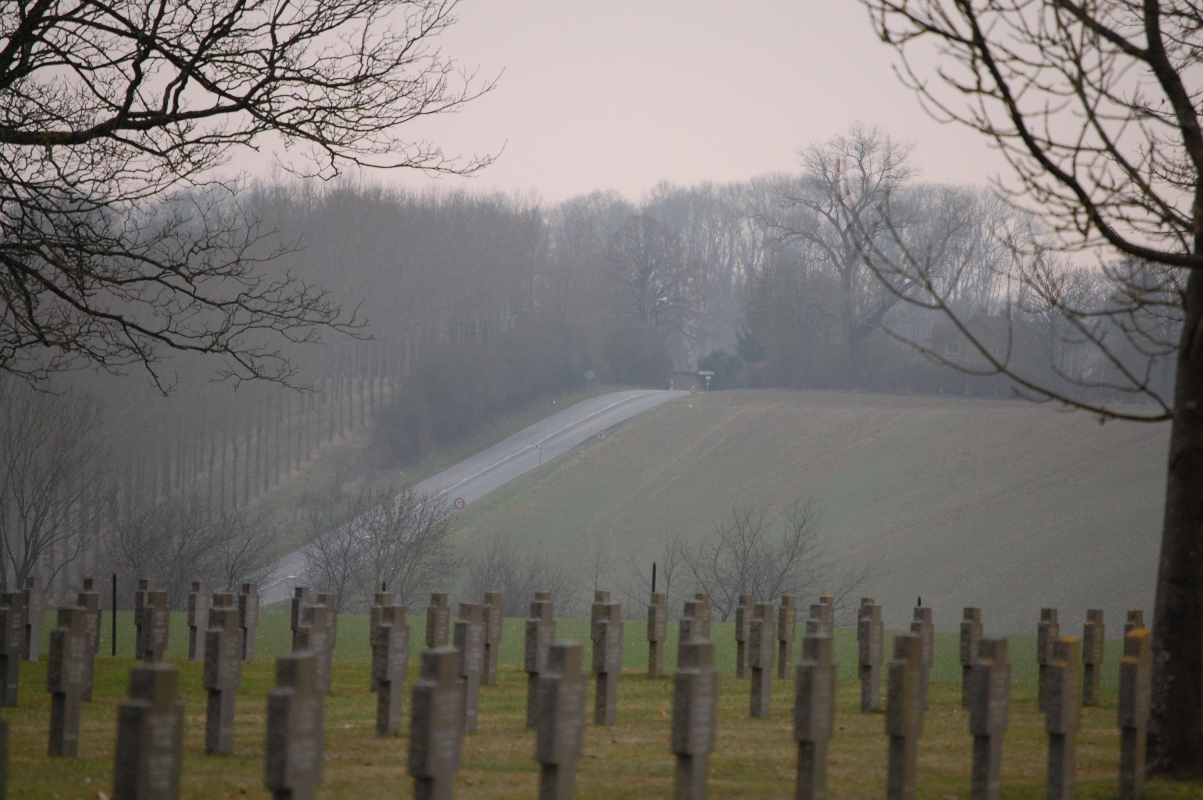
New Zealand graves in front of German burials in Rossignol Wood Cemetery. The cemetery contains 41 Commonwealth and 70 German burials.


Join me on a battlefield tour with The Cultural Experience:

Simon Jones Battlefield Tour Somme Poets 2019

The War Poets: Words, Music and Landscapes, 10th-13th July 2023

First & Last Shots 1914 & 1918

Medics & Padres in the Great War

Walking Ypres 1914-1918

Walking the Somme, Summer 2023

More Information about Battlefield Tours


Home and more posts

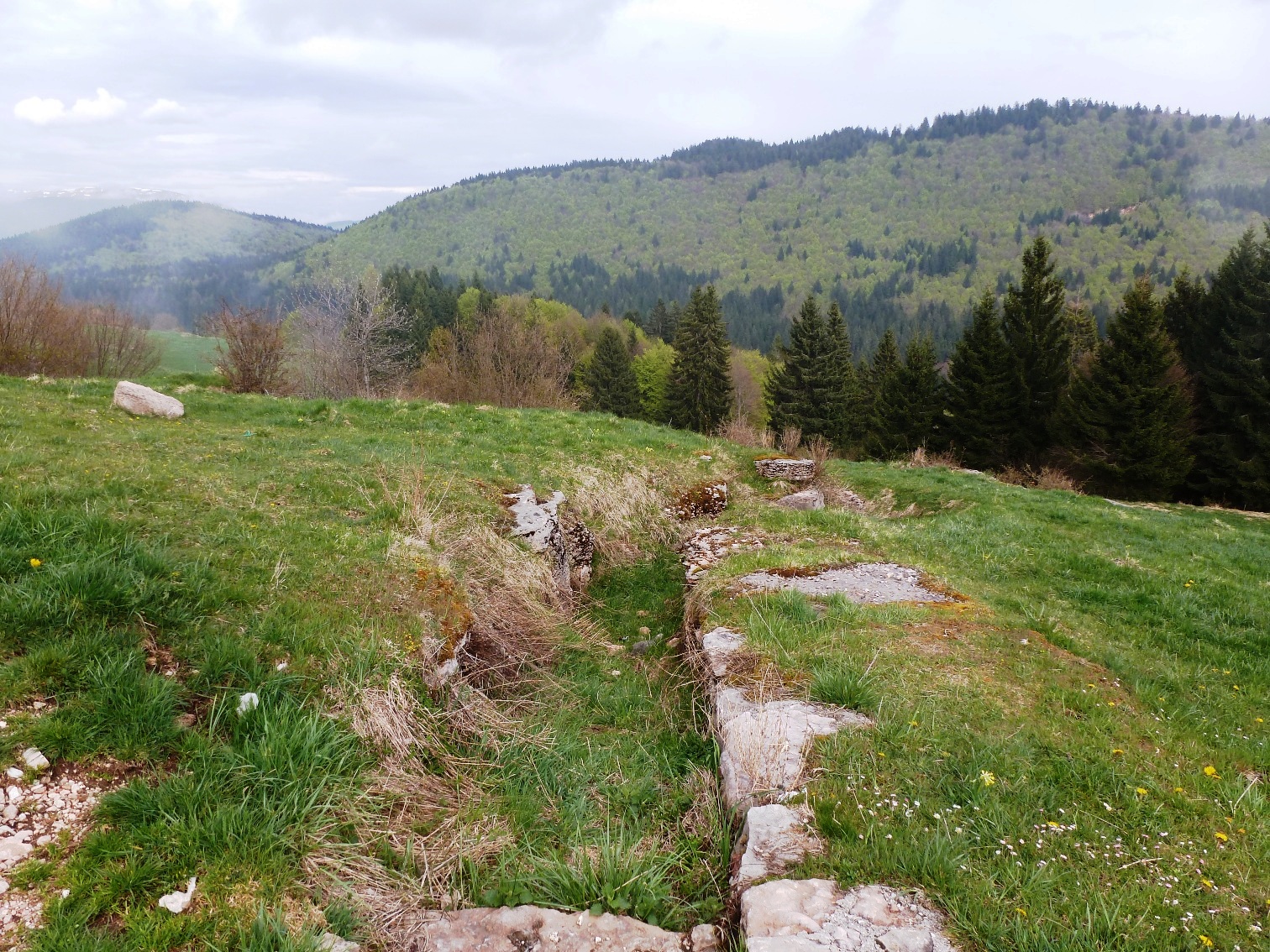
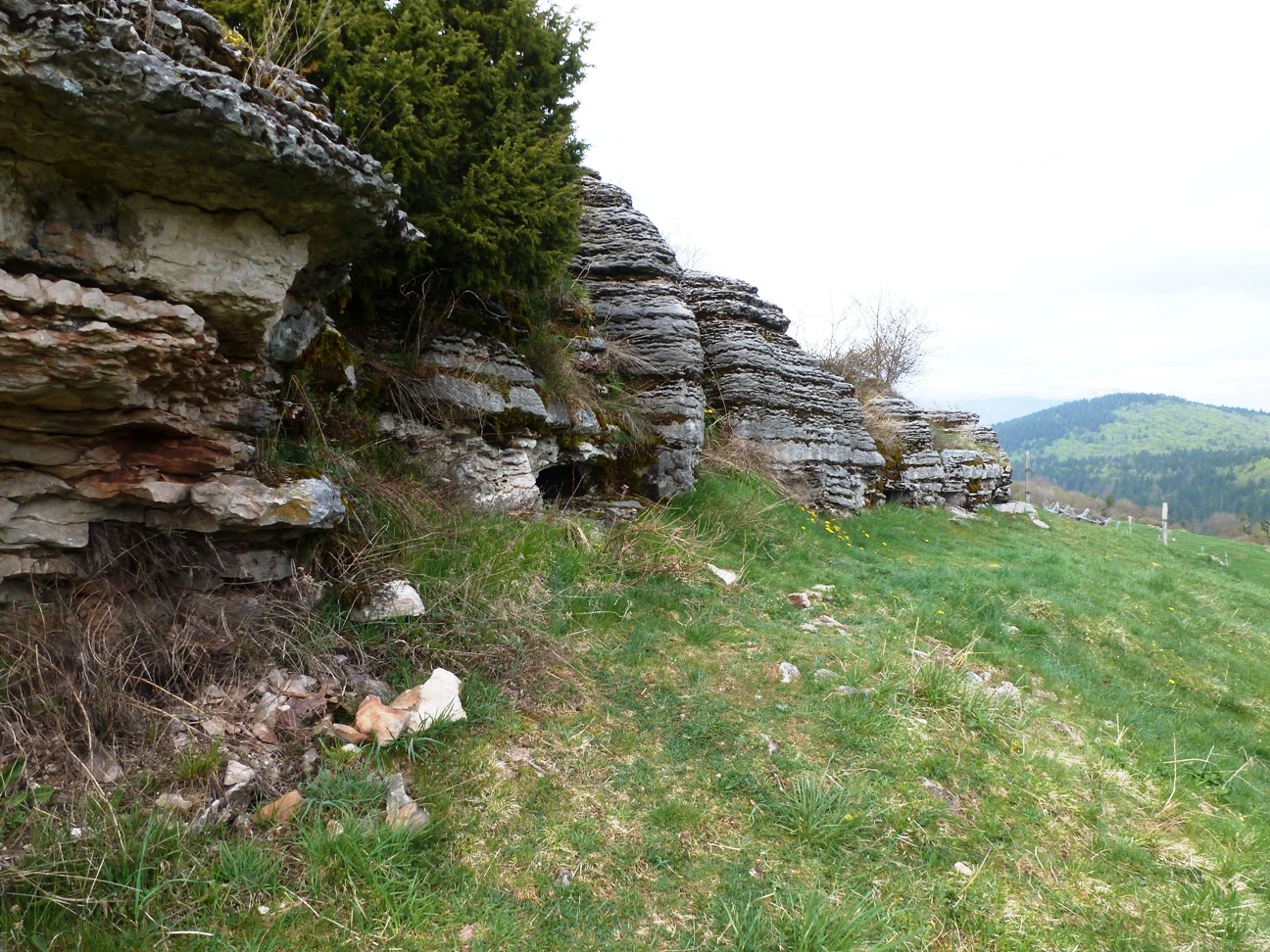
The Italian Front in the First World War at Asiago: Monte Zovetto and Magnaboschi

Monte Zovetto OP 2

Monte Zovetto Italian and British observation posts and shelters.

Monte Zovetto trench 2

Monte Zovetto trench

Monte Zovetto OP 3

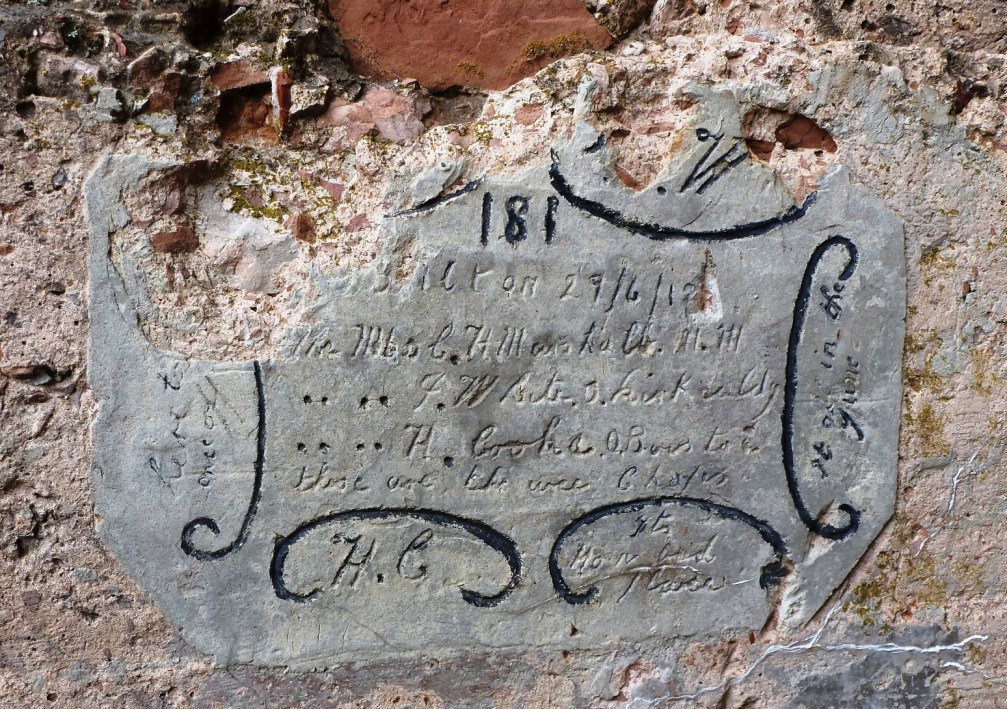
Monte Zovetto inscription OP 4

Monte Zovetto OP 1

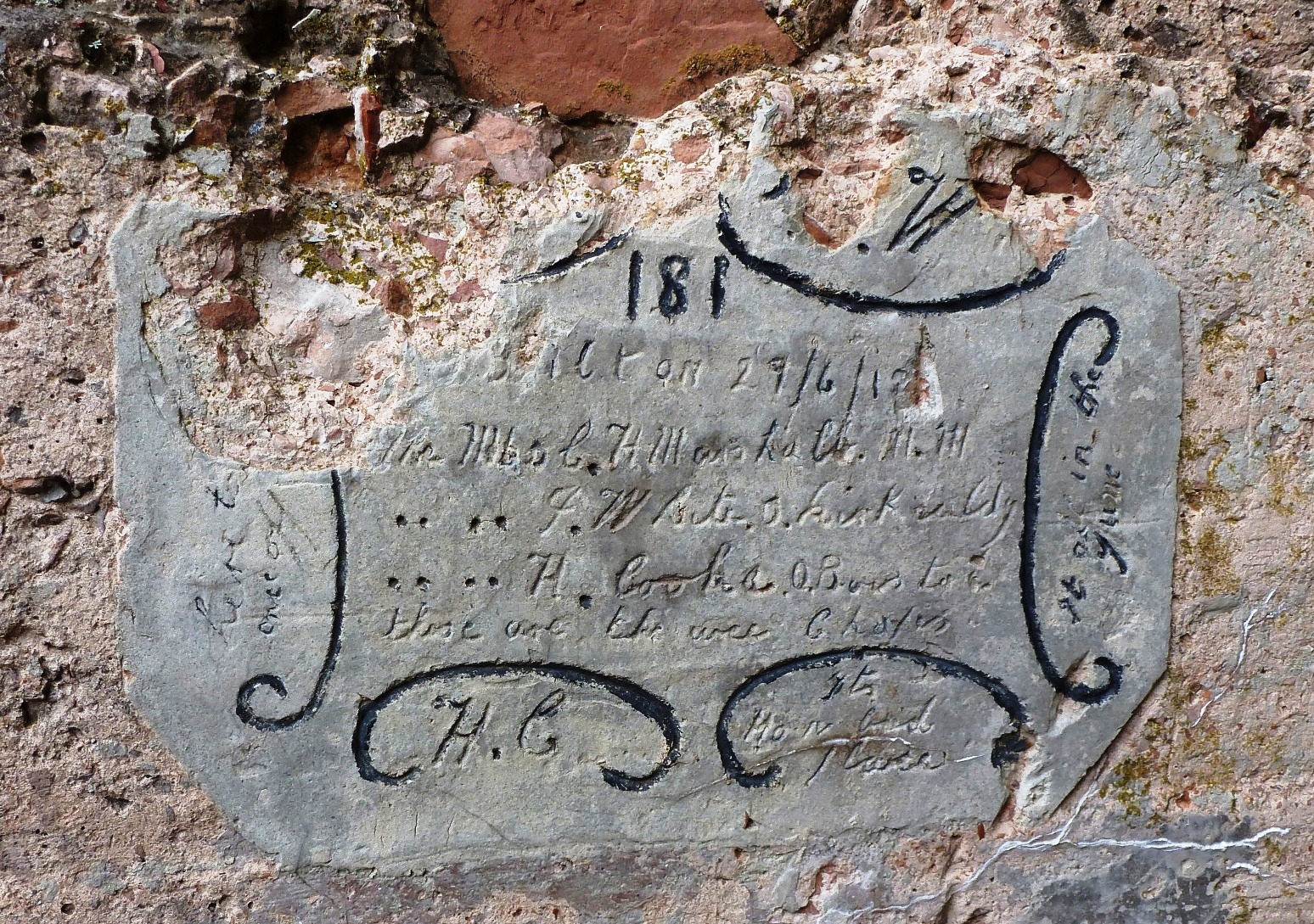
Monte Zovetto inscription 1

Monte Zovetto  inscription left by British artillerymen in June 1918.

Monte Zovetto inscription left by British artillerymen in June 1918.

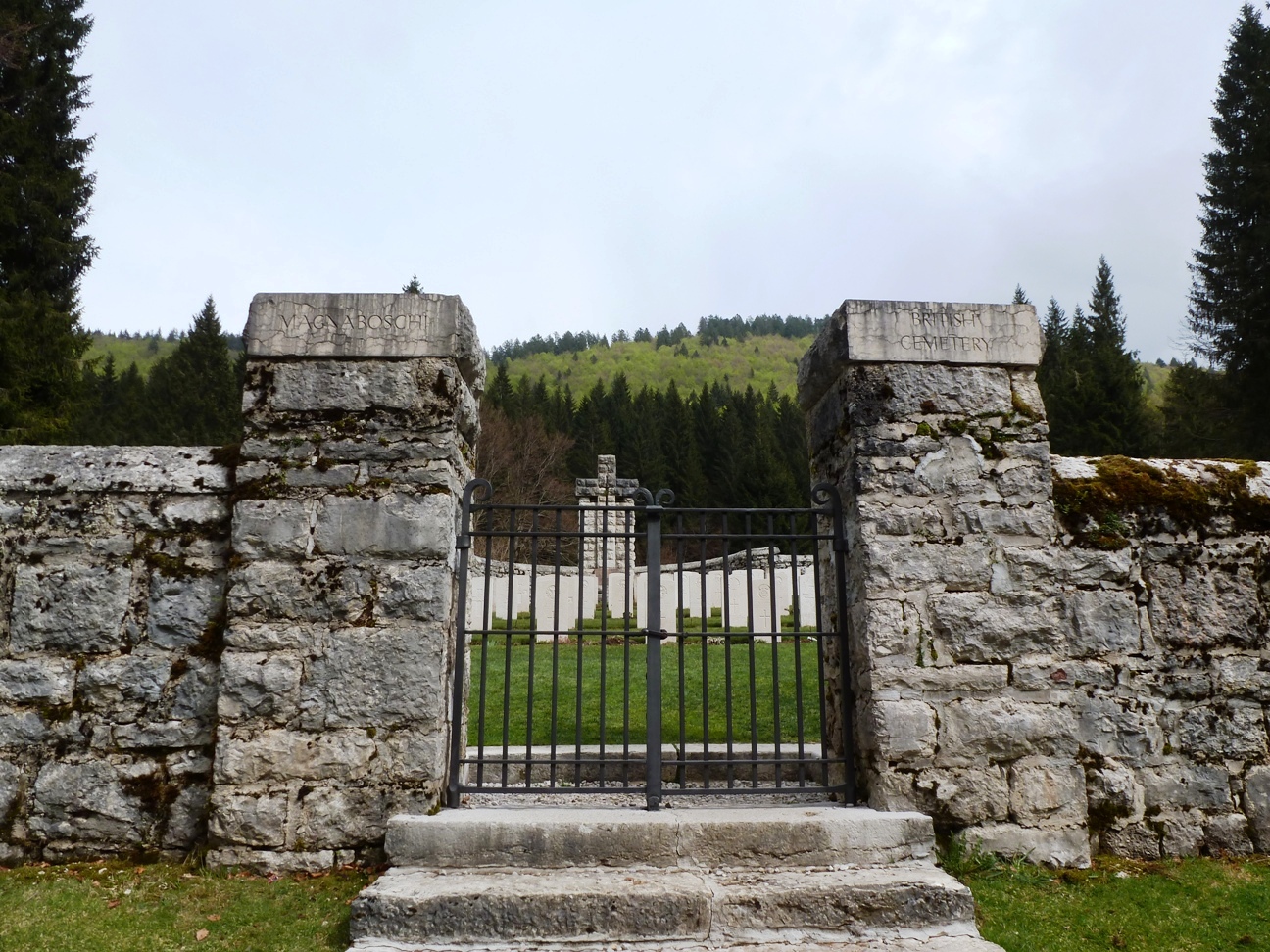
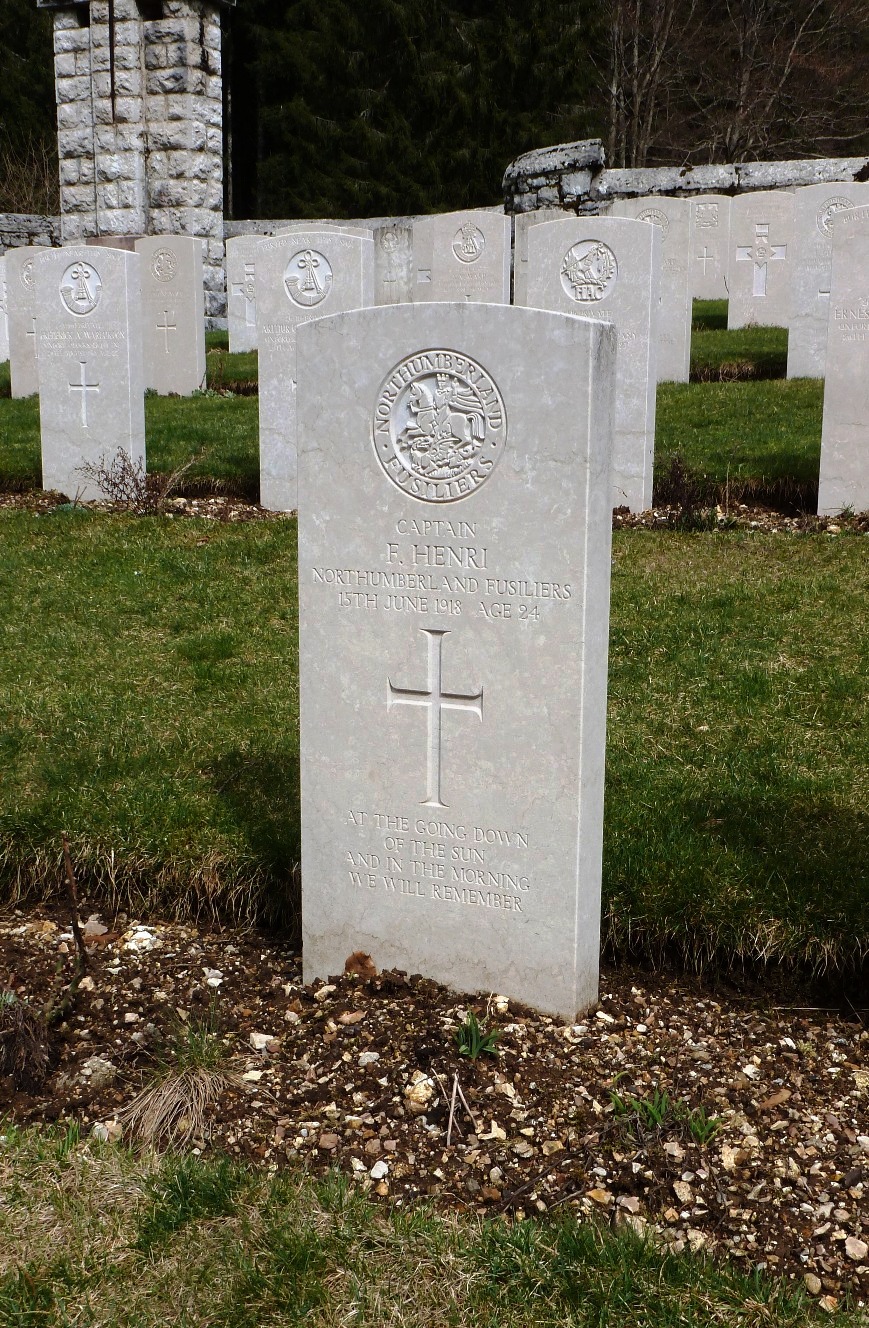
Magnaboschi British Cemetery

Magnaboschi British Cemetery

Magnaboschi British Cemetery

© Simon Jones


Join me on a battlefield tour with The Cultural Experience

Simon Jones Battlefield Tour Somme Poets 2019

The Battles of the Marne & the Aisne 1914 – 1918

First & Last Shots 1914 & 1918

Medics & Padres in the Great War

Walking Ypres 1914-1918

Walking the Somme

More Information about Battlefield Tours


Setsas from Monte Sief

Col di Lana: the First World War in the Dolomite mountains


Where and how did Edward Brittain die?

The Italian Front in the First World War at Monte San Michele.

The Italian Front in the First world War at Redipuglia and Monte Sei Busi.

Contact.

Understanding chemical warfare in the First World War

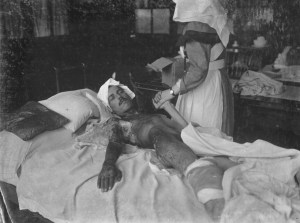
In August 1918, while waiting to advance east of Amiens, Sergeant Sawyer Spence unwittingly lay in a shell hole contaminated with mustard gas. Feeling no ill effects he only reluctantly agreed to be evacuated; only after 24 hours did medics realise that his uniform had been saturated by the oily liquid. By the time he reached a hospital twelve days later, in the converted pavilion of Nottingham’s Trent Bridge Cricket Ground, the whole of one side of his back and legs was septic and discharging pus, the result of massive blistering. He was the worst mustard gas case that the hospital had ever seen.

Sawyer Spence suffering extensive mustard gas blisters, Trent Bridge Hospital, Nottingham, 1918. © Jon Spence, used with permission.

Sawyer Spence suffering extensive mustard gas blisters, Trent Bridge Hospital, Nottingham, 1918. © Jon Spence, used with permission.

Sawyer Spence was one of an estimated half a million chemical warfare victims of the First World War. The first were on 22nd April 1915 when the Germans released 150 tonnes of chlorine gas from their front line trenches north of Ypres in Belgium and allowed it to drift towards the French positions. It inspired some of the most powerful works of art and literature to come out of the First World War yet, since its shocking debut, our understanding of chemical warfare remains surrounded by a miasma of fear, emotion and propaganda.

Chemical weapons were outlawed at arms control conferences at the Hague in 1899 and 1907; despite being signatories, Germany, France and Britain all carried out research before the outbreak of war. When trench warfare atrophied into a vast linear siege, chemicals were high on the list of solutions to break the deadlock; substances that would not cause permanent injury, such as tear gas, were favourites. Germany was first, adding an irritant to shrapnel shells, and thus technically not breaking the Hague Agreement, but the British-Indian troops they were used against in October 1914 failed even to notice. In a second attempt, Germany fired tear gas in shells against the Russians near Bolimow in Poland in January 1915, was equally ineffective when in the cold the liquid failed to vaporise. France followed by issuing instructions in February 1915 for the use of an anti-riot tear gas cartridge at the front, again without particular success. Britain adopted a tear gas, ethyl iodoacetate, in January 1915 after it was identified by Jocelyn Thorpe, professor of organic chemistry at Imperial College, University of London, which was codenamed ‘SK’ after the South Kensington location. Thorpe claimed that the War Office was only convinced of SK’s effectiveness after a small boy was given a shilling to stand in a trench into which it had been released; in April 1915 the British government was still pondering its legality.

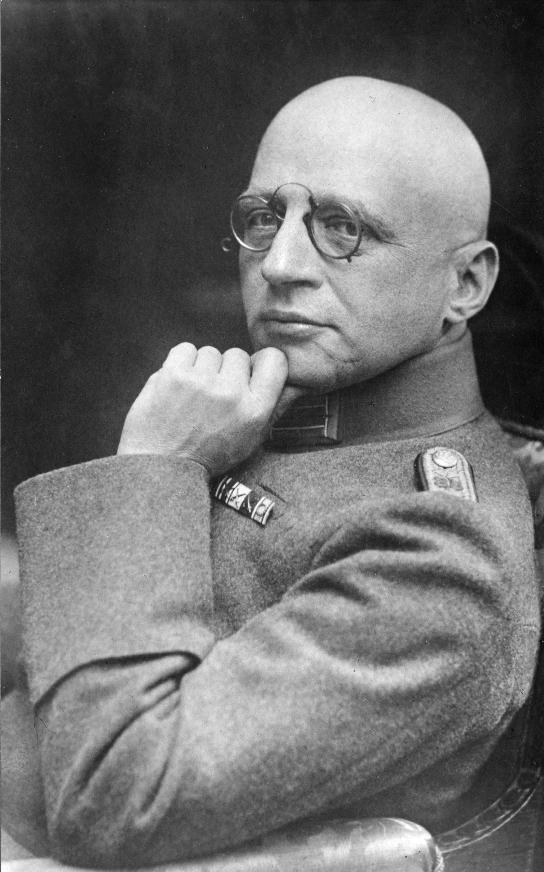
Fritz Haber, in the uniform of the 35th Pioneer Regiment.

Fritz Haber, in the uniform of the 35th Pioneer Regiment.

Germany took the lead in chemical weapons thanks to her developed chemical industry and universities, but also because of the remarkable genius of Fritz Haber. The son of a dyestuff manufacturer, six years before the outbreak of war Haber made perhaps the single greatest chemical discovery of the twentieth century, for which he was to receive the Nobel prize for chemistry: the means of converting atmospheric nitrogen to ammonia. Fertiliser made using the Haber-Bosch process has produced food to increase the world’s population by an estimated one billion people; it has also facilitated the bulk production of explosives. Haber was the first Director of the Kaiser Wilhelm Institute for Physical Chemistry and in 1914 threw his immense energy and talent into his nation’s war effort. Vigorous and persuasive, he was responsible more than any other individual for the development of chemical weapons during the First World War. After the failure of the earlier attempts, Haber made a simple and direct proposal: readily available chlorine gas should be released from cylinders to be carried by a breeze over the enemy positions. If it was successful, the Germans believed that the Allies could not respond owing to their limited capacity for chemical production. Despite moral and military objections by two senior German commanders, the chief of the general staff, von Falkenhayn, decided that it should be tried at Ypres. A simple idea, in practice it was anything but. Carrying the heavy cylinders of chlorine into the trenches and concealing them was dangerous and difficult; when some were hit by shell fire the gas killed three of their own men and injured 50. The prevailing westerly wind placed the Germans at a disadvantage; it refused to blow in the right direction, or changed just as the attack was about to be launched. After a fruitless two week wait, the Germans had to reinstall 6,000 cylinders from the south of Ypres to the north but again twice more postponed when the wind was wrong.

German troops carry poison gas cylinders to be installed in trenches.  © Simon Jones

German troops carry poison gas cylinders to be installed in trenches. © Simon Jones

Finally, the order was given to release when it was ‘half-way favourable’; the troops assembled packed in the trenches throughout the 22nd April until, late in the afternoon, a southerly wind arose and orders were hurriedly issued to attack. The gas hissed from hundreds of pipes placed over the trench parapets and greenish-yellow clouds drifted across no man’s land towards the French positions; in most places, the gas quickly engulfed the trenches and the field guns close behind them. Reservist and North African troops had no means of protection; a powerful odour of bleach and fumes which stung the eyes were quickly followed by choking as they inhaled the gas. Most fled for their lives but the unlucky ones fell to the ground where the gas pooled. As the gas entered their lungs the mucous membranes produced fluid to flush away the irritation, oxygen transference was severely hindered and the victims began to drowned.

A French victim of the first chlorine gas attack. © Simon Jones

A French victim of the first chlorine gas attack. © Simon Jones

It should not have been a surprise to the Allies. At least two German soldiers deserted to the French before the gas attack, revealing detailed information and even producing rudimentary gas masks. Chemical weapons had achieved such negligible results that it was assumed the effects would be equally insignificant but it is cited as one of the great intelligence failures of history; when the name of one of the deserters was published in 1933, he was imprisoned by the Nazis and ultimately sent to Dachau concentration camp.

The Germans, moving cautiously for risk of succumbing to their own gas, gained two and a half miles by nightfall. It was the largest advance since the onset of trench warfare; but lack of troops and resistance on the flanks by Canadians and Belgians prevented them from exploiting the attack. In the captured French positions the Germans took thousands of prisoners, and found gas victims lying on their backs with fists clenched; but their own reports state that they found few dead. A doctor was told by a German officer, himself injured by chlorine, that he saw few French dead and most ‘had run away like a flock of sheep’. The number killed by the first attack, impossible to calculate, may still be somewhere between 800 and 1,400; a figure of 5,000 dead, grossly exaggerated by the Allies for propaganda purposes, is still reported as fact.

The response of the Allies was a mixture of real and artificial outrage; there was genuine anger that a barbarous and unchivalrous method should be used against their troops, and breaking the spirit if not the letter of the Hague Agreement. Chemical weapons nullified the romantic chivalric contest of equals that war was supposed to be but never has been. In this confused notion, to have an agreement and then break it almost seemed worse than if there had been no agreement at all. Paradoxically, an unrealistic notion of the degree to which warfare could be governed by humanitarian considerations may even have made matters worse by bringing about a swifter abandonment of restraint once the system collapsed. The Hague Agreement failed to prevent the use of chemical weapons because it did not anticipate what the war was becoming: a war of nationalism and ideologies, a war of hatred, a war to the death. There was also much inflated indignation to influence neutral American opinion; in this respect the chlorine attack was a propaganda gift to the Allies, as was the sinking of the liner Lusitania just 16 days later.

Many would subsequently express a more detached view on the relative distinction between chemical and so-called conventional weapons. The wartime officer, C. R. M. F. Cruttwell, later principal of Hertford College, concluded that ‘there is little to choose in horror and pain between the injuries inflicted by modern war. The extent to which the human body can be mangled by the splinters of a bomb or shell, without being deprived of consciousness, must be seen to be believed.’ J. B. S. Haldane, future Professor of Genetics at University College London, went further: injured by chlorine developing the first protective masks and shortly afterwards wounded in action, he maintained that the pain and discomfort from gas were ‘utterly negligible compared to those produced by a good septic shell wound’. A weapon which temporarily incapacitated such as tear gas, Haldane said, was ‘the most humane weapon ever invented’. Yet such views ignore the fact that there was nothing irrational about the terror felt by soldiers at being gassed; even the Army pathologist who specialised in gas cases felt that there was something particularly terrible about dying of suffocation from gassing. Coupled uneasily with outrage was the belief that the Allies must adopt such an apparently effective method without hesitation and not be hindered by misguided notions of honour if the enemy was not abiding by them. Five days after the first chlorine attack the British cabinet gave its consent for the Minister for War, Lord Kitchener, to fall ‘to the level of the degraded Germans’ and instructed him to ‘use anything he could get invented’. 

The method used at Ypres turned out to be of limited military value. Nine subsequent German chlorine attacks during the month-long Second Battle of Ypres were thwarted by the desperate resistance of British soldiers protected by rudimentary mouth pads soaked with neutralising solutions, including urine, which limited German gains to a few short lengths of front line trench. The Germans themselves suffered heavy casualties when the wind changed, which worsened when they tried it on the Eastern Front, and on one occasion 1,450 of their own men were gassed with 138 killed. But the chlorine attacks had a profound impact on the British, seemingly unaware of the difficulty of coordinating the massed troops to exploit the gas with a favourable wind to blow it onto the enemy. Britain’s first attack with chlorine gas was to be made in the wrong place for the wrong reasons. Sir Douglas Haig, commanding the British 1st Army, was a sceptic about the value of gas. However, ordered by the government to carry out an attack around Loos over terrain which was utterly unsuitable and for which he had insufficient guns and shells, his view was altered by a demonstration of chlorine gas at Runcorn when it appeared to move so effectively to the Manchester ship canal that bargees had shouted abuse. The gas seemed the means to carry out this unwanted attack and even achieve a rapid advance like that of the Germans at Ypres. Confounding the German belief that the Allies lacked the capacity to do so, Britain managed to stage a chlorine gas attack on 25 September 1915, five months after the German attack; the Battle of Loos however was a failure. On the morning of the attack, Haig took the decision to release the gas on the advice of a meteorologist and the drift of the smoke from the cigarette of his ADC but when the wind appeared to change it was impossible to countermand the order. The British troops encountered exactly the same problems as the Germans but on a larger scale: the wind was wrong and panic that the gas induced in the attackers is recorded by Robert Graves in Good-Bye to All That. The Germans, in strong defensive positions, all had gas masks and the machine gunners had breathing apparatus. Over two and a half thousand British soldiers were hospitalised as gas cases, although two-thirds were more terrified than badly injured. Seven British soldiers, and no Germans, were reported killed by the gas. As a result, the British almost never again used gas directly to assist an attack. An attempt in late June 1916 by General Rawlinson to release 20,000 cylinders of combined phosgene-chlorine gas, during the preparatory bombardment which launched his Battle of the Somme, was again thwarted by the wind as well as by effective German gas masks. Instead British chemical weapons were used to kill, injure and demoralise enemy troops in sectors away from main attacks; in other words for attrition not break-through.

Personnel practicing for the first British gas attack.

Personnel practicing for the first British gas attack.

The escalation of chemical warfare was limited solely by the restraints of research, development and production rather than any questions of morality. The first attacks had shown that chlorine was not poisonous enough and too easily protected against; the Germans led in the introduction of new chemicals owing to their ability to produce chemicals in bulk. Both sides raced to deploy new and more poisonous chemicals and to issue masks to their own troops to protect against a range of potential substances. Phosgene, about one hundred times more toxic than chlorine, was the most prominent threat and a German phosgene attack against the British in December 1915 was thwarted by the rapid issue of an improved gas helmet. The Germans were soon able to penetrate these impregnated cloth helmets with higher concentrations and the British were forced to replace them with a complex but effective mask in which a box filter was connected by rubber hose to a face piece. These ‘Small Box Respirators’ began to be issued in autumn 1916 and within five months every man at the front possessed one. The unsung scientist responsible for coordinating this triumph of design and production, Edward Harrison, weakened by overwork and gas inhalation, died of influenza one week before the war’s end.

Edward Harrison, who gave his life in the development of protection from poison gas.

Edward Harrison, who gave his life in the development of protection from poison gas.

In 1916 the gas shell became the favoured means of overcoming the problem of the wind but a very large number of shells had to be fired to build up a concentration sufficient to penetrate a gas mask, especially after the British introduced Harrison’s Small Box Respirator. The tactic shifted to forcing men to wear their masks for long periods and thereby impede their ability to fight and chemical weapons became particularly important as a counter-battery weapon to silence the opponents’ guns. The aim was also to catch soldiers by surprise before they could adjust their masks and gas shells contained a charge just large enough to break open the shell with a distinctive dull plop. Wilfred Owen’s poem ‘Dulce et Decorum est’ describes his recurring nightmares of a man dying of gas poisoning after soldiers are surprised by phosgene shells which drop softly behind them. Troops easily recognised the sound and in 1918 the Germans increased the size of the charge, rendering them harder to distinguish from high explosive shells. The one major British innovation in chemical weapons, highly effective but also technologically the most crude, was a means of projecting a dense cloud of gas instantaneously onto enemy positions. Inspired by the desire of William Livens to avenge his wife whom he thought had perished on the liner Lusitania (it turned out she hadn’t sailed), each Livens Projector hurled a drum containing 11 litres of liquefied gas, when up to 800 were fired simultaneously, it either gassed the German soldiers before they could get their masks on or penetrated the filters owing to the high density. It was so effective that after its first use Livens boasted that he could kill Germans at 16 shillings per head. The Germans copied the Livens projector and, on the Italian front at Caporetto in October 1917, used it to drench low-lying Italian positions with phosgene; they followed it up with an advance far more substantial and dramatic than that at Ypres in 1915, and the resulting panic formed the central sequence of Hemingway’s A Farewell to Arms.

The first German lethal gas shell, containing 0.285 litres of diphosgene.

The first German lethal gas shell, containing 0.285 litres of diphosgene.

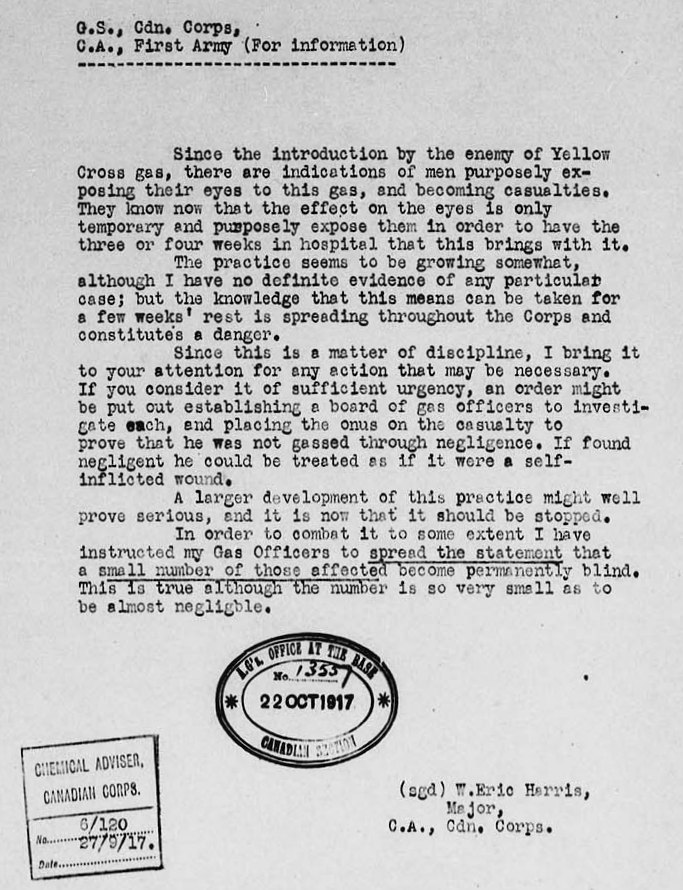
The quest to find toxic chemicals which did not disperse as quickly as a gas led the Germans to a liquid, dichlorodiethyl sulphide, commonly called ‘mustard gas‘ by the British owing to its odour of mustard or horseradish. The most effective chemical agent of the First World War, it would inflict on soldiers a new dimension of horror and suffering. Ironically, after testing on cats in 1916, the British rejected mustard on the grounds that it was not sufficiently lethal. German trials on monkeys demonstrated that it caused eye and respiratory injury but again there were doubts about its lack of toxicity. It was noted that the liquid took much longer to disperse than gas; a detonating shell spread droplets which slowly evaporated in daylight, prolonging its harmful effects. This quality prompted Haber to propose its use to the German High Command when he learnt of the requirement for a chemical weapon to forestall Allied attacks expected in the summer of 1917. However, Haber is said to have warned that it should only be used if Germany was certain of winning the war within a year; once the Allies had the ability to bulk produce their own, Germany would not be able to produce sufficient replacement uniforms needed for decontamination. On the night of 12 July 1917, the Germans fired 50,000 shells containing 125 tonnes of mustard into the ruins of Ypres; it was the first of a series of intense bombardments to target British attack preparations. Within 24 hours, over 2,000 British soldiers had been admitted to Casualty Clearing Stations, many suffering intensely painful inflammation of the eyes which effectively blinded them, they were led in files, each holding on to the man in front. After several hours many developed severe throat and lung irritation which in some turned into fatal broncho-pneumonia. A third prominent symptom, not anticipated by the Germans, was large skin blisters, especially on the buttocks, genitals and armpits. Mustard caused injury by skin contact, especially the sweaty parts of the body, either with the vapour as it evaporated in daylight or sitting where the liquid had been splashed by the bursting shell. The predictions that it would have a low mortality rate were correct: of the 2,143 cases admitted to Casualty Clearing Stations after the first bombardment, 95 died, a comparatively small number; put crudely it had taken 500 mustard gas shells to cause each death. But the Germans reported that the British guns were all but silent for two days afterwards. The effectiveness of mustard did not lie in the death rate, rather the large numbers injured, many of whom, by the standards of the time, recovered after several months in hospital. Many, however, such as those nursed by Vera Brittain on the French coast, suffered serious infection and pneumonia, ‘burnt and blistered all over with great mustard coloured suppurating blisters, with blind eyes… and always fighting for breath, their voices a mere whisper…’ A German mustard gas bombardment of the still partially inhabited town of Armentières later the same month, an operation called ‘Totentanz’ (‘Dance of Death’), caused 675 civilian casualties of which 86 died; a high proportion, many elderly, were unable or unwilling to leave the contaminated area. Yet, paradoxically, for some soldiers injury by mustard gas actually saved their lives by taking them out of the fighting for an extended period; in September 1917, a Canadian Chemical Advisor claimed that soldiers were deliberately exposing their eyes to mustard gas in order to escape the front line.

German troops demonstrate their gas mask at a gas alarm post. © Simon Jones

German troops at a gas alarm post. © Simon Jones

The International Red Cross appealed for an end to gas warfare in February 1918 but neither side was willing. The Allies were beginning to rival the Germans in production capacity and also did not trust the Germans to abide by such an agreement. The German use of chemical weapons during their offensives in the spring and summer of 1918 was lavish, comprising 50% of all shells fired, and sophisticated. Shells were colour coded according to their effect: non-persistent lung irritant gas phosgene shells were designated Green Cross and fired in combination with ‘Blue Cross’ shells designed to penetrate respirator filters and cause sneezing, forcing the soldier to remove his mask. Mustard gas, ‘Yellow Cross,’ was fired into the rear and flanks to block reinforcements from reaching the attack zone and to silence the artillery; as many as 80% of the shells fired into these areas were mustard. British mustard decontamination could not cope and at one point in 1918 the British had about 30,000 men in hospital suffering from the effects. In August 1918, the sight of lines of men blinded by mustard gas inspired society painter John Singer Sargent to produce his monumental canvas ‘Gassed‘ which remains for many the most powerful artistic representation of the First World War. Pushed back by Allied offensives, mustard was initially the ideal defensive weapon for the Germans and the British suffered up to 4,000 mustard casualties per week during September and October. But the effectiveness of German chemical weapons declined as their forces became disorganised and Allied troops learnt to avoid the worst effects of mustard. As Haber had warned, the Allies managed to produce their own mustard within a year of the German use; American production in particular threatened to overwhelm the German ability to decontaminate. By November 1918 the Americans could produce 1,600 tonnes of chemical warfare agent each month, enough for 2.7 million shells. If Germany hadn’t requested an Armistice she would have been overwhelmed by Allied chemical weapons in 1919.

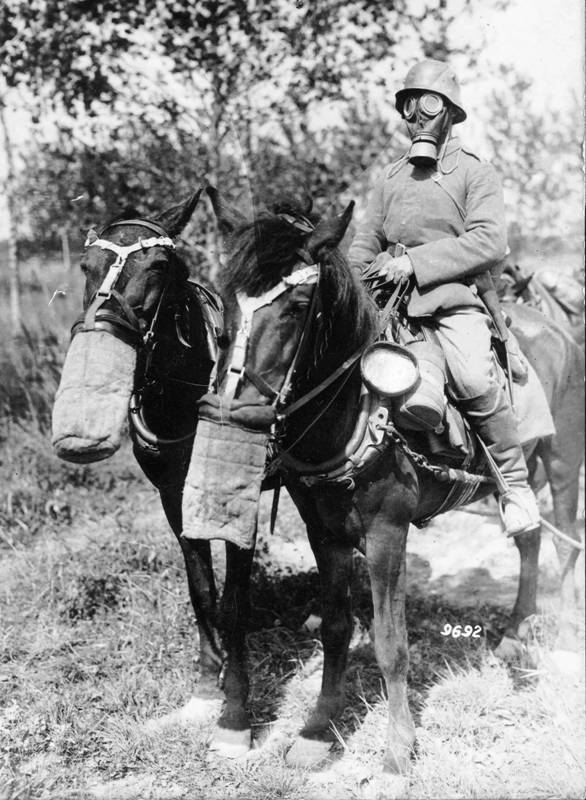
German respirators for man and horses.

German respirators for man and horses.

Was Germany ultimately defeated by chemical weapons? She was already beaten militarily in the field and starved at home by the blockade: chemical weapons did not have a decisive impact on the outcome. Deaths during the war from chemical weapons are estimated at about 18,000, or less than 0.2 per cent of battlefield deaths. Even allowing for the effectiveness of mustard in causing injury rather than death, this was a negligible contribution. Herein lies the reason why gas was not used on the battlefield during the Second World War: chemical warfare wasn’t as effective as other methods of warfare developed and refined during the First World War. With the end of the war, efforts were made to limit the use of chemical weapons. Under the Treaty of Versailles, Germany was forbidden chemical weapons, along with tanks, aircraft and submarines, and in 1925 the Geneva Protocol aimed at a global prohibition of chemical and bacteriological weapons. Between the wars the use of such weapons from the air on towns and cities dominated public anxieties and in the late 1930s most European nations embarked on the mass supply of gas masks to their civilian populations. Whilst the masks were not particularly good, informed opinion was aware that the concentration achievable with aircraft payloads would be low and thankfully the threat never materialised; however, since 1919 chemical weapons have been used almost exclusively against unprotected victims, usually non-combatants, and favoured by rogue states and terrorists. During the lead up to both Gulf wars the term ‘weapons of mass destruction’ encouraged an entirely false equivalence with nuclear weapons; ‘weapons of mass terror’ has been suggested as a more appropriate term.

In the hospital at Trent Bridge Cricket Ground, antiseptic dressings had little effect on Sawyer Spence’s septic mustard gas blisters and caused him such pain that they were abandoned; instead a treatment was begun with a new paraffin medication developed by Boots the Chemist. By early November 1918 he was at home recovering; he died, age 81, in 1973.

Sawyer Spence suffering extensive mustard gas blisters, Trent Bridge Hospital, Nottingham, 1918. © Jon Spence, used with permission.

Sawyer Spence suffering extensive mustard gas blisters, Trent Bridge Hospital, Nottingham, 1918. © Jon Spence, used with permission.

Fritz Haber, who used science to create life and to end it, is surrounded by myths. His wife, Clara, herself a doctor of chemistry, was opposed to his chemical warfare work but it remains unknown whether this was the reason, as has been claimed, for her suicide shortly after the first chlorine attack. The oft-quoted description of chemical warfare as ‘a higher form of killing’ attributed to him is almost certainly apocryphal. It is clear however that when the Nazis took power Haber, a Jew who had converted to Christianity, was unable to retain his post as head of the Kaiser Wilhelm Institute for Physical Chemistry. His friend Albert Einstein had concluded many years before that his own future did not lie with identifying himself with the German state. Haber realised this too late; leaving Germany in 1934 he died soon afterwards. A method of pest control using hydrogen cyanide gas invented in 1918 under Haber’s direction and marketed as ‘Zyklon B’ was used by the Nazis to kill over a million people.

Dr Clara Haber (née Immerwahr) committed suicide on 2 May 1915 while her husband was home on leave after the first gas attack.

Dr Clara Haber (née Immerwahr) committed suicide on 2 May 1915 while her husband was home on leave after the first gas attack.

See below for bibliography including online sources.

Text © Simon Jones


Guardian

My article: The First World War scientists who gave their lives to defeat poison gas


IWM Q3999

The Lochnagar Mine: how and why it was blown and who were the men who dug it


Q 11718

Understanding the 1914 Christmas Truce


Contact me

Join me on a battlefield tour with The Cultural Experience:

Simon Jones Battlefield Tour Somme Poets 2019

The Tank War 17th-20th May 2025

The Battles of the Marne and Aisne 6th-11th September 2025

Mons and Le Cateau 31st August – 3rd September 2025

More Information about Battlefield Tours


Sources for Understanding Chemical Warfare in the First World War
C H Foulkes “Gas!” The Story of the Special Brigade (1934)
L F Haber The Poisonous Cloud (1986)
R Hanslian Der Chemische Krieg (1937)
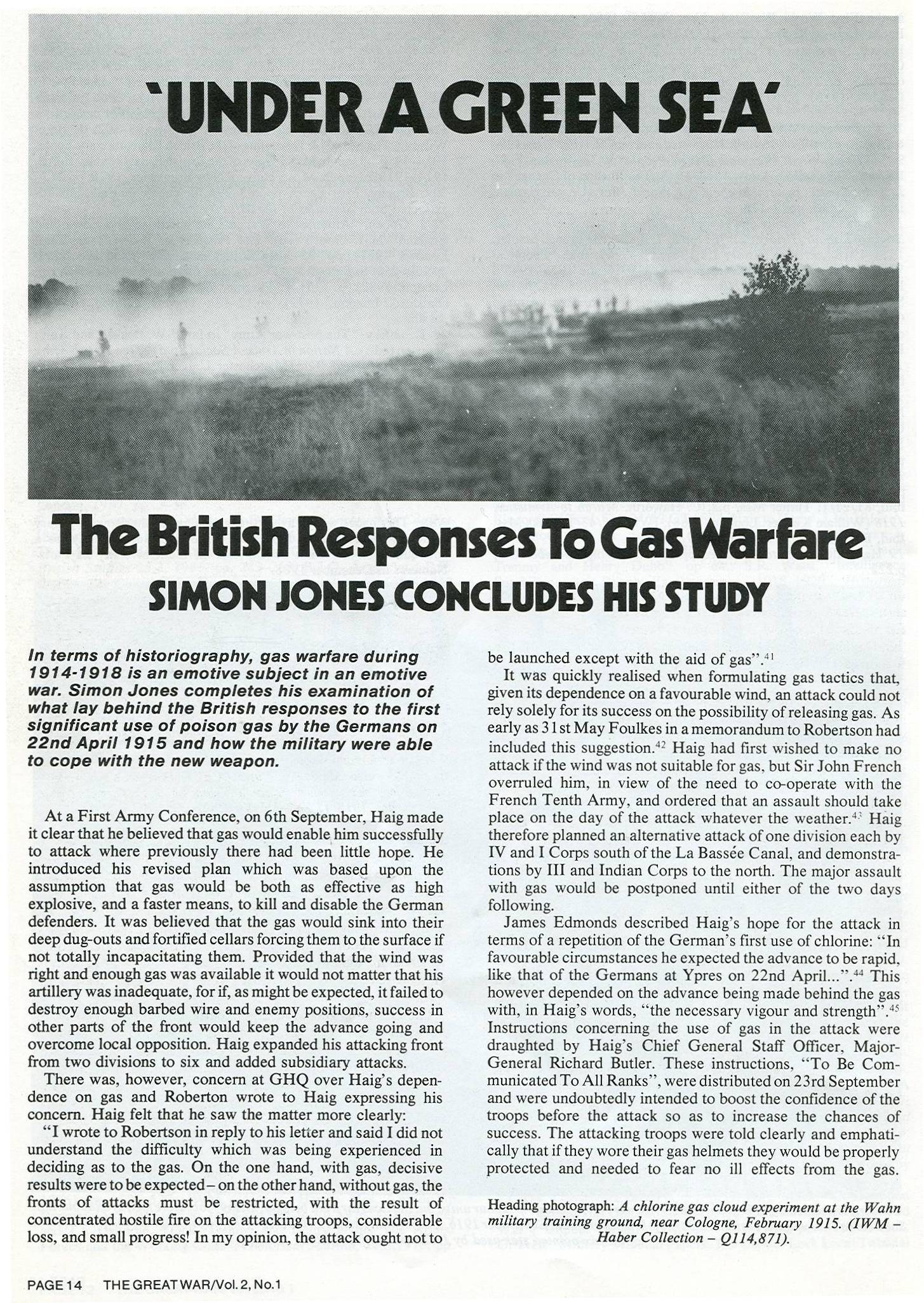
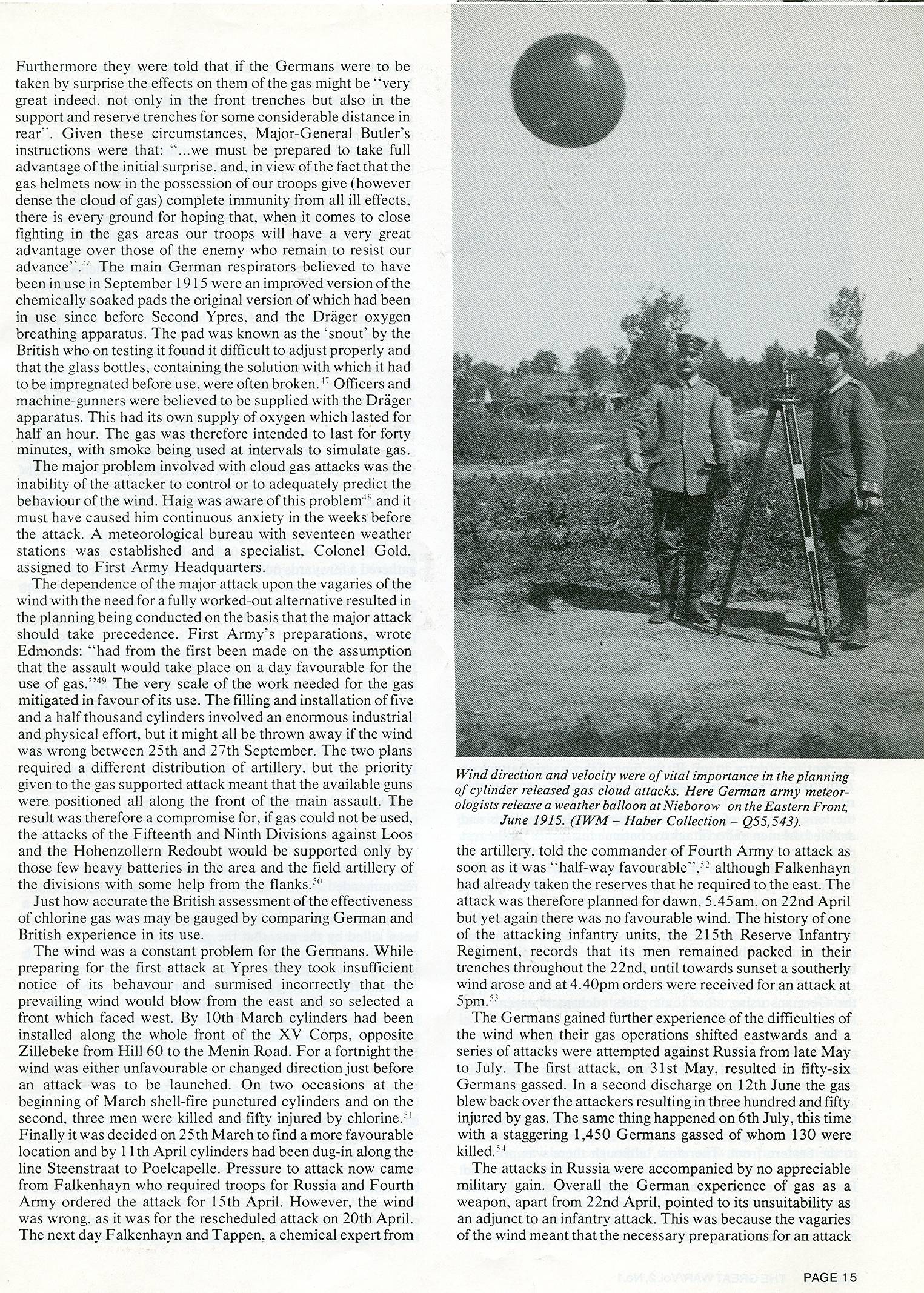
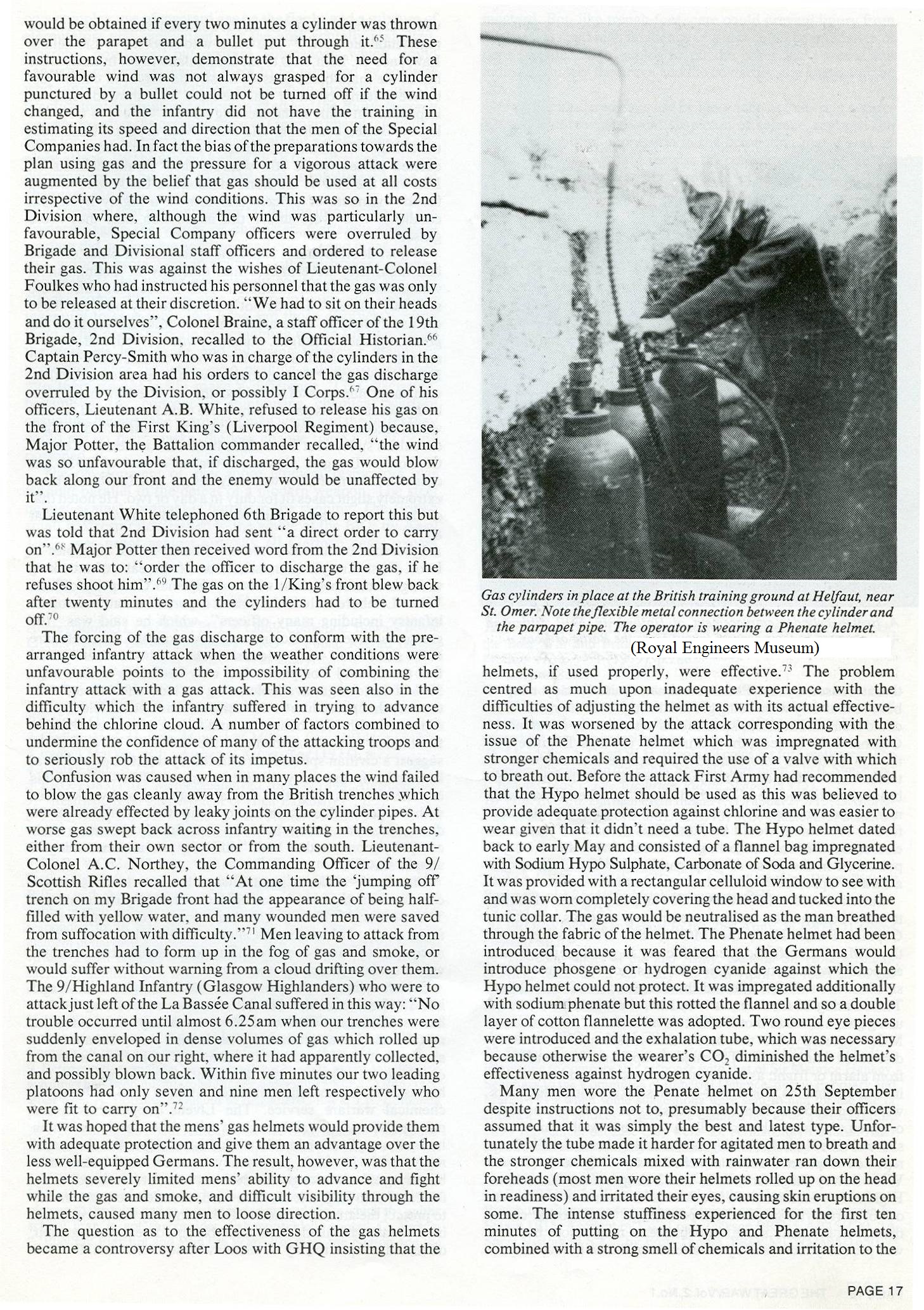
S Jones ‘Under a green sea’ The British responses to gas warfare’ The Great War Vol 1 No 4 & Vol 2 No 1 (1989).
S Jones ‘The first BEF gas respirators, 1915’ Military Illustrated Nos 32 & 33 (1991).
S Jones ‘The right medicine for the Bolshevist’: British air-dropped chemical weapons in north Russia 1919’, Imperial War Museum Review No 12 (c1998)

S Jones World War One Gas Warfare Weapons and Equipment (2007)
G Lachaux and P Delhomme La Guerre des Gaz 1915-1918 (1985)
A Lejaille La Guerre des Gaz (website) http://pageperso.aol.fr/guerredesgaz/
A Lejaille ‘La protection française polyvalente contre les gaz de combat’ Militaria Nos 226 (2004), 237 & 241 (2005).
O Lepick La Grande Guerre Chimique (1998)
W G MacPherson (ed.) Medical Services Disease of the War Vol. II (1923).
D Martinetz Der Gaskrieg 1914/18 (1996)
Y Mouchet ‘Les masques à gaz allemands de la Grande Guerre’ Militaria No 220 (2003)
A Palazzo Seeking Victory on the Western Front The British Army and Chemical Warfare in World War I (2000).
A M Prentiss Chemicals in War (1937)
D Richter Chemical Soldiers (1994)
W Zecha “Unter die Masken!” Giftgas auf den Kriegsschauplätzen Österreich-Ungarns im Ersten Weltkrieg (2000).

The First Gas Attacks, A Century On

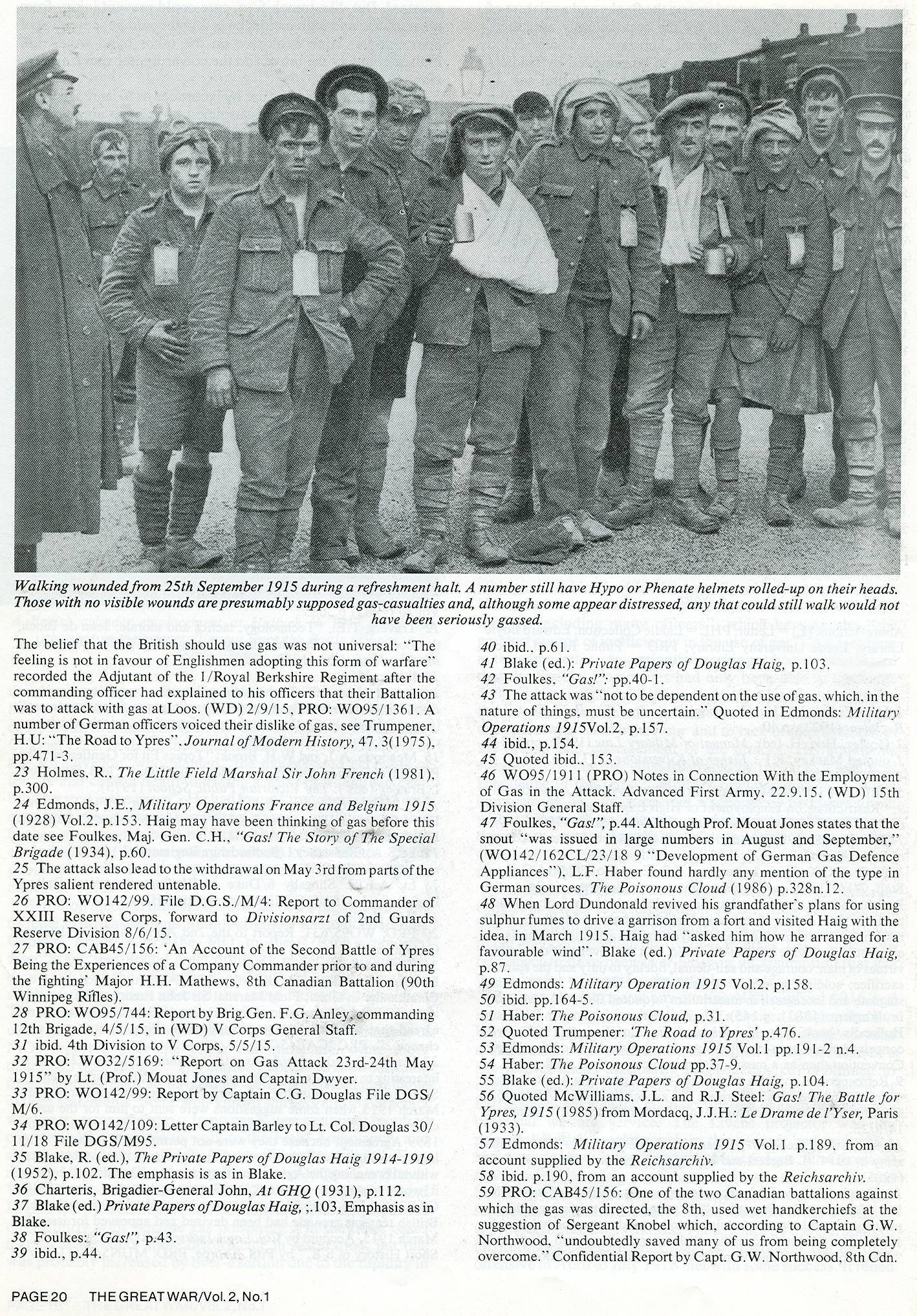
British gas casualties Bailleul May 1915

How a confused British response to the first German chlorine gas attacks led to the disaster of the British attack at Loos in September 1915.

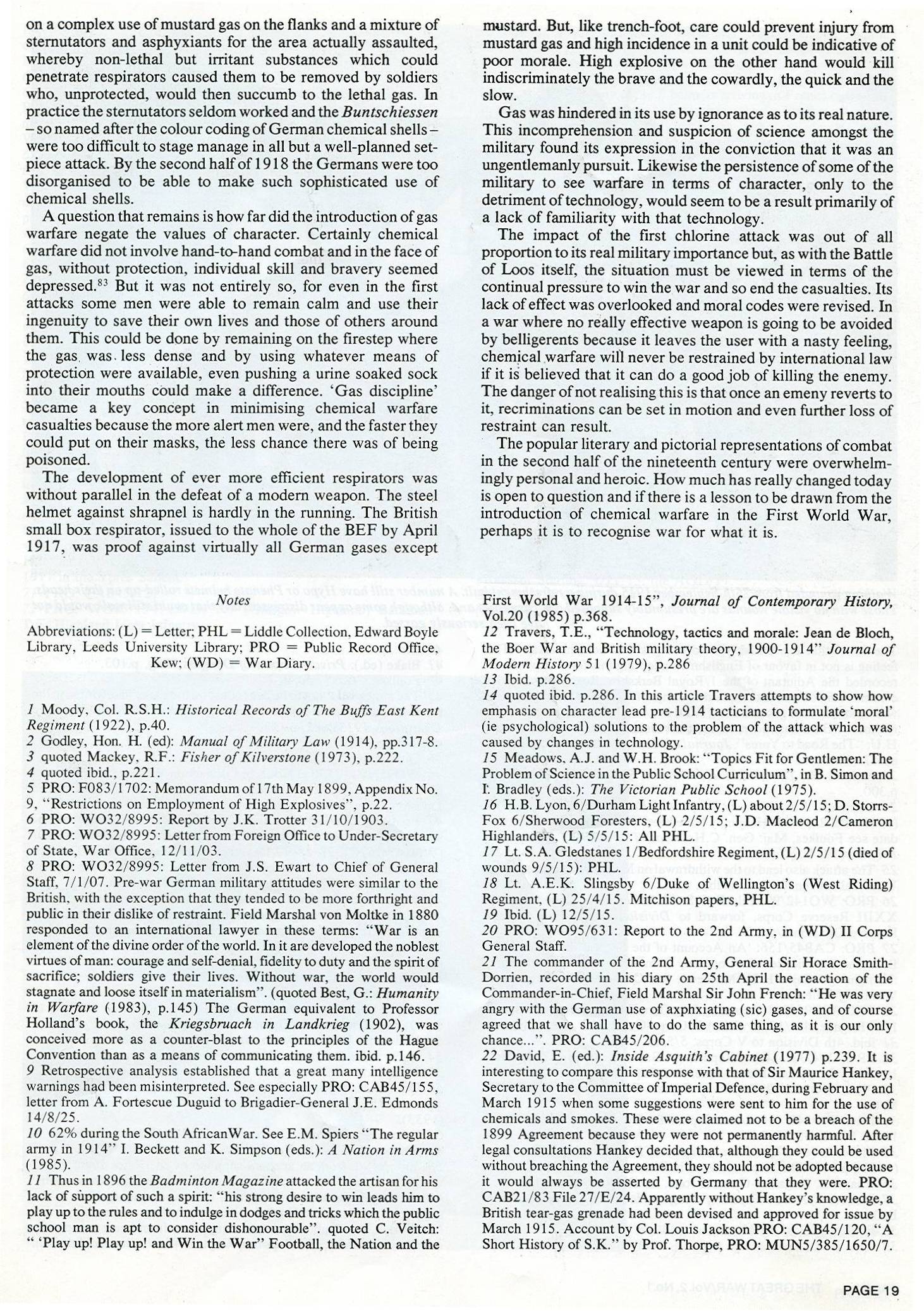
Originally published in The Great War, Vol. 1, No. 4 and Vol. 2, No. 1 (1989). Click images to enlarge.

GreatWar01

GreatWar02

GreatWar03

GreatWar04

GreatWar05

GreatWar06

GreatWar07

GreatWar08

GreatWar09

GreatWar10

GreatWar11

GreatWar12

GreatWar13

GreatWar14

GreatWar15


Join me on a battlefield tour with The Cultural Experience

Simon Jones Battlefield Tour Somme Poets 2019

The Battles of the Marne & the Aisne 1914 – 1918

First & Last Shots 1914 & 1918

Medics & Padres in the Great War

Walking Ypres 1914-1918

Walking the Somme

More Information about Battlefield Tours


British_55th_Division_gas_casualties_10_April_1918[1]

Yellow Cross: the Advent of Mustard Gas in 1917

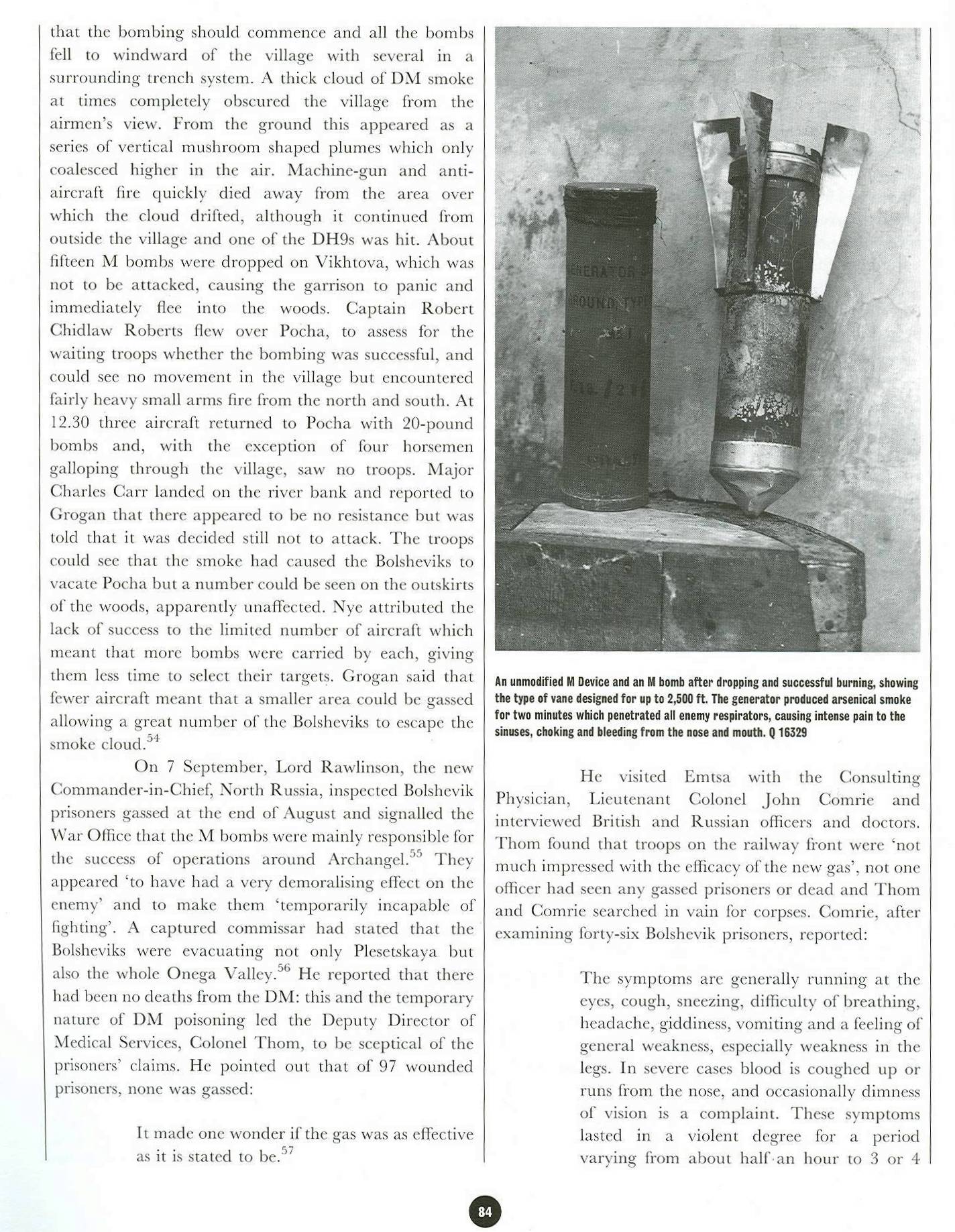
When Chemical Weapons Were First Dropped From the Air, North Russia 1919

Grantham N Russia RE Lib

Lieutenant Donald R Grantham MC RE, holding M Generators adapted as aircraft bombs, Lake Onega seaplane base, 1919. (RE Museum)

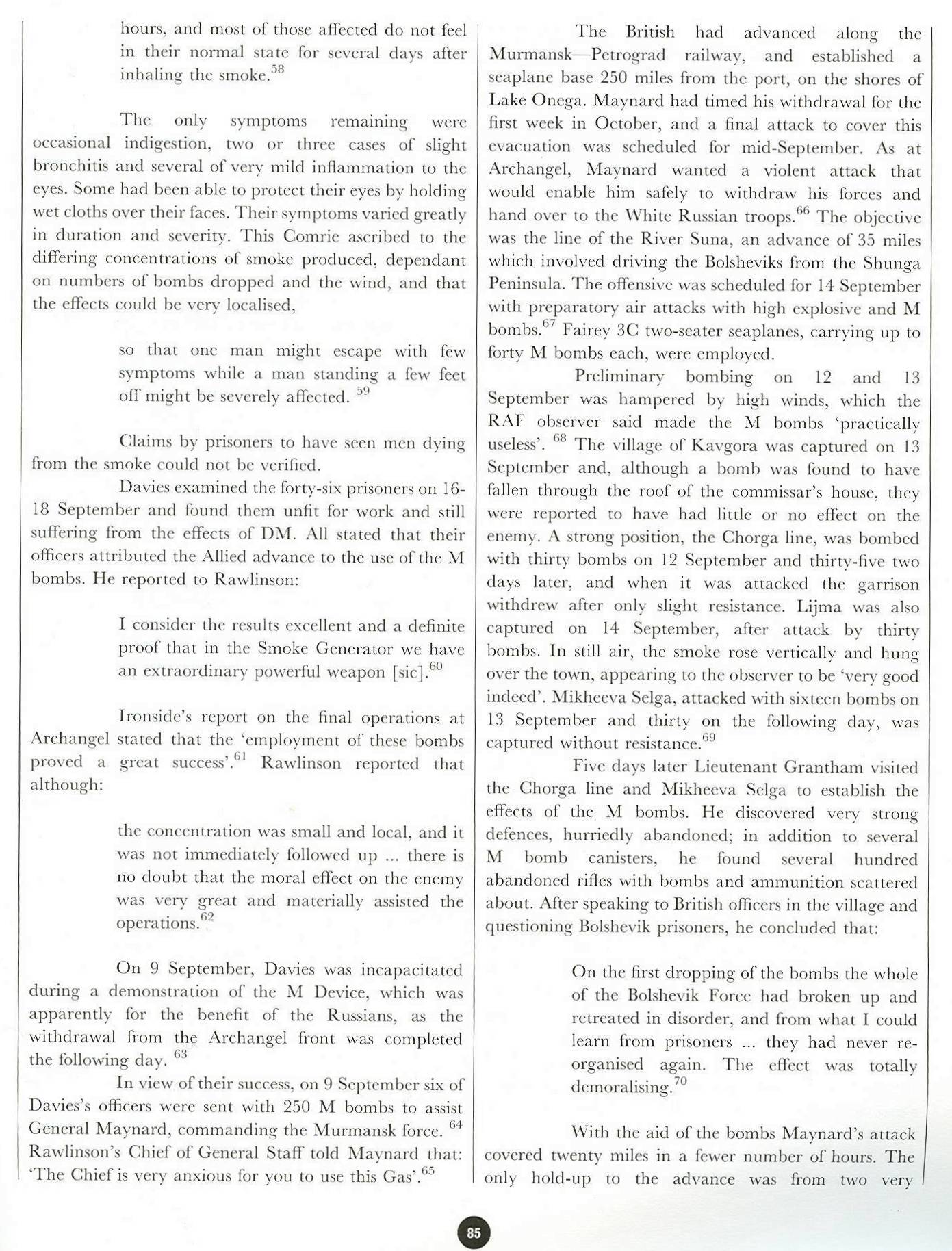
The first time chemical weapons were used from aircraft was during British operations against Bolshevik forces around Archangel and Murmansk in 1919. Here is a shorter version of my article on the episode which was published in the Imperial War Museum Review (No. 12, 1999) and is given in full below. (Click each page to enlarge). Scroll to the bottom for more articles.

1

2


sawyer-spence

Understanding Chemical Warfare in the First World War


3

4
5

6

7
8
9
10
11


Join me on a battlefield tour with The Cultural Experience

Simon Jones Battlefield Tour Somme Poets 2019

The Battles of the Marne & the Aisne 1914 – 1918

First & Last Shots 1914 & 1918

Medics & Padres in the Great War

Walking Ypres 1914-1918

Walking the Somme

More Information about Battlefield Tours


German Yellow Cross mustard gas shell for 105mm howitzer.

Yellow Cross: The advent of Mustard Gas in 1917


H15258

Myths of Messines: the ‘Lost Mines’

Understanding the 1914 Christmas Truce

Q 11718

They say they are not going to fire again if we don’t but of course we must and shall do, but it doesn’t seem right to be killing each other at Xmas time. [1]

At Christmas 1914, hundreds of soldiers stopped fighting one another, left their trenches and shook hands in no man’s land. For several days, even weeks, British and German soldiers in Flanders barely fired a shot, helped bury one another’s dead, and even played football together. The 1914 Christmas Truce is felt to typify the attitudes of the men in the trenches who, in contrast to those behind the lines, did not hate their enemies and did not want to fight them. Why is this utterly atypical event believed to give a truer picture of the attitude of the soldiers in the trenches than the four years spent in remorseless, brutal conflict? It is not difficult to understand the appeal of the Truce: in the midst of inhumanity at Christmas time soldiers, inspired by the Christian story, spontaneously stopped fighting and shook hands with their enemies.

Like much about the First World War, the 1914 Truce is an event which in the view of many historians has been popularly misrepresented. In particular, media stories about the Truce show an inability properly to interpret historical sources, which are admittedly often partial or contradictory. In the trenches the individual soldier’s view of events was so restricted that, in places where fraternisation did not take place, soldiers refused to believe that it could have occurred. But as many as a hundred eyewitness accounts prove beyond doubt that many truces really happened, not only in the British-held sector but also that of their French ally.

Who was in the trenches at Christmas 1914?

Soldiers have always arranged truces when it suited them, employing conventions to enable this. In addition, where opposing forces have been in close proximity for a period of time, such as during a siege, unauthorised fraternisation might also take place. By Christmas 1914, the lines of trenches were continuous along the Western Front in conditions that resembled a vast, linear, siege operation. After the German advance through Belgium of August 1914 was halted at the Marne, the Germans attempted to outflank the French and British forces by retreating north, leaving in their wake lines of entrenchments which, by October, reached to the North Sea. The Germans tried to break through at Ypres and failed, with tremendous slaughter, in the bitter fighting of the month-long First Battle of Ypres, 24 October to 22 November, the opposing sides both suffering more than 100,000 casualties (54,000 British, 50-80,000 French and 80-130,000 German). Immediately before Christmas, smaller scale attacks on 18-20 December left many bodies still lying in no man’s land.

Fraternisation was to take place on two-thirds of the still-small 20 miles of front held by the British, from St Eloi just south of Ypres, to La Bassée. Losses had been such that there was just a comparative handful of survivors left from the fighting of August 1914. Their places had been taken by more Reservists, new recruits and Territorials. Likewise on the German side were Reservists and young soldiers. The British noticed that Saxon and Bavarian troops were more easy-going than Prussians and many of the troops opposite the British where fraternisation occurred were from these state armies.

The commander of II Corps (holding the northernmost five miles), General Smith-Dorrien, anticipated that the static nature of trench warfare and the closeness of the lines in many places might lead the troops to fraternise and on 5 December issued orders to prohibit it:

Friendly intercourse with the enemy, unofficial armistices (e.g. “we won’t fire if you don’t” etc.) and the exchange of tobacco and other comforts, however tempting and occasionally amusing they may be, are absolutely prohibited. [2]

Orders by General Smith-Dorrien in II Corps memorandum G.507, 5th December 1914 [2].

Christmas Eve: Carols and First Contact

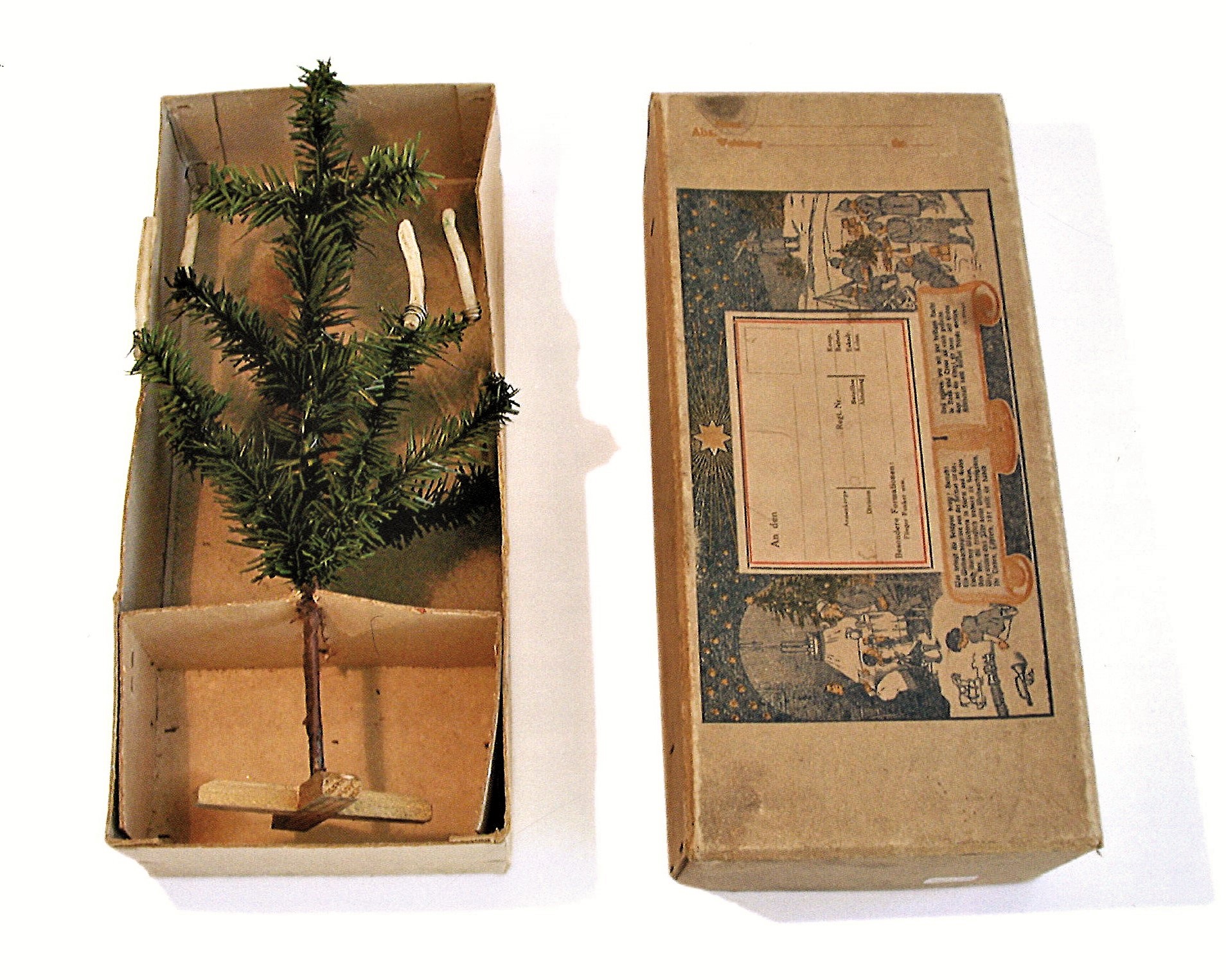
But on Christmas Eve, Smith-Dorrien’s orders were to be ignored or forgotten by many. As firing by sniping and artillery fire died down, fraternisation developed by degrees. As a gesture towards their own troops the Germans sent hundreds of small Christmas trees to their men at the front. When, on Christmas Eve soldiers placed them with lit candles on their trench parapets, in full view of their enemies, it seemed to many wrong to fire on them. Both sides also organised singing in their trenches. Leutnant Johannes Niemann of the 133rd Saxon Regiment was ordered into the trenches on Christmas Eve, and placed a Christmas tree in his dugout and another on the parapet. Then he and his men began to sing Stille Nacht and O du Fröhliche. On the other side of no man’s land, a Seaforth Highlander described how they sang carols and then listened ‘spellbound’ as the sound of German harmonies floated across the turnip field which comprised no man’s land. [3] At one place, however, where the Germans brought a band up to the trenches, it was shelled by British artillery. But mutual carol singing led to calls to meet halfway.

Kriegsbäumchen

German Christmas tree for troops at the front, 1914-18. (Landeskirchliches Archiv Stuttgart)

A Lieutenant with the 1st Royal Warwickshires, Bruce Bairnsfather (soon famous as a cartoonist), described how in the evening impromptu concerts led to an invitation from the Germans to ‘Come over here!’ at which a Sergeant disappeared into the darkness of no man’s land, out of which they could catch snatches of spasmodic conversation. [4] The 2nd Argyll and Sutherland Highlanders witnessed candles being lit on the parapets followed by the singing of Stille Nacht and other carols before an invitation was called across in English by an ex-waiter who had worked in Glasgow. After some light-hearted banter it was agreed that two only from each side should go out but no one else was allowed out of the trenches. One was a young Argylls Second Lieutenant who met a German officer, ‘our conversation was no different from that of meeting a friendly opponent at a football match’ and appropriately enough the German gave him a photograph of his pre-war regimental football team. The Argyll officer gave him a tin of bully beef in return and, after ten minutes, they bid one another a friendly farewell. [5] Not all responded to overtures but many made arrangements to meet on Christmas Day. The Queen’s Westminster Rifles were suspicious at first but, after the Germans lit fires and songs were exchanged, some men ventured out. The established convention for a soldier under cover of a white flag of truce was for him to be brought into the lines blindfolded, in order that he would not learn anything of military use so that he might returned to his own lines. This precaution was forgotten in the case of a German who approached the Westminsters on Christmas Eve and had to be made a prisoner, about which he was ‘awfully upset’. The next morning however three of the Westminsters were also missing and it was discovered from the Germans that they had wandered drunkenly into the German trenches and had also been captured. [6]
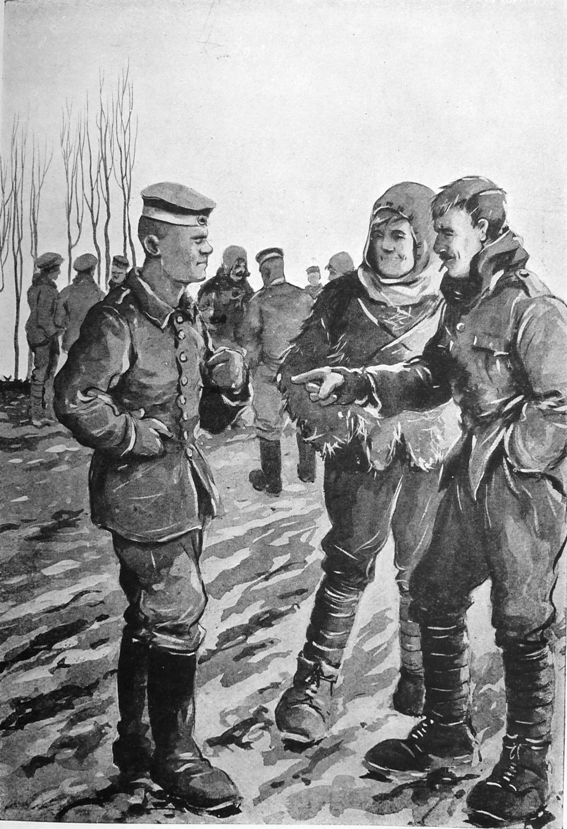
A Memory of Christmas 1914

Bruce Bairnsfather illustrated his detailed account of the truce with this cartoon in his 1916 memoirs ‘Bullets and Billets’ and captioned it: ‘A memory of Christmas, 1914: “Look at this bloke’s buttons, ‘Arry. I should reckon ‘e ‘as a maid to dress ‘im” ‘

Not everyone in the trenches wished to meet the enemy. An officer of the Rifle Brigade was disgusted to find the German trenches ‘looking like the Thames on Henley Regatta night’. He was in no mind to allow them to enjoy themselves, one of his men having been killed that afternoon, but his Captain, who had seen less of the fighting, wouldn’t let him fire. However, as soon as a shot came from the Germans, he lined his men up and ordered them to shoot away their Christmas trees. When two other officers on the right got out of the trenches and met two Germans halfway across no man’s land, he regarded it as ‘an awfully stupid thing to do’ by those who hadn’t yet ‘seen the Germans in their true light’. [7] But many joined gladly. Two officers of 1st North Staffordshires who walked across to meet the German commander were asked by him for permission to bury his dead in no man’s land; they agreed on condition that only those who were there for that purpose would be permitted. [8] The burial of the dead was for many the real justification for the Truce.

Christmas Day: Peace Breaks Out

On Christmas morning early fog dispersed to reveal a clear blue sky, in only a few places remaining thick until midday. Bruce Bairnsfather recalled that it was ‘just the sort of day for peace to be declared’. [9] In places the Germans put up boards on the trenches reading ‘Merry Christmas’ or ‘You no fight, we no fight’. Officers told their men not to shoot unless it was absolutely necessary and once one side ceased fire, the other followed. The quiet was described by an officer as unfamiliar:

The silence seemed extraordinary after the usual din. From all sides birds seem to arrive, and we hardly ever see a bird generally. [10]

Where the fog suddenly cleared, men of both sides could be seen running about in the open trying to keep warm, behaviour which at any other time would have been suicidal. They waved to one another, and soon were meeting. British accounts tend to give the Germans credit for initiating contact, whereas many German accounts say that the British came out first. Soldiers variously describe the experience as ‘wonderful’, ‘the greatest thing took place here’, the ‘most extraordinary celebration of [Christmas] that any of us will ever experience’, ‘one of the most extraordinary sights that anyone has ever seen,’ ‘While you were eating your turkey etc., I was out talking and shaking hands with the very men I had been trying to kill a few hours before!! It was astounding!’ For Bairnsfather, ‘there was not an atom of hate on either side that day’.

Simple pragmatism was the most powerful impetus to stop firing at one another. The officer of the Rifle Brigade who shot down the Christmas trees the night before now found himself arranging burials with the enemy in no man’s land, justifying it on the grounds that they were not the militaristic Prussians but the more sympathetic Saxons. Together they buried the bodies of nine German soldiers in no man’s land:

We gave them some wooden crosses for them, which completely won them over, and soon the men were on the best of terms and laughing. [11]

Burial of the dead was the main activity in many areas where truces occurred, an unpleasant but important duty to soldiers on both sides. In the largest joint burial, 100 were interred and an officer of the 6th Gordons described ‘a most wonderful burial service’ in which the Germans formed up on one side of the grave and the British on the other, while the 23rd Psalm and prayers were read first in English and then in German. [12] But although the burial and ceremony were conducted jointly, there was still suspicion: afterwards one private showed another a dagger he had kept concealed, adding ‘I don’t trust these bastards’. [13] Burial was perhaps the most poignant of the shared activities, but at least one officer (himself part-German) said that the experience of seeing the dead of their own side left them with a stronger hatred of the Germans than before.
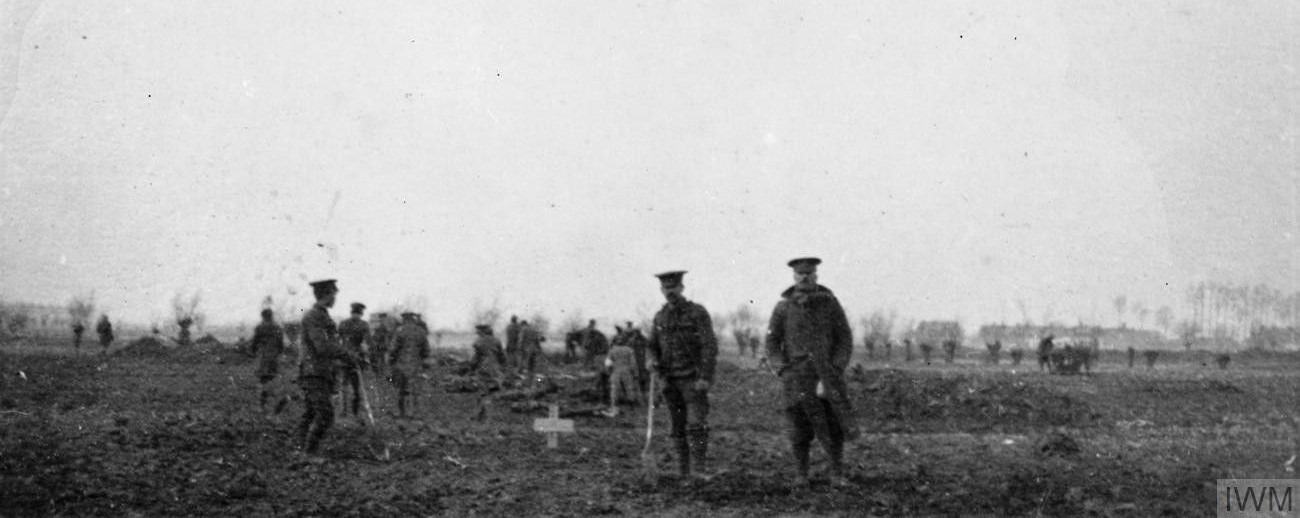
Q 50720-British and German troops meeting in No-Man's Land during the unofficial truce... Robson, Harold Burge (2)

British and German troops burying their dead in no man’s land on Christmas Day 1914, Bridoux-Rouge Banc sector, Flanders. Photographed by Harold Burge Robson of the Northumberland Hussars (Cropped IWM Q 50720).

Officers from both sides tried to get a good look at their opponents’ positions to gather intelligence, noting in particular the locations of machine guns and snipers, and were on the lookout for the enemy trying the same thing. As more men went into no man’s land it was difficult to keep them from crossing a halfway line. When Henry Williamson (a nineteen year old private in the London Rifle Brigade) was turned back from the German lines his officer told him not to do it again. Some who got too close to their opponents’ trenches were taken prisoner, as had occurred with the Westminsters. Both sides did manage to gain sight or even access to their opponents’ trenches and return safely. A British officer described how he had a cigar with a sniper who claimed to be ‘the best shot in the German Army, who said he had killed more of us than any dozen others’. But the officer had located the sniper’s firing position and planned to shoot him the next day.
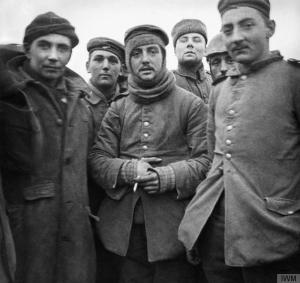
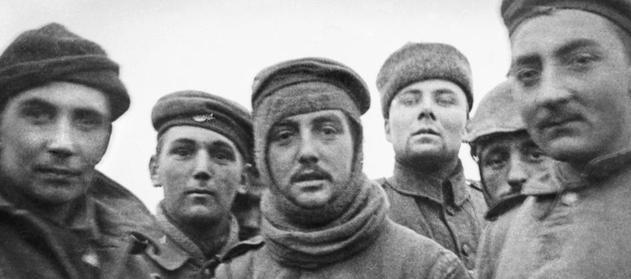
British soldiers of the London Rifle Brigade meeting German troops of the 104th or 106th Saxon Infantry Regiments, in no man's land, Christmas Day 1914.

British soldiers of the London Rifle Brigade meeting German troops of the 104th or 106th Saxon Infantry Regiments, in no man’s land, Christmas Day 1914. (IWM Q 11718)

Another major value of the truces was the opportunity for both sides to improve their trenches and dugouts during daylight without having to worry about exposing themselves to sniper fire. The chance to improve the appalling winter conditions was welcomed where, in the rudimentary trenches, the high Flanders water level meant that digging down more than a few feet met water. Sometimes tools were even shared, as both sides made the most of the chance for improvement works while in some places the cease fire proved so advantageous that it continued into the New Year.

Even in places where there were no dead to be buried, no man’s land was quickly swarming with men ‘shaking hands and wishing each other a happy Christmas’. They swapped badges and buttons, Germans offered cigars, the British gave them foodstuffs, bully beef or jam, in return, even hair cuts were provided. At lunchtime many soldiers returned to their lines to eat, but the 6th Cheshires killed a pig and cooked it in no man’s land. Some of the 2nd Royal Welch Fusiliers were given a barrel of beer by the Germans, for which they offered a plum pudding in return. The beer, from a French brewery just behind the German trenches, was so poor that the British shelled it a few days later.

One reason for fraternisation was simple curiosity, they just wanted to look at the men that they had been fighting. Many British were surprised to find that some at least of the Germans were ‘very nice fellows.’ Many of the Germans had worked in Britain before the war, especially as waiters. The soldiers good-naturedly discussed their respective causes and whilst they may have both expressed a desire to stop fighting and to go home, they remained implacable enemies. Conversation with Germans revealed them subject to propaganda, some believed that London was already occupied by them, others were ‘fed up’ with the war and, the British reported, were realising that they had been ‘bluffed’. One told a Corporal in the 6th Gordons that ‘the war is finished here. We don’t want to shoot.’ An officer of the 1st Royal Warwicks wrote home to say ‘The Germans are just as tired of the war as we are, & said they should not fire again until we did.’ A Staff Officer compiling the War Diary of the 15th Infantry Brigade reported the outcome of conversations: ‘Little mention of the war was made. They expected it to finish within 2 months at least.’ Significantly, the truces were accompanied by only a small number of desertions by either side.
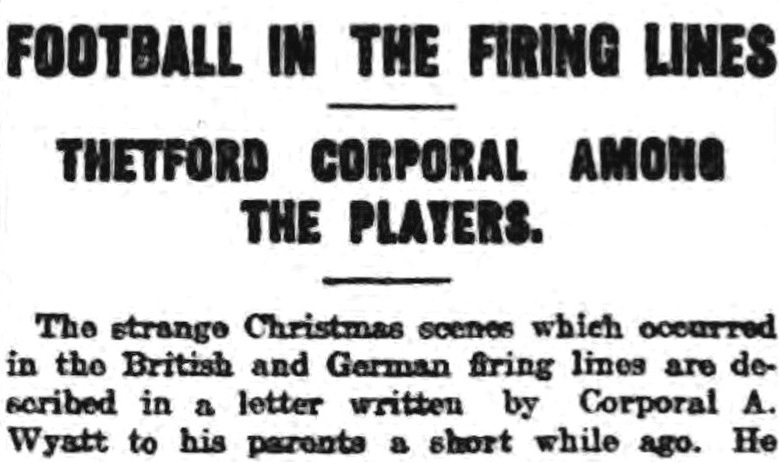
albert-wyatt-letter-thetford-watton-times-13021915a

The Thetford and Watton Times, 13 February 1915.

Who played Football?

An activity which has come to capture the popular idea of the Truce, supposedly symbolising the fraternal and unwarlike spirit of the soldiers at the front, is football. Many descriptions of it contain references to the intention to play football, or to football being played elsewhere. For example, the commanding officer of the 1st Grenadier Guards said that the Germans wanted to play them on Boxing Day but that unfortunately they couldn’t supply a ball. Some soldiers played football among themselves, as they took advantage of the lack of firing to play behind or even in front of their trenches, the chance to keep warm being a major impetus.

Perhaps remarkably, out of a large number of references to football in hearsay or intending to be played, there are direct, reliable accounts of just two instances of British and Germans actually playing together. Several British sources can be accepted as eyewitness accounts for a game just in front of the German-held village of Messines (Mesen), south of Ypres. Ernie Williams of the 6th Cheshires recalled in 1983 that no man’s land in his sector was not as broken up by shellfire as in other places. He said that the Germans produced a ball and there was ‘a general kickabout’ with ‘about a couple of hundred taking part. I had a go at the ball… There was no referee, and no score, no tally at all.’ [14] That nearly seventy years had passed when Williams’s recollections were recorded has cast some doubt on the reliability of his account. However, a letter from a Sergeant-Major in the same battalion, Frank Naden, was published in a local newspaper which referred to football ‘in which the Germans took part’. [15] The 6th Cheshires was attached for duty in the trenches to the 1st Norfolks and the recent discovery of another letter, also in a local newspaper, by Corporal Albert Wyatt of this unit provides even clearer evidence: ‘We finished up in the same old way, kicking a football about between the two firing lines. So football in the firing line between the British and Germans is the truth, as I was one that played.’ [16] Ideally, there would be confirmation from the opposing troops in the sector, but none of the German accounts from the 16th Bavarian Reserve Infantry Regiment at Messines makes any reference to football.
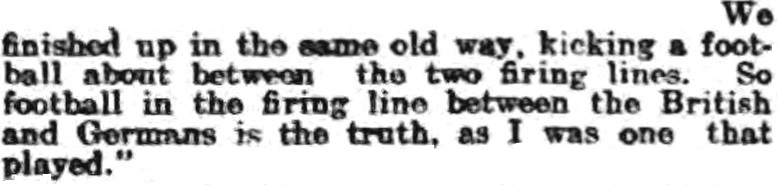
albert-wyatt-letter-thetford-watton-times-13021915b

Letter from Corporal Albert Wyatt, 1st Norfolks, The Thetford and Watton Times, 13 February 1915.

A more organised game of football is described by two members of the same German regiment in a different sector, in accounts which both originate from the late 1960s. Lieutenant Johannes Niemann, of the 133rd Saxon Infantry Regiment described a match for a 1968 BBC television programme:

Suddenly a Tommy came with a football, kicking already and making fun, and then began a football match. We marked the goals with our caps. Teams were quickly established for a match on the frozen mud, and the Fritzes beat the Tommies 3-2. [17]

A letter to Niemann from another member of the regiment, Hugo Klemm, confirmed that football was played. [18] Niemann further stated that they played against Scottish soldiers who they noticed, as their kilts flew up, wore no underpants. [19] The only kilted British regiment facing Niemann’s was the 2nd Argyll and Sutherland Highlanders, but none of the accounts of the Truce from its members, including one by a professional footballer, describes football being played. [19]

Finding clear evidence of the same game from both British and German sources remains elusive. An anonymous letter printed in The Times, in which the writer stated: ‘The — Regiment actually had a football match with the Saxons, who beat them 3–2!!!’ is often cited as corroboration for the match described by Niemann, but a more complete version of the letter, which appeared in the Carlisle Journal, gives the German unit as 107th Saxon Infantry Regiment which places it several miles to the south of Niemann’s 133rd Regiment. [20] Thus the accounts that we have from the German side cannot be corroborated from British sources and, although detailed, were written fifty-four years after the event.
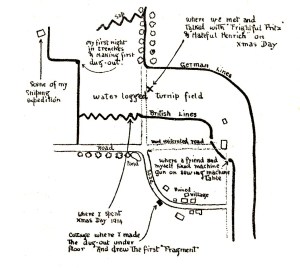
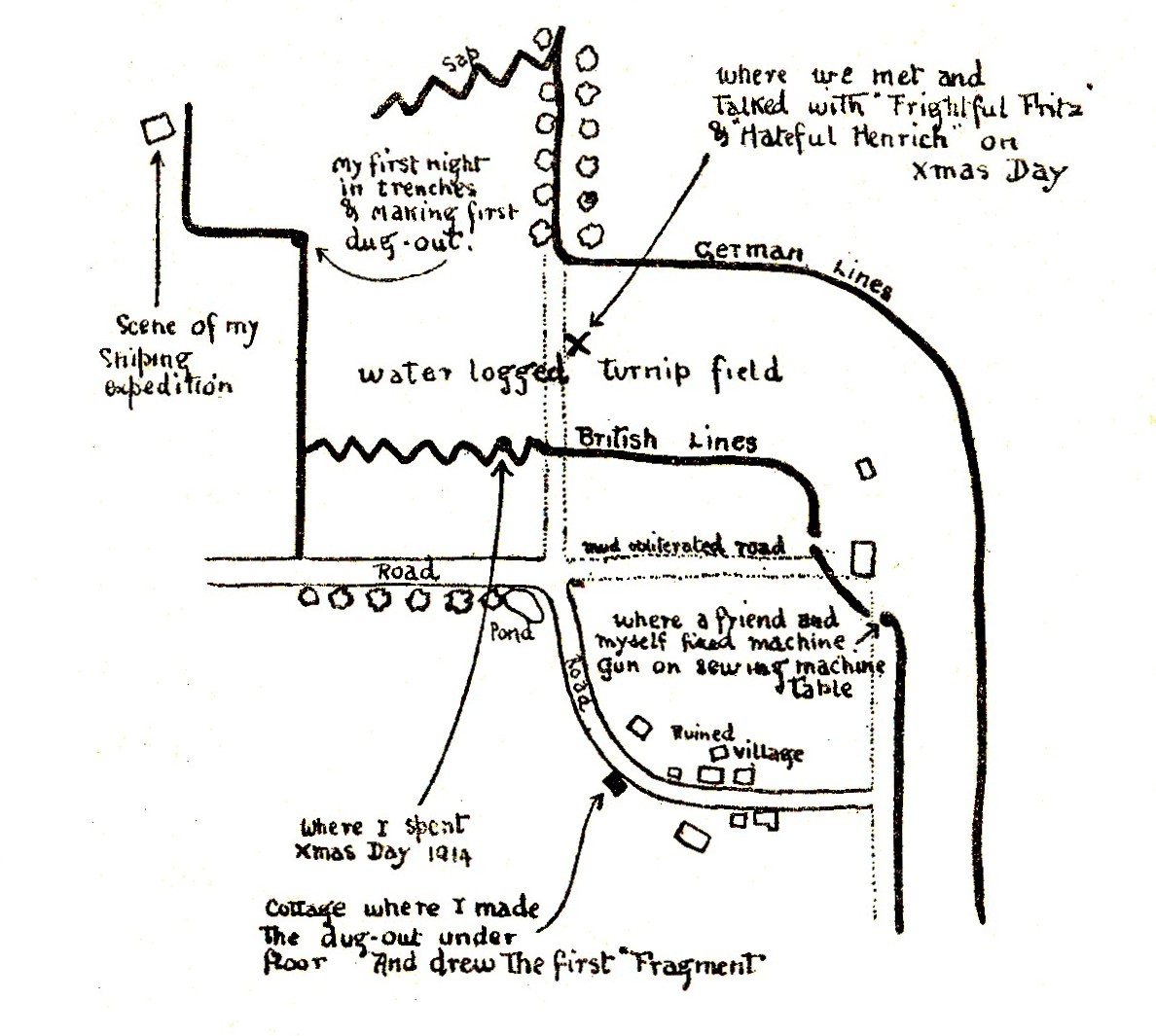
Bruce Bairnsfather's map showing the turnip field where he met Germans on Christmas Day 1914. From 'Bullets and Billets' (1916).

Bruce Bairnsfather’s map showing the turnip field where he met Germans on Christmas Day 1914. From his 1916 memoirs ‘Bullets and Billets’ which contain no mention of football during the Truce.

Football is firmly attached to the story of the Truce. Although it was not the intention of those erecting them, two memorials to the event have become the focus for claims that football matches were played in their vicinity. One erected in 2008 at Frelinghien is where the Royal Welch Fusiliers were given the beer but where no accounts refer to football. The other, unveiled in December 2014 by the Union of European Football Associations (UEFA), is at Saint Yvon, immediately north of Ploegsteert Wood, close to where Bruce Bairnsfather recorded in detail his experiences of meeting the Germans. In 2007, footballs appearing at a nearby wooden cross, erected eight years previously by the Khaki Chums who had spent several days over Christmas living in a reconstructed trench, signalled a growing belief that it marked the spot where the ‘football match’ had been played. This belief has taken root so firmly that in December 2014 UEFA placed a memorial at this spot, despite having been given expert advice that the evidence concerning the location was questionable. Two accounts, one German and one British, have however served to reinforce the believe that football was played at Saint Yvon. The first is the diary of a German officer in this sector, Lieutenant Kurt Zehmisch, who describes the Truce and states that:

Soon a couple of Englishmen brought a football out of their trench and a game started. [21]

Accounts by members of Bairnsfather’s unit, the 1st Royal Warwickshires, indicate that they played football amongst themselves in sight of the Germans and this is what Zehmisch appears to be describing, rather than a match between the British and Germans. [22] Bairnsfather’s own account of the Truce published in 1916 made no reference at all to football. [23] In a 1929 magazine article, he claimed that a football match was proposed but, before it could take place, further fraternization was forbidden. However, in a television interview for the Canadian Broadcasting Corporation in 1958, he described how football was actually played, with the implication that he was an eye-witness. [24] If he had seen football between the opposing sides, it would seem plausible that he would have described it in 1916 and in particular would have depicted it in at least one of his many cartoons. The evidence points to him either consciously or unconsciously embroidering the story or speaking generally about what he had heard had happened, rather than what he had actually seen himself.

Opposition to the Truces

It is often implied that opposition to the Truce came only from the commanders behind the lines but there were many actually in the trenches who had strong qualms about participating in the Truce. Significant numbers refused to take part at all, the most common way of preventing fraternisation was to open fire on those making peaceful overtures. The 2nd Grenadier Guards had lost heavily in fighting on Christmas Eve and, when the Germans ‘put their heads up and shouted Merry Xmas’, the Guards shot at them. [25] Likewise a Staff Officer, recording in his diary that strict orders were issued against allowing any truces, expressed his attitude to fraternisation with the enemy, although he may not have been a direct witness the incident that he described:

The Germans did try. They came over towards us singing. So we opened rapid fire on to them, which is the only sort of truce they deserve. [26]

Many men were killed in this way on Christmas Day, sometimes owing to those in neighbouring trenches not agreeing to a Truce, and in a number of instances the Germans apologised where this had happened. The second-in-command of a battalion of British-Indian troops stopped fraternisation by calling his men back in, scolded two of his officers and reported what had occurred to battalion headquarters. But when this resulted in the stopping of their leave, he felt it far too harsh. Both were killed a few months later, before they could return home. A Lieutenant in 1st East Lancashires at Ploegsteert described receiving a signal from battalion headquarters to make a football pitch by filling up shell-holes, and to challenge the Germans to a match on 1st January. He was furious and took no action, except to destroy the signal. [27] The medical officer to 1st King’s Shropshire Light Infantry in a letter home condemned those singing carols and fraternising, claiming that the regiments which had done so had since come to blows with those which had opposed the Truce. [28] After the Royal Welch Fusiliers left the trenches on Boxing Day, having drunk the beer given to them by the Germans, they were shouted at and spat upon by the French women in Armentieres who told them: ‘you boko kamerade Allemenge’. [29]

As night fell on Christmas Day most men returned to their trenches although, in places, singing continued. Where there had been fraternisation, there was in the main no firing during the night. One battalion did open fire on a German who came as far as their barbed wire but decided that he must have been drunk. On Boxing Day, Germans were still to be seen walking on top of their trenches. Efforts were made to bring the situation back to normal, often by firing a few shots into the air, but neither side wished to resume active hostilities. In one place the task of burying the dead was still to be completed. In another, some artillery officers came up to see what was happening, and found both sides repairing their trenches in full view of the other. Light snow falling on Boxing Day turned to sleet after dark. The worsening weather led to flooding which, while it put an end to fraternisation, also saw the persistence of a passive attitude and general lack of hostility which lasted for many weeks.

Senior officers were generally hostile to the truces but not consistently so. General Smith-Dorrien, who had issued the order against fraternisation earlier in December, visited the trenches on the evening of Boxing Day. He didn’t find fraternisation but was ‘considerably disappointed by the state of affairs’ and ‘the apathy of everything I saw’. On his return to his headquarters, reports of Christmas Day truces were waiting for him. He was famous for his temper, thought to have originated with an old wound, and issued an angry memorandum calling for the names of officers and units which had taken part, with a view to disciplinary action. The British Commander-in-Chief, Sir John French, also issued orders to prevent a reoccurrence and called for local commanders to be brought to account. Only in retrospect did he concede that he might have agreed to an armistice, had the question been submitted to him. General Rawlinson, commanding IV Corps, described reports in his diary without apparent disapproval and did not call for punishments. His subordinate commander, General Capper (7th Division) allowed an informal armistice on 26th and 27th specifically to enable dead to be buried and for the clearing of streams and drainage ditches.

On 28th December, the commander of 11th Brigade sent a message to his three battalions in the trenches telling them to make use of the opportunities of the continuing cessation of hostilities to strengthen their defences but not to let the enemy near their trenches. The Germans seem to have taken the same view, however an army order of 29 December forbade fraternisation as high treason. General Smith-Dorrien issued an order on 1 January which was milder but still required court martial for officers or NCOs who allowed fraternisation. Except for the two officers denied leave, no British soldiers appear to have been punished for fraternising with Germans in 1914. The German order meant that there was little or no contact on New Year’s Eve, except the odd deserter or drunk coming over, but where there had been a cease fire this held good. Elsewhere, Germans showing themselves above the trenches were met by small arms or artillery fire.
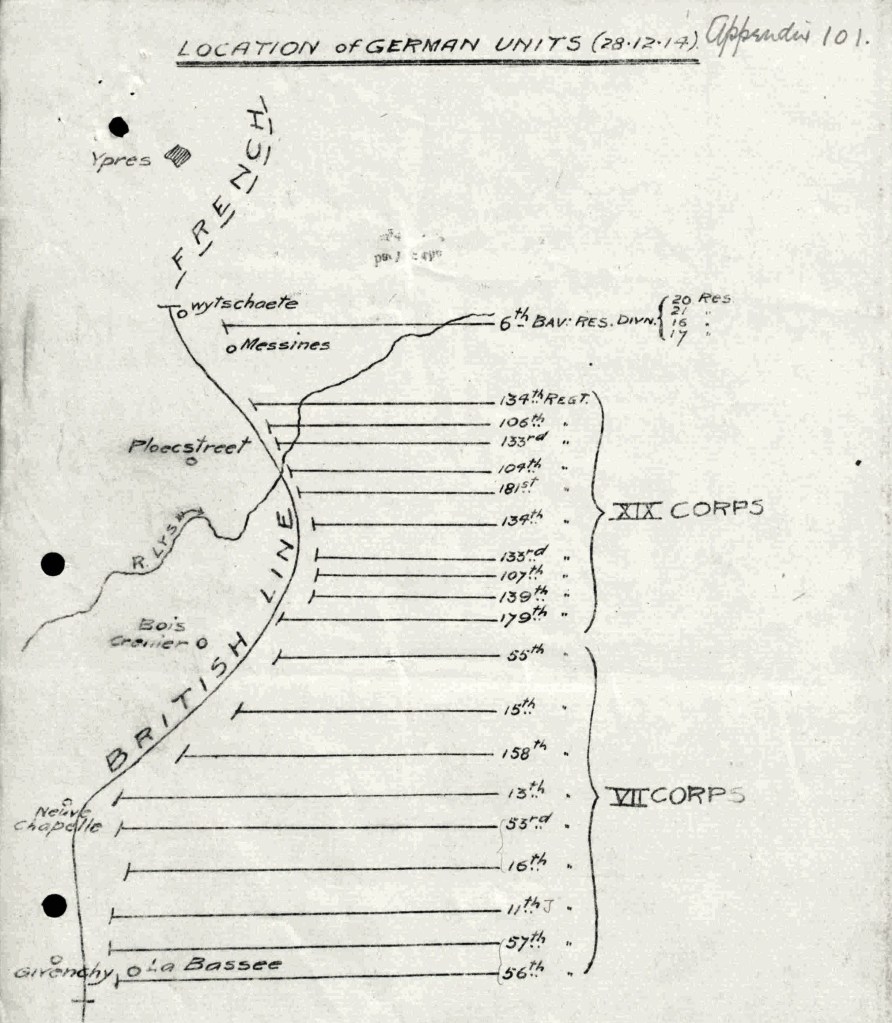
The benefit of the Truce to the opposing intelligence services is shown by this British map compiled on 28th December showing every German regiment facing its troops (7 Division GS War Diary, UK National Archives WO 95/1634).

The Legacy of the Christmas Truces

Small, isolated truces took place on the Western Front in 1915, 1916 and even 1917 but they were never on anything like the same scale as in 1914. After the war, the idea that it could have ended at Christmas 1914 was expressed by some who experienced the Truce. Major Murdoch McKenzie Wood, a Member of Parliament who had taken part serving with the Gordon Highlanders, stated in the House of Commons in 1930 that, if it had been left to the men at the front, ‘there would never have been another shot fired… it was only the fact that we were being controlled by others that made it necessary for us to start trying to shoot one another again.’ [30] There is little evidence from the time of this view, either from those at the front or at home. In January 1915, a Manchester Guardian editorial replied on behalf of liberal opinion to the question why the men had gone back into their trenches and were, as the newspaper put it, ‘hard at it again, slaying and being slain’: the answer was that ‘there was very much to be done yet – that Belgium must be freed from the hideous yoke that has been thrust upon her…’ This view was shared by most British soldiers in the trenches, not to mention Belgian and French. One former soldier, asked in 1981 whether, if they had had their way, they would have stopped fighting and gone home was adamant that they would not:

We all wanted to win the war and to see the Germans beaten. It was all right just having the truce and meeting the Germans, but as for ending the war, no, that was quite out of the question. In any case we all expected the war would end next spring… [31]

Perhaps the nearest thing to a consensus among soldiers on both sides is that, although they may not personally have hated their enemies, the Truce was only a temporary cessation of fighting. Most were convinced of the rightness of their cause and believed that the quickest way to end the war was to beat their opponent.
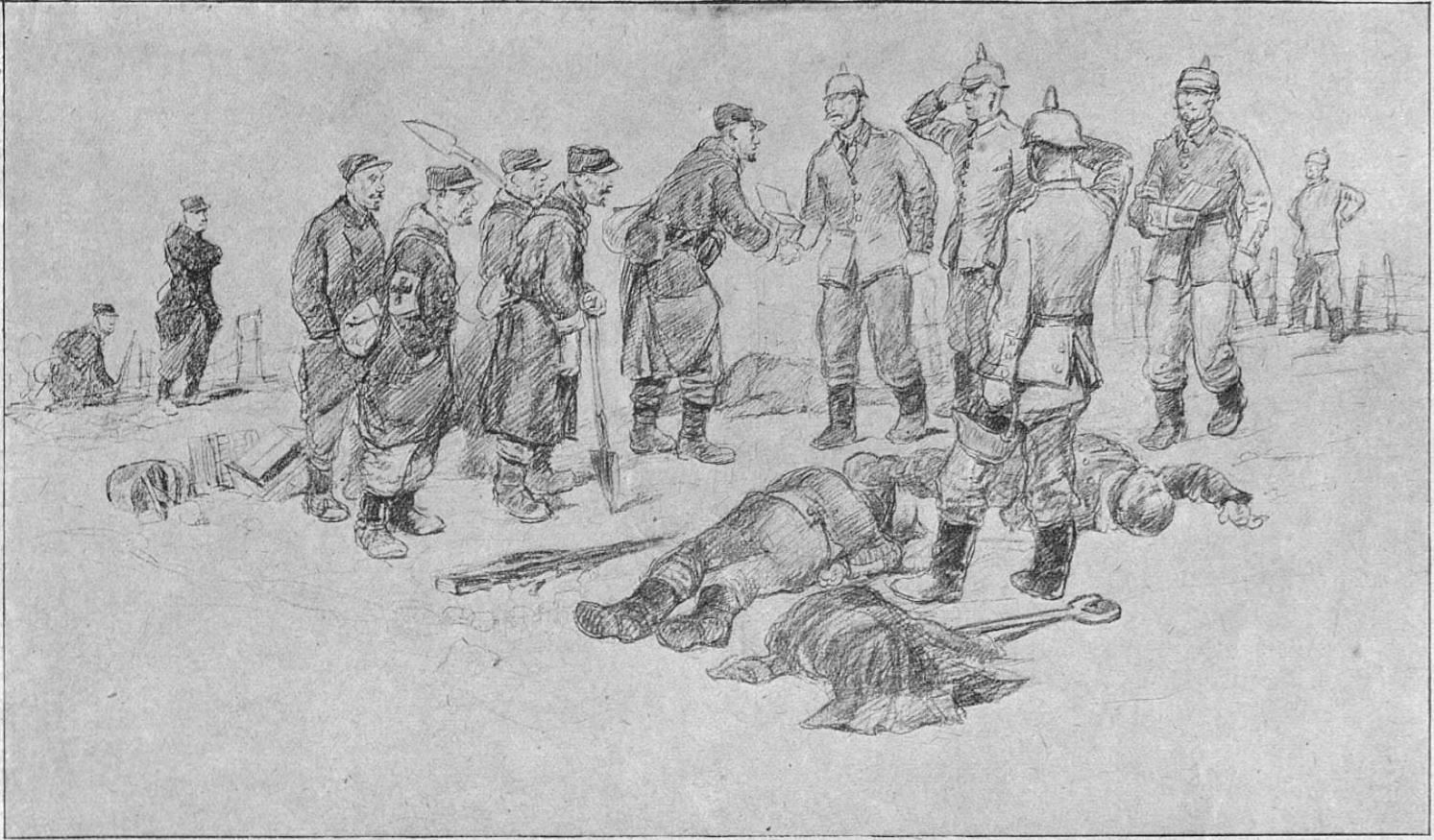
The Graphic January 30, 1915p21-Christmas Truce

Full fraternisation between French and German troops was rarer. This encounter between soldiers burying their dead in no man’s land on Christmas Day, when they briefly shook hands, saluted and exchanged cigars, was described by Emile Barraud of the 39th Regiment to an artist from The Graphic (30 January 1915).

One man who not surprisingly abhorred the Truce was a twenty-five-year-old Corporal in the 16th Bavarian Reserve Infantry Regiment named Adolf Hitler, at least according to the testimony a fellow soldier from 1940. Men from the future Fuhrer’s regiment almost certainly played football with the Norfolk and Cheshire Regiments but Hitler’s duties as a runner at regimental headquarters seldom took him right into the front line. [32] Two and a half miles to the south of Hitler’s Regiment, a nineteen-year-old Henry Williamson did fraternise with the other side. The disconnect between the preceding violence and suffering, and the warmth and fellow feeling of the Truce seemed so unreal to the young soldier as to leave him troubled for the rest of his life. The realisation that both sides thought that they had God on their side and were fighting for right, led him to believe that future conflict could be avoided with the elimination of misunderstandings between the peoples of different nations. A mistaken belief that Hitler had participated in the Truce led Williamson to conceive a misguided sympathy for him which contributed to his support for fascism. [33] In 1946, still deeply troubled by the Christmas Truce, he embarked on what became a cycle of fifteen novels in an attempt to understand his experiences before, during and after the war.

The Christmas Truce, and especially the role played by football, is an object lesson in the interpretation of historical sources, in particular in distinguishing between hearsay and direct eyewitness accounts. The Truce, like many historical events, has been used to support whatever interpretation of the past suits a particular view of the present. The fanciful presentation of the Truce, in drama, literature, popular history and journalism, shows that we need to step back from contemporary preoccupations if we are to gain historical understanding and that, if we want our history to be ‘relevant’, it probably won’t be good history. One soldier looked back on the 1914 Christmas Truce as ‘just a happy dream.’ [34] He did not realize how apt his description was to be.

Scroll down for references © Simon Jones


Buy signed copies of The War Underground 1914-18 and World War I Gas Warfare (Osprey Elite Series)pxl_20240522_141416108-cr

John Nash Over the Top SimonJonesHistorian

‘It was in fact pure murder’: John Nash’s ‘Over the Top’


sawyer-spence

Understanding Chemical Warfare in the First World War


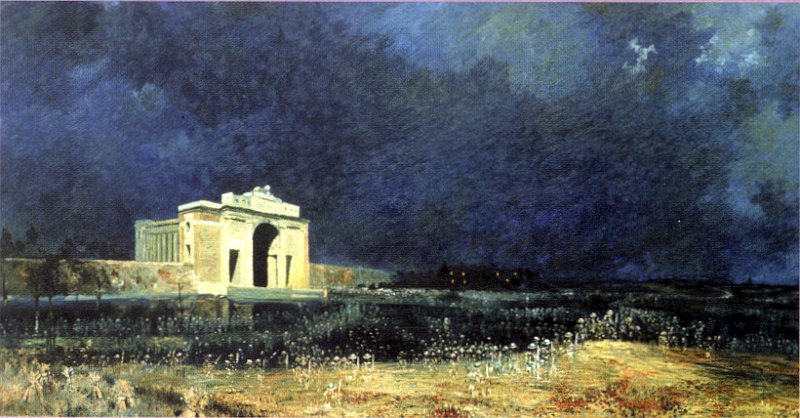
Menin_Gate_at_midnight_(Will_Longstaff)

‘Anon.’ no longer: the author of Menin Gate poem revealed


References:

  1. Private William Tapp, Malcolm Brown and Shirley Seaton, Christmas Truce the Western Front December 1914, (2001), p. 195.
  2. Brown & Seaton, op. cit., p. 36.
  3. John Ferguson, Brown & Seaton, op. cit., p. 61.
  4. Bruce Bairnsfather, Bullets and Billets, (1916), pp. 85-97.
  5. Second Lieutenant Ian Stewart, Brown & Seaton, op. cit., p. 64.
  6. Brown & Seaton, op. cit., pp. 65-66.
  7. Unnamed officer, Brown & Seaton, op. cit., pp. 67-68.
  8. Captain R. J. Armes, Brown & Seaton, op. cit., pp. 68-69.
  9. Bairnsfather, op. cit., p. 90.
  10. Edward Hulse, Brown & Seaton, op. cit., p. 92.
  11. Brown & Seaton, op. cit., p. 84.
  12. Arthur Pelham-Burn, Brown & Seaton, op. cit., p. 89.
  13. Brown & Seaton, op. cit., pp. 90.
  14. Brown & Seaton, op. cit., p. 138.
  15. Brown & Seaton, op. cit., p. 139.
  16. The Thetford and Watton Times, 13 February 1915. I was first alerted to this newscutting by Taff Gillingham who obtained it from the Norfolk Regiment Museum.
  17. Brown & Seaton, op. cit., p. 136. Niemann also described the football match in a history of his regiment written at the same time, J. Niemann, Das 9. Königlich Sächsische Infanterie-Regiment Nr.133 im Weltkrieg, 1914-18, (1968) p. 32.
  18. ‘Everywhere you looked the occupants from the trenches stood around talking to each other and even playing football.’ Brown & Seaton, op. cit., p. 136.
  19. Chris Baker, The Truce the Day the War Stopped (2014), p. 161.
  20. The Times, 1/1/1915, p. 3; The Carlisle Journal, 8/1/1915 quoted http://www.christmastruce.co.uk/cumbria/.
  21. Baker, op. cit., p. 162.
  22. Taff Gillingham, pers. comm. 15 December 2014.
  23. Bairnsfather, op. cit., pp. 85-97.
  24. ‘The American Magazine’, December 1929, p. 145 (I am grateful to Paul Baggaley for drawing my attention to this source); http://www.cbc.ca/player/play/2448571386 (accessed 8/11/2016).
  25. George Darrell Jeffreys, Brown & Seaton, op. cit., p. 104.
  26. Billy Congreve, Brown & Seaton, op. cit., p. 104.
  27. C. E. M. Richards, Brown & Seaton, op. cit., p. 139.
  28. Tom Ingram, Brown & Seaton, op. cit., p. 192.
  29. Frank Richards, Brown & Seaton, op. cit., p. 154.
  30. Brown & Seaton, op. cit., p. 190.
  31. Graham Williams, Brown & Seaton, op. cit., p. 192.
  32. Heinrich Lugauer, Thomas Weber, Hitler’s First War (Oxford, 2010), p. 63.
  33. Brown & Seaton, op. cit., p. 193.
  34. Leslie Walkington, Brown & Seaton, op. cit., p. 192.

    EB-Literary Executors for the Vera Brittain Estate, 1970 and The Vera Brittain Fonds, McMaster University Library-CropBWenh

    Where and how was Edward Brittain killed? The death in action of her brother Edward, in Italy in June 1918, forms the final tragedy of Vera Brittain’s memoir Testament of Youth.


    joe-cox-and-tom-hodgettsres

    Shirebrook Miners in the Tunnelling Companies


    Vincent Faupier19698175Res

    Who was Ivor Gurney’s ‘The Silent One’? The night attack by the 2/5th Glosters on 6-7 April 1917


Yellow Cross: Measures to protect against Mustard Gas

As a follow-up to my post on the introduction of mustard gas I have provided some details of the means that could be taken to protect against the weapon.

During the first three weeks after its first use on 12-13 July 1917, around 14,000 British soldiers were admitted to Casualty Clearing Stations affected by mustard gas. Of this number, 7,797 were Fifth Army casualties from the Ypres Salient.  This was more casualties than had been suffered by the British from gas shelling during the entire previous year.  Owing to the length of time required for recovery, more than three quarters had to be evacuated to hospitals on the lines of communication.

Mustard Victim 1

A British victim of the first mustard gas attack, recorded five days after exposure, this man was suffering from slight laryngitis and bronchitis but his eyes and skin were affected, the latter in areas of perspiration. W. G. MacPherson (ed.), History of the Great War Medical Services Diseases of the War, Vol. II, plate VI.

The British found unexploded shells marked with a yellow cross the morning after the first bombardment and within three days scientists, at the British Expeditionary Force’s (BEF) Central Laboratory at Helfaut, identified the contents as mustard gas.  Rapid treatment and secrecy prevented mustard from having a fatal effect on British morale.  Limited detection was possible from the smell of garlic or mustard and, until the Germans modified the shells, the distinctive ‘plop’ sound of their bursting.  Mustard gas evaporated in sunlight and, after a night bombardment, might not be noticed until sunrise when the vapour became dangerous.  In winter it could lie dormant for several weeks.  Those affected might not know they were contaminated for several hours, feeling no pain until conjunctivitis and skins lesions appeared, the sweaty parts being affected worse.

Mustard Victim 2

A British mustard gas victim recorded eleven days after exposure showing the effects of sitting on contaminated ground. This man’s injuries healed in three weeks. W. G. MacPherson (ed.), History of the Great War Medical Services Diseases of the War, Vol. II, plate VII.

Powdered chloride of lime became the standard means of removing mustard gas and was scattered over the shell craters and areas where the shells had burst.  The chloride of lime then had to be covered with clean earth both to camouflage it and because the smell prevented the detection of further mustard.  It was used in solution to wash guns, trees, etc which had been splashed.  Clean uniforms had to be issued immediately.

The French had already attached a pharmacist to each unit for anti-gas duties and in response to mustard created battalion and battery decontamination squads.  However, the affected areas were often so extensive that there was insufficient chloride of lime: the teams therefore had to choose the key points to treat, and prohibit access to others.  In late August fatigue uniforms impregnated with oil were issued while special overalls treated with boiled linseed oil and dyed horizon blue, impregnated gauntlets, and trench boots were developed.  The British were unimpressed by the French anti-mustard gas clothing, finding that neither the gloves nor the boots would keep out mustard.  They devised hooded overalls of black oiled cloth but the BEF Army Chemical Advisers did not consider that the amount of injury suffered from mustard gas warranted special clothing and concentrated instead on training and discipline.  Skin blistering could sometimes be prevented by directly applying chloride of lime and Britain, Germany and France all developed anti-mustard gas ointments, the French version Pommade Z comprising 10% chloride of lime in Vaseline.

Member of a French mustard gas decontamination squad, with oil impregnated overalls, ARS respirator and Vermorel sprayer containing chlorine of lime. © Simon Jones

German mustard shelling became intense with the series of offensives beginning in March 1918, and during the period of withdrawal of September – October when the British suffered 3-4,000 casualties per week.  Special clothing was again issued by the British from March but it was seldom possible to have it available when needed.  The USA ultimately developed the most extensive measures for both protection and decontamination in the form of mobile shower units.  Germany lacked the resources to produce either adequate protective clothing or replacement uniforms.  As the Allies began to use mustard, this presented Germany with a potentially disastrous situation.

e001540690CROP

Memorandum by the Chemical Advisor to the Canadian Corps, 27 September 1917, expressing concern that men were deliberately contaminating themselves with mustard gas. (Library and Archives Canada http://data2.collectionscanada.ca/e/e062/e001540690.jpg)

Chemical weapons added novel ways to the already horrific means of injury and death during the First World War.  Morale, discipline and training were major factors in combating mustard gas.  The non-permanent nature of mustard injury led the Chemical Advisor to the Canadian Corps to report at the end of September 1917 that he believed men were deliberately exposing their eyes to mustard in order to gain a few weeks rest in hospital.  Tens of thousands of Allied soldiers were hospitalised for months with mustard gas.  Yet mustard gas presents a paradox because the mortality rate was far lower than for any other weapon and, by being kept away from the fighting at a time when casualty rates were extremely high, mustard gas will actually have saved the lives of many of its victims.

British_55th_Division_gas_casualties_10_April_1918[1]

British troops temporarily blinded by mustard gas at an Advanced Dressing Station at Béthune, 10 April 1918. The Germans bombarded areas north and south of the Lys attack area on 7 – 9 April to cut off support from the flanks. Note the soldiers in the background staring at the casualties (Wikimedia Commons/ Imperial War Museum).

Further reading

Simon Jones, World War I Gas Warfare Tactics and Equipment, (Osprey, London 2007).

W. G. MacPherson (ed.), History of the Great War Medical Services Diseases of the War, Vol.  II, (HMSO, London, 1923).


Join me on a battlefield tour with The Cultural Experience:

Simon Jones Battlefield Tour Somme Poets 2019

The Tank War 17th-20th May 2025

The Battles of the Marne and Aisne 6th-11th September 2025

Mons and Le Cateau 31st August – 3rd September 2025

More Information about Battlefield Tours


German Yellow Cross mustard gas shell for 105mm howitzer.

Yellow Cross: The advent of Mustard Gas in 1917


Sawyer Spence (1)

Understanding Chemical Warfare in the First World War


Simon Jones, World War I Gas Warfare Tactics and Equipment


Contact me

Facebook

LinkedIn

Yellow Cross: the advent of Mustard Gas in 1917

In July 1917, on the eve of the Third Battle of Ypres, the Germans introduced two new chemical weapons to the battlefield. One was a failure, the other a spectacular success. The story of their use illustrates one of the lessons of chemical weapons from the First World War: the impossibility of predicting how they would behave in the field.[1]While gas played a comparatively minor role on the battlefield in 1916, it would become ubiquitous by the end of the following year. Chemical warfare in 1917 was characterised by the British introduction of a new and effective means of delivery for chemical agents, the Livens projector, and by the German introduction of a new agent for artillery shells, mustard gas. This article focuses on the introduction and impact of mustard gas.

All the combatants used colour-coded markings on their shells, and the Germans used a system to simplify the complex varieties of chemical fillings according to their function. The existing diphosgene shells and others containing lethal lung irritant gas, which might dissipate in a few hours and was regarded as non-persistent, were marked with a green cross. In July 1917 as British preparations for the Third Battle of Ypres were underway, the Germans introduced two new chemical agents, neither of which can accurately be described as a gas.

Blue Cross Shell

German Blue Cross shell for the 77mm field gun, showing the glass bottle containing the chemical embedded in the explosives.

The first was diphenyl chloroarsine, or Blue Cross. The concept of these shells was not in themselves to cause death or injury, but to penetrate respirator filters with a fine particulate dust, causing uncontrollable sneezing and coughing which would force the wearers to remove their respirator and succumb to lethal diphosgene shell. The ‘mask-breaker’ shells were coded with a blue cross. If effectively disseminated, the arsenic dust could cause intense pain to the sinuses and mental depression. However, two factors served to diminish the effect of these shells. Firstly the Germans chose as their method of dissemination to embed a glass bottle containing the powder in a high explosive shell and this rarely produced particles fine enough to penetrate the British respirator filters. Secondly, the British had already introduced this concept with stannic chloride and, between April and June 1917, had issued a particulate filter as an extension for their respirator to protect their own troops in the Ypres Salient. Moreover, they had under development a new filter box incorporating the filter which they began issuing in July. The Blue Cross shells however had the advantage of being effectively indistinguishable in flight and detonation from normal high explosive shells, thus soldiers had no warning of the bursting of the shells and might succumb before they could adjust their masks.

Strandfest: the first use of Blue Cross at Nieuwpoort, 10 July 1917

The Germans introduced Blue Cross shells during their operation to retake the bridgehead at Nieuwpoort (Nieuport) from which they rightly suspected that the recently-arrived British were to launch an operation along the Belgian coast. They amassed 146 artillery batteries for this small, local action, under the codename Strandfest (which might roughly translate as ‘Beach Party’). Because of bad weather, the attack date was shifted several times, until early on 10 July orders were issued for a ten-hour preparatory bombardment to commence at 10am. In addition to diphosgene (Green Cross) and tear gas shells, the British reported another type which burst like a high explosive shell but caused sneezing, slight irritation of the nose and eyes, and tightness of the chest. At 8pm, the German 3rd Marine Division stormed the British positions and threw them back over the Yser. Despite taking 1,250 British prisoners, the Germans were apparently unable to establish how useful the new Blue Cross shells had actually been in achieving the success.[2]

In order to obtain evidence of the effectiveness of both the Blue Cross shells and the method of combining them with Green Cross, the Germans staged a major raid on 28 July at Wytschaete, south of Ypres. Code-named, Heuernte or ‘Hay Making,’ the operation involved a bombardment of British positions at 10.40pm for six minutes by nine light field howitzer batteries with 100 rounds each of Blue Cross ammunition. This was followed by 14 minutes with high explosives after which five raiding parties entered the British trenches. They found, however, that the British had withdrawn from the shelled area and no prisoners were obtained.

British investigations following the 10 July attack where also inconclusive. There were reports of the new symptoms but they were unable to recover an unexploded shell in order to identify the filling until early August. The more dramatic use of mustard gas, which occurred shortly afterwards on the night of 12-13 July, also delayed investigation into the Blue Cross shells.

The development of Mustard Gas

While Blue Cross was developed as an attack ammunition for use in conjunction with Green Cross, mustard was adopted as a defensive agent which was suitable for the continuous poisoning of an area. Mustard gas, dichlorodiethyl sulphide, is in fact an oily liquid with a low boiling point, given the name mustard gas by the British owing to its odour of mustard or horseradish in its impure form. It was to become the most effective chemical agent used during the First World War owing not to the numbers which it killed but to the temporary effects of skin blistering and severe conjunctivitis and to its ability to render ground uninhabitable owing to the time which it took to evaporate. Its effect on the skin was noted by Viktor Meyer in 1886 and both the British and French considered adopting mustard in 1916 only to reject it on the grounds of its lack of toxicity. Professor Ernest Starling, in charge of British anti-gas research, had ordered experiments on cats in 1916. However, the persistency of mustard, that is, the way that it continued to poison for hours or days after release, was not noticed and the range being only that of a bursting shell, it was turned down.

The Germans named it ‘Lost’ after the names of the proposers in 1916: Dr Wilhelm Lommel at the Bayer research laboratories and Dr Wilhelm Steinkopf at the Kaiser Wilhelm Institute. Trials were carried in September and October 1916 out by Doctors Ferdinand Flury and Curt Wachtel, toxicologists at the Kaiser Wilhelm Institute. Their test results on monkeys demonstrated eye and respiratory injury but made no mention of skin symptoms. Wachtel later described how, in late 1916, mustard came to be adopted. [3] The head of the Kaiser Wilhelm Institute for Physical Chemistry and also head of the German chemical warfare programme, Fritz Haber, learnt from the German commanders Hindenburg and Ludendorff that they required a defensive gas suitable for preventing Allied attacks expected in the summer of 1917. Haber was able to propose the newly-tested mustard gas which would remain dangerous for long after the gas shell then in use had dissipated, and industrial production was initiated. Haber’s son, L F Haber, however suggests that, while mustard was selected because of its persistency, its effect was still expected to be as a lethal lung-irritant rather than the non-lethal casualty producer that it in fact turned out to be: ‘No one appears to have remembered that Meyer, thirty years earlier, had written of its blistering action.’[4]

The lack of lethal effect was in fact noted before it was used in the field, according to Wachtel, following a serious explosion at the Adlershof gas shell filling plant, near Berlin, in the spring of 1917. Occurring after the first 1,200 77mm shells had been prepared, this explosion delayed the first use of mustard by several weeks. But a lack of casualties during the fire fighting and clean up led to claims that it was not sufficiently toxic which had to be refuted with further toxicology tests. A trial was conducted in which 500 mustard shells were fired on a test range on which several hundred cats and dogs were tethered. Before its use in the field, mustard was dismissed by most gas warfare experts as being the best means to kill cats but not as a war gas. [5]

German Yellow Cross mustard gas shell for 105mm howitzer.

German Yellow Cross mustard gas shell for 105mm howitzer.

The First Mustard Gas Bombardment, 12-13 July 1917

The new shells were marked with a yellow cross to indicate their persistency. The first bombardments which the Germans carried out at Ypres were clearly intended to forestall the British offensive. From the start, mustard was a defensive agent, used to poison areas of ground over which the Germans had no intention of attacking in the foreseeable future. Some 50,000 shells, containing 125 tonnes of mustard, were used on this first night. [6] The bombardment, with 77mm and 105mm shells, was in three phases apparently reflecting the way that non-persistent gas clouds were created and topped up using shells: starting at 10.10pm for twenty minutes, it resumed at 12.30am, again for twenty minutes, followed by a third phase at 1.55am for twenty-five minutes.[7]

On detonation the shells, bursting with a dull plop, sprayed the liquid in a seven-metre radius in the case of the 77mm and about 10 metres in the case of the 105mm.[8] Contact with either the liquid or the vapour, which evaporated in sunlight, caused injury. However, the lack of any immediate symptoms meant that British troops did not keep their masks on and did not appreciate the danger of being present in the vicinity of the shells. At first those in the bombardment suffered only slight irritation of the nose which caused some sneezing (perhaps the result of Blue Cross shells). However, in an hour or two they suffered painful inflammation of the eyes, vomiting, followed by reddening of the skin and blistering.

45 Bde WD 12 July 1917

The first mustard gas bombardment reported in the War Diary of the 45th Infantry Brigade, 12 July 1917. (The National Archives, WO95/1943)

Large numbers of British casualties began to report to medical units to the rear of Ypres. The first were admitted to Numbers 47 and 61 Casualty Clearing Stations at Dozinghem (near Poperinge) and Numbers 46 and 64 at Mendinghem (near Proven) and on 13-14 July a total of 2,143 were admitted to these four units. By the time they reached the Casualty Clearing Station the conjunctivitis had developed so rapidly that they were virtually blind and had to be led in files, each man holding on to the man in front, guided by an orderly or lightly wounded man.

British_55th_Division_gas_casualties_10_April_1918[1]

British mustard gas casualties at an Advanced Dressing Station, April 1918 (IWM Q 11586).

In the first few hours the symptoms were in strong contrast to those usually found in gas cases, with only one or two casualties suffering from symptoms of acute pulmonary oedema (again this was possibly caused by Green Cross shells mixed with the new shells). The majority suffered little distress to their breathing, although some exhibited a husky voice and a hard cough. After a few more hours, symptoms of laryngitis, tracheitis and bronchitis became more definite in a large number of the cases and some developed grave or fatal broncho-pneumonia. [9]

Men developed blisters on their buttocks, genitals and armpits. Within two days many were suffering from bronchitis and some had died from inflammation of the lungs. By the sixth day the conjunctivitis which caused the blindness had disappeared but the breathing difficulties were still severe and the blistering had been replaced by skin rashes. Of the 2,143 cases admitted to the four Casualty Clearing Stations, a comparatively small number, 95, or 4.4%, died. German unit histories report that the British guns were all but silenced for up to two days.

c080027 C-080027

Canadian victim of mustard gas at No.7 Canadian General Hospital, Etaples, c. 1917 (Library and Archives Canada/ Wikimedia).

Up to the end of July, the Germans bombarded the Ypres area every night with mustard, during which the Germans gunners had to surround their own gun positions with chloride of lime as a precaution against leaks or premature bursts of the shells. In addition, a series of set-piece gas shoots were conducted. On 15 July a ‘multi-coloured’ shoot of a thousand rounds was carried out which, despite barrel bursts, was repeated the following day. Then, on 17th and again on 21st, more extensive gas shoots were carried out on tracks, shelters and accommodation at Zillebeke Lake.

On the night of 20-21 July Blue and Green Cross were again tried in combination in an operation called Britentod or ‘British death,’ postponed from the previous night owing to strong winds. British battery positions at Voormezele were targeted, each German field battery having been issued with 900 rounds of Green Cross and each howitzer battery 350 rounds of Blue Cross. The bombardment, from 1am to 3am, completely silenced the British batteries although no mention is made of mustard having been used.

On the same night, in an operation called Totentanz, or ‘Dance of Death,’ Armentières was first targeted with mustard gas, injuring about 6,400. The following night, 21-22 July, Nieuwpoort was heavily bombarded with mustard, thus the south and north flanks successively of the expected British attack area were rendered impassable. The casualties were worse overall than those suffered at Ypres as the troops here had not yet received adequate warning and instructions regarding mustard gas.

On 23-24 July, Britentod was repeated, then on 26-27 gas bombardments in the Wytschaete sector named Schlesien and Apolda. On 28-29 July, renewed gas bombardments of Armentières and Nieuwpoort were carried out between 1am and 4.30am. The civilian casualties from mustard gas in Armentieres totalled 675, of which 86 had died by 18 August, a high mortality due in part to the number of elderly citizens, many living in cellars, who were either unable or reluctant to leave the area while the shelling was in progress.

From July, Blue and Yellow Cross shells were used in very large numbers with a reduction only coming in the winter of 1917-18. Once the Germans had identified the improved protection afforded by the British respirator against Blue Cross, they came to use these shells at the beginning of a gas bombardment, as the shells could not be distinguished from HE shell. The sneezing symptoms would therefore affect men before they could adjust their masks and then cause them to succumb to Green Cross shells used subsequently. HE or Blue Cross shells were also used to disguise the distinctive bursting sound of Yellow Cross mustard gas shells.

During August and September 1917, the Germans used mustard to defeat French attacks on either side of the river Meuse, causing 13,158 to be poisoned and 143 killed. Losses were so great in the affected areas that it has been claimed that the French were forced to abandon the attack.[10] The combination of Green and Blue Cross shells, used for the first time to support the attack at Nieuwpoort on 10 July, was later used for the successful German assault across the Daugava river on 1 September 1917 which lead to the fall of Riga. The artillery fire plan was the work of Colonel Georg Bruchmüller and the publicity accorded it has led some to assume incorrectly that Bruchmüller invented this combination of gas shells, called Buntschiessen or ‘colour shoots’.

Mustard gas caused serious casualties to the British in July 1917 but there seems to be no evidence to support the claim by Beumelburg and Hanslian that it caused the start of the 3rd Battle of Ypres to be postponed for a fortnight.[11] Hanslian and Seesselberg claimed also that it prevented a British break-though during the offensive. However, whilst mustard continued to be used throughout the battle, it was not used to cover the withdrawal of German forces as it would be in 1918, as they could not contaminate ground which they would wish immediately to recapture. Although the Germans improved slightly the effectiveness of their Blue Cross shells, the Allies regarded them as a wasted effort, something that post-war German writers could not accept.

Conclusion: Yellow Cross in 1918

The year 1918 was to see the development of German gas tactics, in particular the use of the persistent mustard gas to block the flanks of areas attacked. The Germans used gas shells in unprecedented numbers and they were integral to their spring and summer offensives. Against infantry, the Green Cross diphosgene and Blue Cross combination was 50% of the total shells used. Against artillery, the ratio was as high as 80% mustard to high explosive. Areas outside the attack zone were heavily shelled with mustard to prevent counter attacks. Mustard was extremely effective as a counter-battery weapon and British decontamination measures broke down. At one point in 1918 the British had the equivalent to two divisions in hospital suffering from mustard gas injuries. However, gas was less effective during the June – July offensives: attacking in gas masks behind a gas barrage was especially fatiguing for the Germans, while Allied casualties were decreasing.

For the remainder of the year, the Germans were in retreat and mustard was to prove far more suited to defence than attack. On 31 July 1918 they used 340,000 mustard gas shells to forestall a Franco-American attack west of Verdun. During September – October British mustard gas casualties were 3 – 4,000 per week but as the British advanced continued, German bombardments became less effective and poorly targeted. It was impossible for the Germans to create their complex fire plans as supply and command became disorganised. When the Allied advances began, the Germans discovered that French troops were less hindered by mustard having learnt to minimise casualties when passing through affected areas. Supplies of mustard were less plentiful by September and during October gas ceased to be a factor in halting the Allied advance.

The cases of both Blue Cross and Yellow Cross shells demonstrate that chemical weapons rarely behave on the battlefield in ways predictable in the laboratory or on the firing range. Nevertheless, the German use of mustard was rightly regarded as a military success. Despite apparently intending its effect to be as a lethal lung irritant rather than a non-lethal casualty producer, mustard revolutionised chemical warfare, and introduced an agent which almost alone amongst the chemical weapons of the First World War has continued application into the 21st century. Until the introduction of mustard, the artillery arm, by far the most flexible means of using gas, had been handicapped by the lack of an agent effective enough in the smaller quantities delivered by shell. By its persistent nature mustard provided this. The German unity of research, production and military expertise, embodied in the person of Fritz Haber, meant that the right substance was available to meet the military demand.

The introduction of mustard gas however was a gamble for Germany. A physicist at the Kaiser Wilhelm Institute, Wilhelm Westphal, claimed that when Haber described mustard gas to General Ludendorff, he warned against its use unless the war was certain to be won within the year. Otherwise the Allies would produce mustard for themselves and Germany lacked the Allies’ ability to replace contaminated uniforms. This alone, he said, could lose the war for Germany. It did take the Allies a year to produce their own mustard gas, achieved by the French through accepting casualties in their factories comparable to those at the front. Westphal’s anecdote may be apocryphal but when the Germans identified French-produced mustard in August 1918, this awareness that the Allies would probably soon be using it on a large scale was one more reason why the Germans would be unable to continue fighting in 1919.

Text (c) Simon Jones. See below for Notes.


???????????????

Yellow Cross: Measures to protect against mustard gas


Join me on a battlefield tour with The Cultural Experience:

Simon Jones Battlefield Tour Somme Poets 2019

The Tank War 17th-20th May 2025

The Battles of the Marne and Aisne 6th-11th September 2025

Mons and Le Cateau 31st August – 3rd September 2025

More Information about Battlefield Tours


sawyer-spence

Understanding Chemical Warfare in the First World War


Notes on Yellow Cross: the advent of Mustard Gas

[1] This article is an extract from a paper delivered at the In Flanders Fields Museum in 2007 and is partially referenced. Contact me if you require more information on sources.
[2] W. Volkart, Die Gasschlacht in Flandern im Herbst 1917, (E S Mittler & Sohn, Berlin, 1957) p.46. The British Official History, J. E. Edmonds, Military Operations France and Belgium 1917 Vol. II, (HMSO. London, 1948), p. 119, mistakenly states that the Germans used mustard gas in the bombardment prior to this assault.
[3] Curt Wachtel, Chemical Warfare, (Chemical Publishing Co., Brooklyn, 1941), pp. 226-7.
[4] L. F. Haber, The Poisonous Cloud, (Clarendon Press, Oxford, 1986), p. 117.
[5] Wachtel, op. cit., pp. 221-2.
[6] Volkart, op. cit., citing Rudolf Hanslian, Der Chemische Krieg, (E S Mittler & Sohn, Berlin, 1937).
[7] Hanslian, op. cit., pp. 132-141.
[8] Volkart, op. cit., p.40.
[9] W. G. MacPherson (ed.), History of the Great War Medical Services Diseases of the War, Vol. II, (HMSO, London, 1923), pp. 292-293.
[10] Hanslian, op. cit., pp. 132-141.
[11] Hanslian op. cit., p. 140.