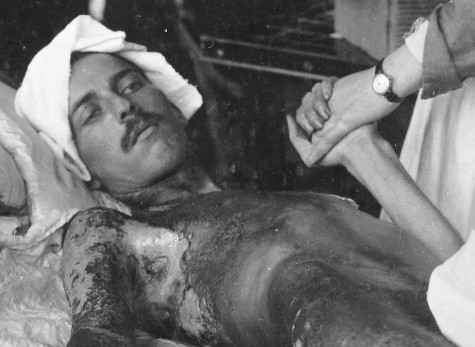
In August 1918, while waiting to advance east of Amiens, Sergeant Sawyer Spence unwittingly lay in a shell hole contaminated with mustard gas. Feeling no ill effects he only reluctantly agreed to be evacuated; only after 24 hours did medics realise that his uniform had been saturated by the oily liquid. By the time he reached a hospital twelve days later, in the converted pavilion of Nottingham’s Trent Bridge Cricket Ground, the whole of one side of his back and legs was septic and discharging pus, the result of massive blistering. He was the worst mustard gas case that the hospital had ever seen.

Sawyer Spence suffering extensive mustard gas blisters, Trent Bridge Hospital, Nottingham, 1918. © Jon Spence, used with permission.
Sawyer Spence was one of an estimated half a million chemical warfare victims of the First World War. The first were on 22nd April 1915 when the Germans released 150 tonnes of chlorine gas from their front line trenches north of Ypres in Belgium and allowed it to drift towards the French positions. It inspired some of the most powerful works of art and literature to come out of the First World War yet, since its shocking debut, our understanding of chemical warfare remains surrounded by a miasma of fear, emotion and propaganda.
Chemical weapons were outlawed at arms control conferences at the Hague in 1899 and 1907; despite being signatories, Germany, France and Britain all carried out research before the outbreak of war. When trench warfare atrophied into a vast linear siege, chemicals were high on the list of solutions to break the deadlock; substances that would not cause permanent injury, such as tear gas, were favourites. Germany was first, adding an irritant to shrapnel shells, and thus technically not breaking the Hague Agreement, but the British-Indian troops they were used against in October 1914 failed even to notice. In a second attempt, Germany fired tear gas in shells against the Russians near Bolimow in Poland in January 1915, was equally ineffective when in the cold the liquid failed to vaporise. France followed by issuing instructions in February 1915 for the use of an anti-riot tear gas cartridge at the front, again without particular success. Britain adopted a tear gas, ethyl iodoacetate, in January 1915 after it was identified by Jocelyn Thorpe, professor of organic chemistry at Imperial College, University of London, which was codenamed ‘SK’ after the South Kensington location. Thorpe claimed that the War Office was only convinced of SK’s effectiveness after a small boy was given a shilling to stand in a trench into which it had been released; in April 1915 the British government was still pondering its legality.

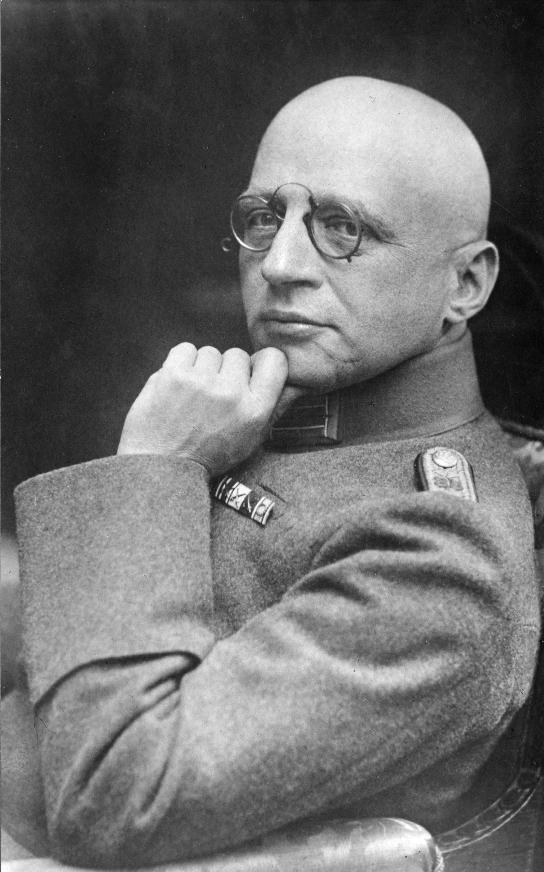
Fritz Haber, in the uniform of the 35th Pioneer Regiment.
Germany took the lead in chemical weapons thanks to her developed chemical industry and universities, but also because of the remarkable genius of Fritz Haber. The son of a dyestuff manufacturer, six years before the outbreak of war Haber made perhaps the single greatest chemical discovery of the twentieth century, for which he was to receive the Nobel prize for chemistry: the means of converting atmospheric nitrogen to ammonia. Fertiliser made using the Haber-Bosch process has produced food to increase the world’s population by an estimated one billion people; it has also facilitated the bulk production of explosives. Haber was the first Director of the Kaiser Wilhelm Institute for Physical Chemistry and in 1914 threw his immense energy and talent into his nation’s war effort. Vigorous and persuasive, he was responsible more than any other individual for the development of chemical weapons during the First World War. After the failure of the earlier attempts, Haber made a simple and direct proposal: readily available chlorine gas should be released from cylinders to be carried by a breeze over the enemy positions. If it was successful, the Germans believed that the Allies could not respond owing to their limited capacity for chemical production. Despite moral and military objections by two senior German commanders, the chief of the general staff, von Falkenhayn, decided that it should be tried at Ypres. A simple idea, in practice it was anything but. Carrying the heavy cylinders of chlorine into the trenches and concealing them was dangerous and difficult; when some were hit by shell fire the gas killed three of their own men and injured 50. The prevailing westerly wind placed the Germans at a disadvantage; it refused to blow in the right direction, or changed just as the attack was about to be launched. After a fruitless two week wait, the Germans had to reinstall 6,000 cylinders from the south of Ypres to the north but again twice more postponed when the wind was wrong.
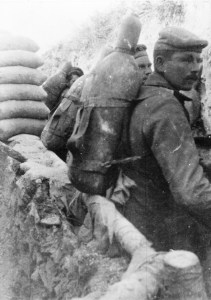
German troops carry poison gas cylinders to be installed in trenches. © Simon Jones
Finally, the order was given to release when it was ‘half-way favourable’; the troops assembled packed in the trenches throughout the 22nd April until, late in the afternoon, a southerly wind arose and orders were hurriedly issued to attack. The gas hissed from hundreds of pipes placed over the trench parapets and greenish-yellow clouds drifted across no man’s land towards the French positions; in most places, the gas quickly engulfed the trenches and the field guns close behind them. Reservist and North African troops had no means of protection; a powerful odour of bleach and fumes which stung the eyes were quickly followed by choking as they inhaled the gas. Most fled for their lives but the unlucky ones fell to the ground where the gas pooled. As the gas entered their lungs the mucous membranes produced fluid to flush away the irritation, oxygen transference was severely hindered and the victims began to drowned.

A French victim of the first chlorine gas attack. © Simon Jones
It should not have been a surprise to the Allies. At least two German soldiers deserted to the French before the gas attack, revealing detailed information and even producing rudimentary gas masks. Chemical weapons had achieved such negligible results that it was assumed the effects would be equally insignificant but it is cited as one of the great intelligence failures of history; when the name of one of the deserters was published in 1933, he was imprisoned by the Nazis and ultimately sent to Dachau concentration camp.
The Germans, moving cautiously for risk of succumbing to their own gas, gained two and a half miles by nightfall. It was the largest advance since the onset of trench warfare; but lack of troops and resistance on the flanks by Canadians and Belgians prevented them from exploiting the attack. In the captured French positions the Germans took thousands of prisoners, and found gas victims lying on their backs with fists clenched; but their own reports state that they found few dead. A doctor was told by a German officer, himself injured by chlorine, that he saw few French dead and most ‘had run away like a flock of sheep’. The number killed by the first attack, impossible to calculate, may still be somewhere between 800 and 1,400; a figure of 5,000 dead, grossly exaggerated by the Allies for propaganda purposes, is still reported as fact.
The response of the Allies was a mixture of real and artificial outrage; there was genuine anger that a barbarous and unchivalrous method should be used against their troops, and breaking the spirit if not the letter of the Hague Agreement. Chemical weapons nullified the romantic chivalric contest of equals that war was supposed to be but never has been. In this confused notion, to have an agreement and then break it almost seemed worse than if there had been no agreement at all. Paradoxically, an unrealistic notion of the degree to which warfare could be governed by humanitarian considerations may even have made matters worse by bringing about a swifter abandonment of restraint once the system collapsed. The Hague Agreement failed to prevent the use of chemical weapons because it did not anticipate what the war was becoming: a war of nationalism and ideologies, a war of hatred, a war to the death. There was also much inflated indignation to influence neutral American opinion; in this respect the chlorine attack was a propaganda gift to the Allies, as was the sinking of the liner Lusitania just 16 days later.
Many would subsequently express a more detached view on the relative distinction between chemical and so-called conventional weapons. The wartime officer, C. R. M. F. Cruttwell, later principal of Hertford College, concluded that ‘there is little to choose in horror and pain between the injuries inflicted by modern war. The extent to which the human body can be mangled by the splinters of a bomb or shell, without being deprived of consciousness, must be seen to be believed.’ J. B. S. Haldane, future Professor of Genetics at University College London, went further: injured by chlorine developing the first protective masks and shortly afterwards wounded in action, he maintained that the pain and discomfort from gas were ‘utterly negligible compared to those produced by a good septic shell wound’. A weapon which temporarily incapacitated such as tear gas, Haldane said, was ‘the most humane weapon ever invented’. Yet such views ignore the fact that there was nothing irrational about the terror felt by soldiers at being gassed; even the Army pathologist who specialised in gas cases felt that there was something particularly terrible about dying of suffocation from gassing. Coupled uneasily with outrage was the belief that the Allies must adopt such an apparently effective method without hesitation and not be hindered by misguided notions of honour if the enemy was not abiding by them. Five days after the first chlorine attack the British cabinet gave its consent for the Minister for War, Lord Kitchener, to fall ‘to the level of the degraded Germans’ and instructed him to ‘use anything he could get invented’.
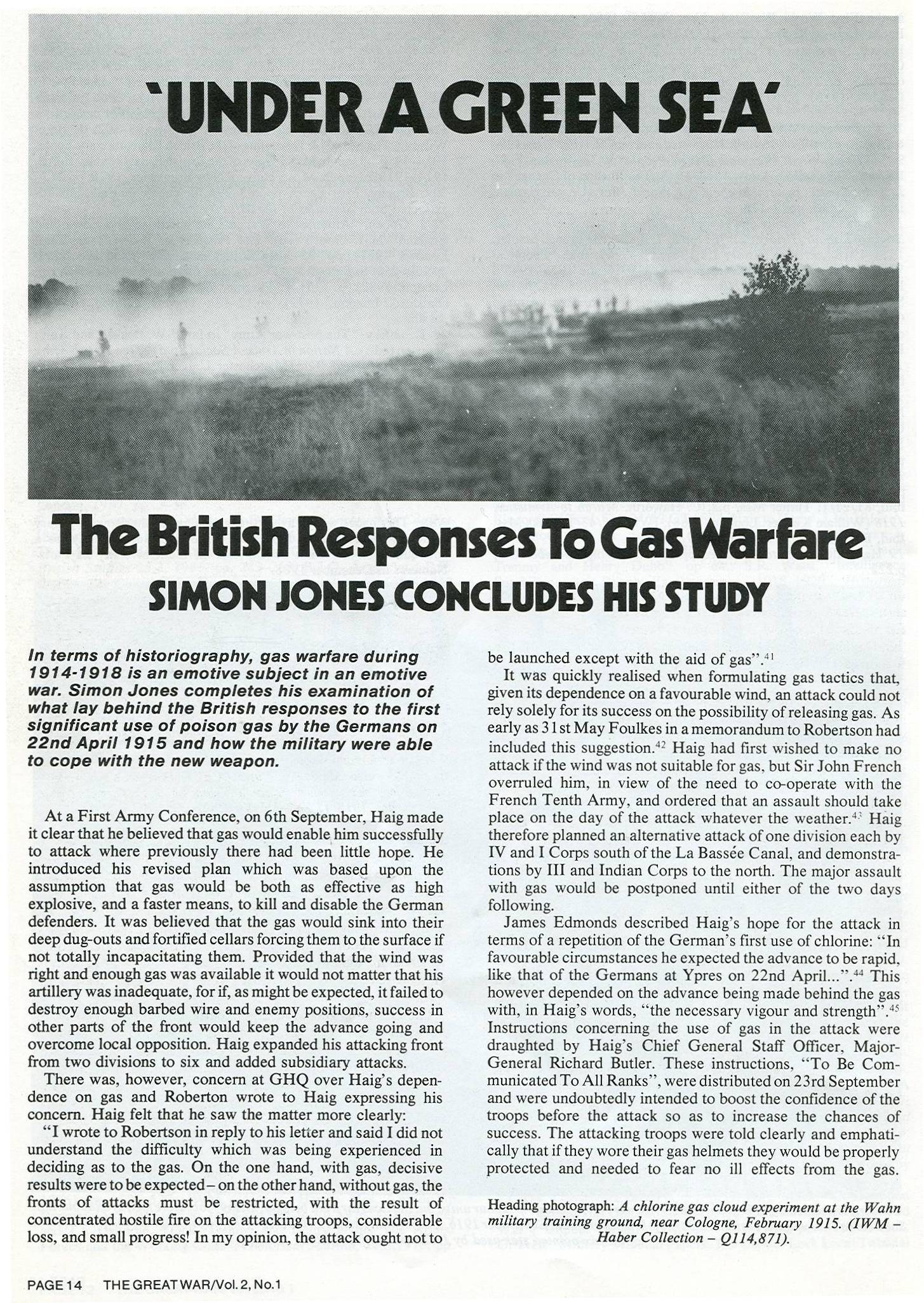
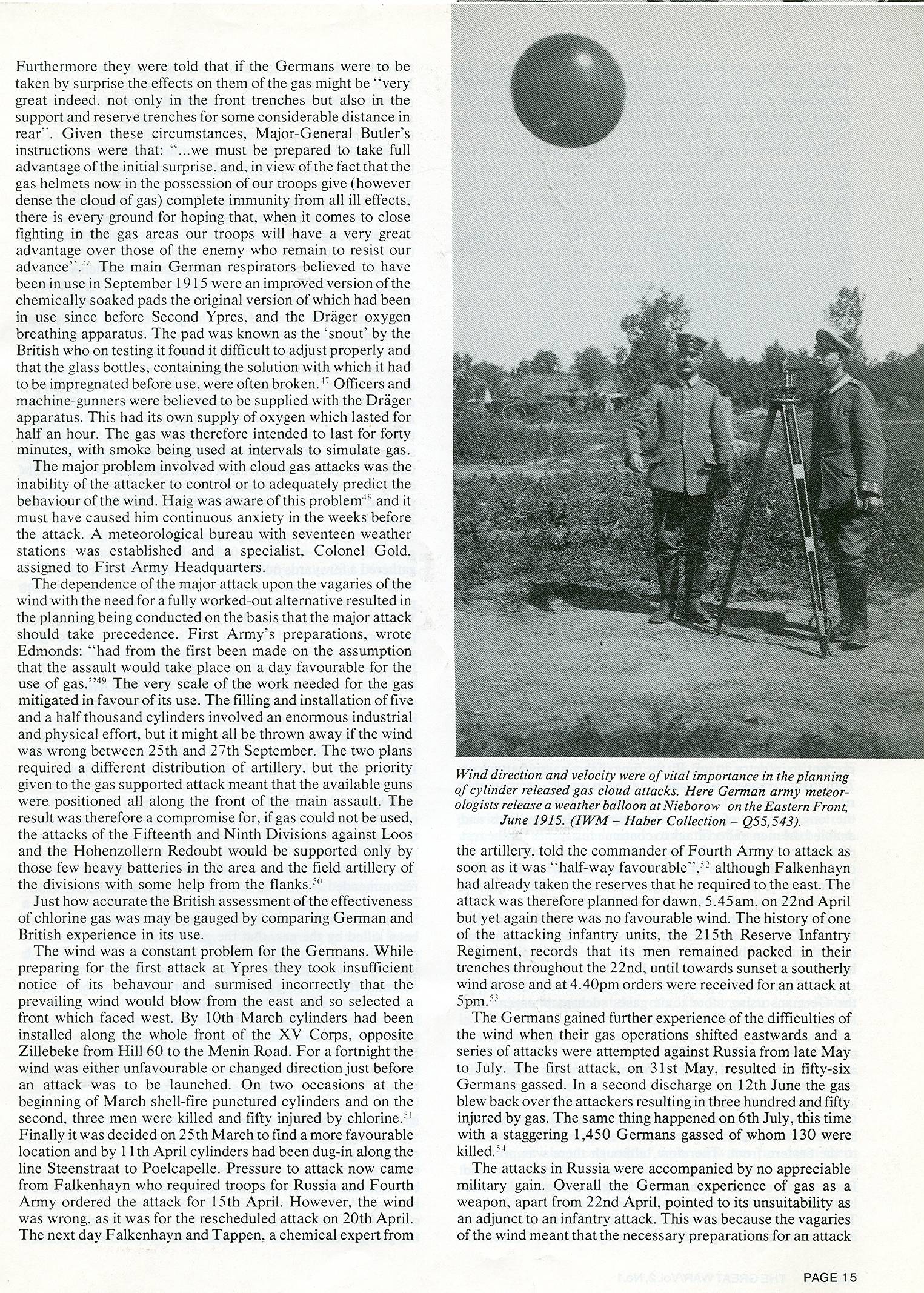
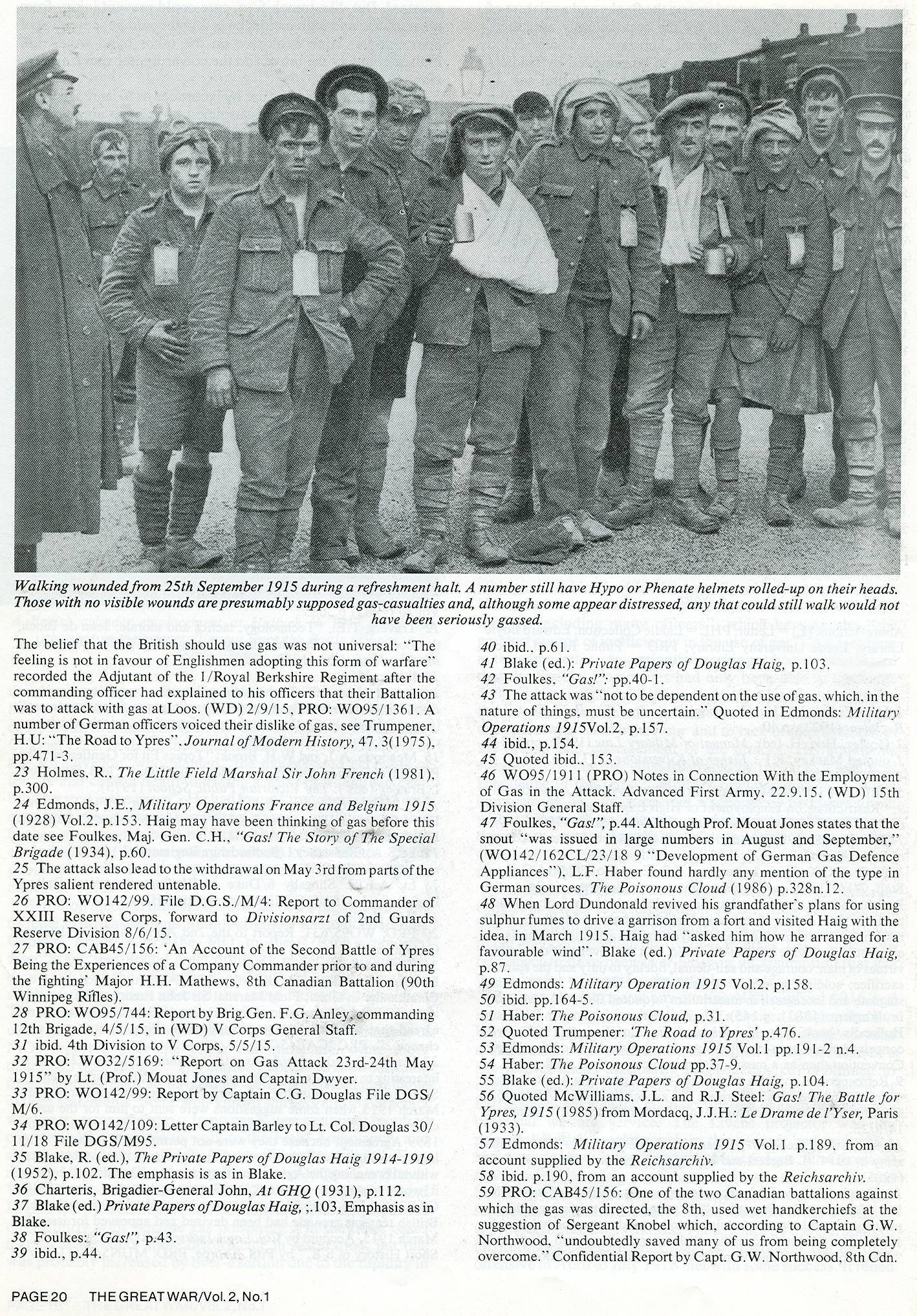
The method used at Ypres turned out to be of limited military value. Nine subsequent German chlorine attacks during the month-long Second Battle of Ypres were thwarted by the desperate resistance of British soldiers protected by rudimentary mouth pads soaked with neutralising solutions, including urine, which limited German gains to a few short lengths of front line trench. The Germans themselves suffered heavy casualties when the wind changed, which worsened when they tried it on the Eastern Front, and on one occasion 1,450 of their own men were gassed with 138 killed. But the chlorine attacks had a profound impact on the British, seemingly unaware of the difficulty of coordinating the massed troops to exploit the gas with a favourable wind to blow it onto the enemy. Britain’s first attack with chlorine gas was to be made in the wrong place for the wrong reasons. Sir Douglas Haig, commanding the British 1st Army, was a sceptic about the value of gas. However, ordered by the government to carry out an attack around Loos over terrain which was utterly unsuitable and for which he had insufficient guns and shells, his view was altered by a demonstration of chlorine gas at Runcorn when it appeared to move so effectively to the Manchester ship canal that bargees had shouted abuse. The gas seemed the means to carry out this unwanted attack and even achieve a rapid advance like that of the Germans at Ypres. Confounding the German belief that the Allies lacked the capacity to do so, Britain managed to stage a chlorine gas attack on 25 September 1915, five months after the German attack; the Battle of Loos however was a failure. On the morning of the attack, Haig took the decision to release the gas on the advice of a meteorologist and the drift of the smoke from the cigarette of his ADC but when the wind appeared to change it was impossible to countermand the order. The British troops encountered exactly the same problems as the Germans but on a larger scale: the wind was wrong and panic that the gas induced in the attackers is recorded by Robert Graves in Good-Bye to All That. The Germans, in strong defensive positions, all had gas masks and the machine gunners had breathing apparatus. Over two and a half thousand British soldiers were hospitalised as gas cases, although two-thirds were more terrified than badly injured. Seven British soldiers, and no Germans, were reported killed by the gas. As a result, the British almost never again used gas directly to assist an attack. An attempt in late June 1916 by General Rawlinson to release 20,000 cylinders of combined phosgene-chlorine gas, during the preparatory bombardment which launched his Battle of the Somme, was again thwarted by the wind as well as by effective German gas masks. Instead British chemical weapons were used to kill, injure and demoralise enemy troops in sectors away from main attacks; in other words for attrition not break-through.

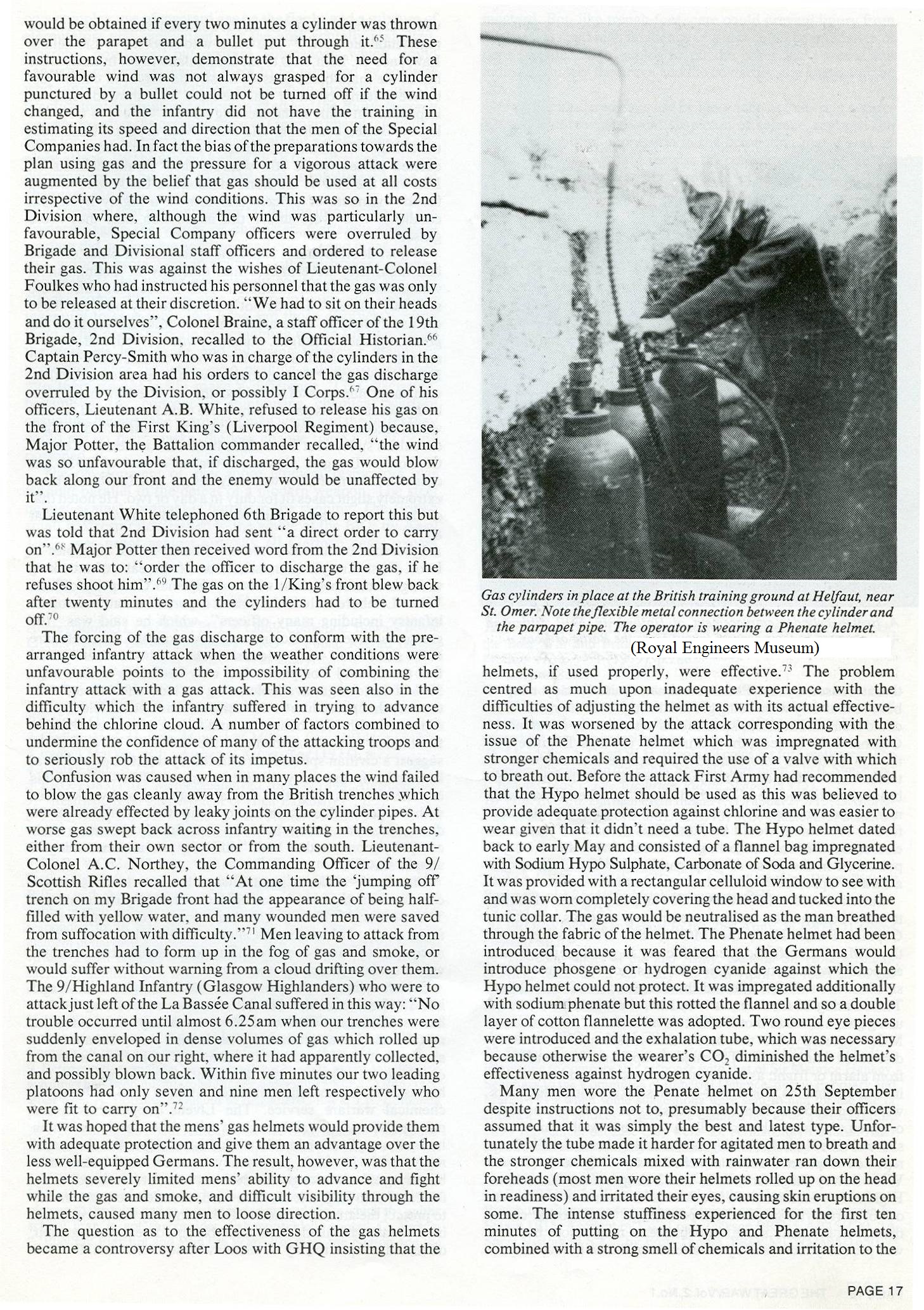
Personnel practicing for the first British gas attack.
The escalation of chemical warfare was limited solely by the restraints of research, development and production rather than any questions of morality. The first attacks had shown that chlorine was not poisonous enough and too easily protected against; the Germans led in the introduction of new chemicals owing to their ability to produce chemicals in bulk. Both sides raced to deploy new and more poisonous chemicals and to issue masks to their own troops to protect against a range of potential substances. Phosgene, about one hundred times more toxic than chlorine, was the most prominent threat and a German phosgene attack against the British in December 1915 was thwarted by the rapid issue of an improved gas helmet. The Germans were soon able to penetrate these impregnated cloth helmets with higher concentrations and the British were forced to replace them with a complex but effective mask in which a box filter was connected by rubber hose to a face piece. These ‘Small Box Respirators’ began to be issued in autumn 1916 and within five months every man at the front possessed one. The unsung scientist responsible for coordinating this triumph of design and production, Edward Harrison, weakened by overwork and gas inhalation, died of influenza one week before the war’s end.

Edward Harrison, who gave his life in the development of protection from poison gas.
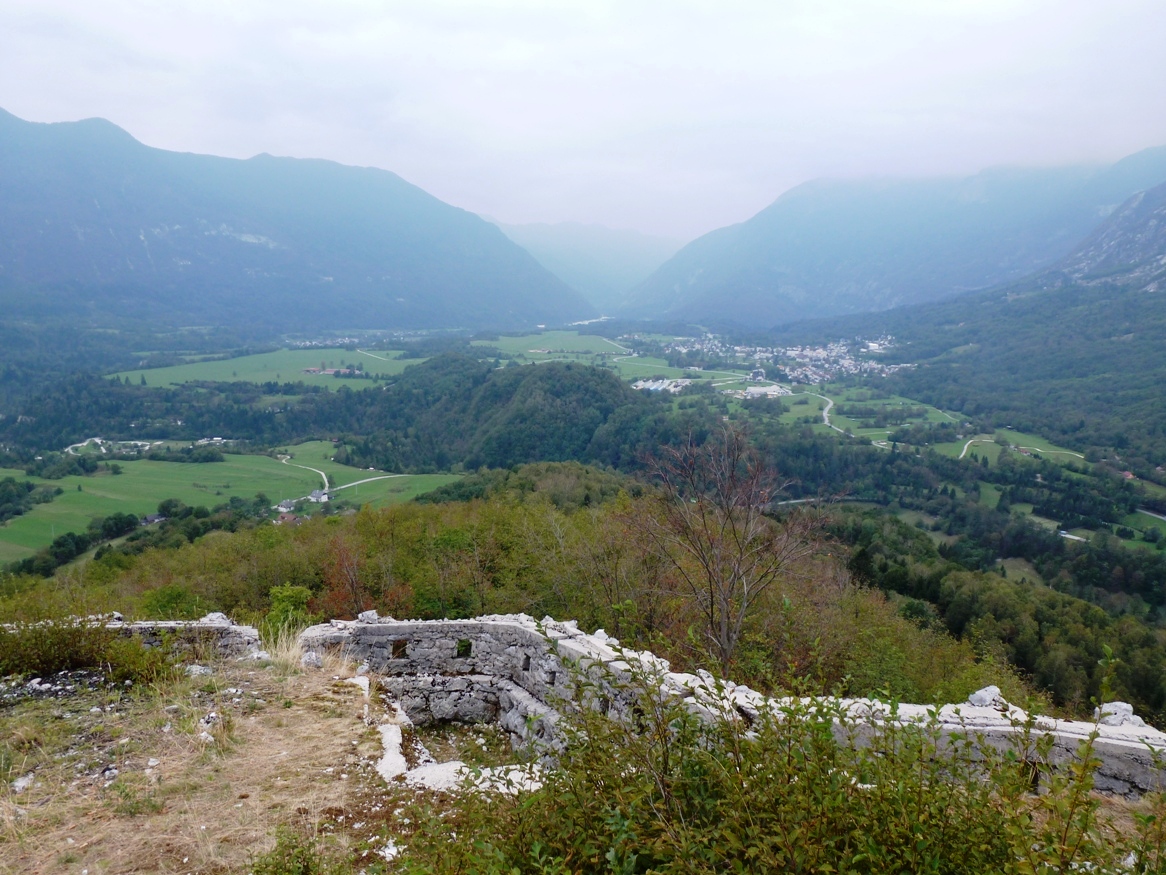
In 1916 the gas shell became the favoured means of overcoming the problem of the wind but a very large number of shells had to be fired to build up a concentration sufficient to penetrate a gas mask, especially after the British introduced Harrison’s Small Box Respirator. The tactic shifted to forcing men to wear their masks for long periods and thereby impede their ability to fight and chemical weapons became particularly important as a counter-battery weapon to silence the opponents’ guns. The aim was also to catch soldiers by surprise before they could adjust their masks and gas shells contained a charge just large enough to break open the shell with a distinctive dull plop. Wilfred Owen’s poem ‘Dulce et Decorum est’ describes his recurring nightmares of a man dying of gas poisoning after soldiers are surprised by phosgene shells which drop softly behind them. Troops easily recognised the sound and in 1918 the Germans increased the size of the charge, rendering them harder to distinguish from high explosive shells. The one major British innovation in chemical weapons, highly effective but also technologically the most crude, was a means of projecting a dense cloud of gas instantaneously onto enemy positions. Inspired by the desire of William Livens to avenge his wife whom he thought had perished on the liner Lusitania (it turned out she hadn’t sailed), each Livens Projector hurled a drum containing 11 litres of liquefied gas, when up to 800 were fired simultaneously, it either gassed the German soldiers before they could get their masks on or penetrated the filters owing to the high density. It was so effective that after its first use Livens boasted that he could kill Germans at 16 shillings per head. The Germans copied the Livens projector and, on the Italian front at Caporetto in October 1917, used it to drench low-lying Italian positions with phosgene; they followed it up with an advance far more substantial and dramatic than that at Ypres in 1915, and the resulting panic formed the central sequence of Hemingway’s A Farewell to Arms.

The first German lethal gas shell, containing 0.285 litres of diphosgene.
The quest to find toxic chemicals which did not disperse as quickly as a gas led the Germans to a liquid, dichlorodiethyl sulphide, commonly called ‘mustard gas‘ by the British owing to its odour of mustard or horseradish. The most effective chemical agent of the First World War, it would inflict on soldiers a new dimension of horror and suffering. Ironically, after testing on cats in 1916, the British rejected mustard on the grounds that it was not sufficiently lethal. German trials on monkeys demonstrated that it caused eye and respiratory injury but again there were doubts about its lack of toxicity. It was noted that the liquid took much longer to disperse than gas; a detonating shell spread droplets which slowly evaporated in daylight, prolonging its harmful effects. This quality prompted Haber to propose its use to the German High Command when he learnt of the requirement for a chemical weapon to forestall Allied attacks expected in the summer of 1917. However, Haber is said to have warned that it should only be used if Germany was certain of winning the war within a year; once the Allies had the ability to bulk produce their own, Germany would not be able to produce sufficient replacement uniforms needed for decontamination. On the night of 12 July 1917, the Germans fired 50,000 shells containing 125 tonnes of mustard into the ruins of Ypres; it was the first of a series of intense bombardments to target British attack preparations. Within 24 hours, over 2,000 British soldiers had been admitted to Casualty Clearing Stations, many suffering intensely painful inflammation of the eyes which effectively blinded them, they were led in files, each holding on to the man in front. After several hours many developed severe throat and lung irritation which in some turned into fatal broncho-pneumonia. A third prominent symptom, not anticipated by the Germans, was large skin blisters, especially on the buttocks, genitals and armpits. Mustard caused injury by skin contact, especially the sweaty parts of the body, either with the vapour as it evaporated in daylight or sitting where the liquid had been splashed by the bursting shell. The predictions that it would have a low mortality rate were correct: of the 2,143 cases admitted to Casualty Clearing Stations after the first bombardment, 95 died, a comparatively small number; put crudely it had taken 500 mustard gas shells to cause each death. But the Germans reported that the British guns were all but silent for two days afterwards. The effectiveness of mustard did not lie in the death rate, rather the large numbers injured, many of whom, by the standards of the time, recovered after several months in hospital. Many, however, such as those nursed by Vera Brittain on the French coast, suffered serious infection and pneumonia, ‘burnt and blistered all over with great mustard coloured suppurating blisters, with blind eyes… and always fighting for breath, their voices a mere whisper…’ A German mustard gas bombardment of the still partially inhabited town of Armentières later the same month, an operation called ‘Totentanz’ (‘Dance of Death’), caused 675 civilian casualties of which 86 died; a high proportion, many elderly, were unable or unwilling to leave the contaminated area. Yet, paradoxically, for some soldiers injury by mustard gas actually saved their lives by taking them out of the fighting for an extended period; in September 1917, a Canadian Chemical Advisor claimed that soldiers were deliberately exposing their eyes to mustard gas in order to escape the front line.
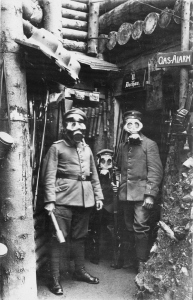
German troops at a gas alarm post. © Simon Jones
The International Red Cross appealed for an end to gas warfare in February 1918 but neither side was willing. The Allies were beginning to rival the Germans in production capacity and also did not trust the Germans to abide by such an agreement. The German use of chemical weapons during their offensives in the spring and summer of 1918 was lavish, comprising 50% of all shells fired, and sophisticated. Shells were colour coded according to their effect: non-persistent lung irritant gas phosgene shells were designated Green Cross and fired in combination with ‘Blue Cross’ shells designed to penetrate respirator filters and cause sneezing, forcing the soldier to remove his mask. Mustard gas, ‘Yellow Cross,’ was fired into the rear and flanks to block reinforcements from reaching the attack zone and to silence the artillery; as many as 80% of the shells fired into these areas were mustard. British mustard decontamination could not cope and at one point in 1918 the British had about 30,000 men in hospital suffering from the effects. In August 1918, the sight of lines of men blinded by mustard gas inspired society painter John Singer Sargent to produce his monumental canvas ‘Gassed‘ which remains for many the most powerful artistic representation of the First World War. Pushed back by Allied offensives, mustard was initially the ideal defensive weapon for the Germans and the British suffered up to 4,000 mustard casualties per week during September and October. But the effectiveness of German chemical weapons declined as their forces became disorganised and Allied troops learnt to avoid the worst effects of mustard. As Haber had warned, the Allies managed to produce their own mustard within a year of the German use; American production in particular threatened to overwhelm the German ability to decontaminate. By November 1918 the Americans could produce 1,600 tonnes of chemical warfare agent each month, enough for 2.7 million shells. If Germany hadn’t requested an Armistice she would have been overwhelmed by Allied chemical weapons in 1919.
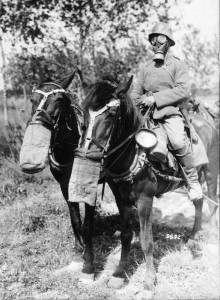
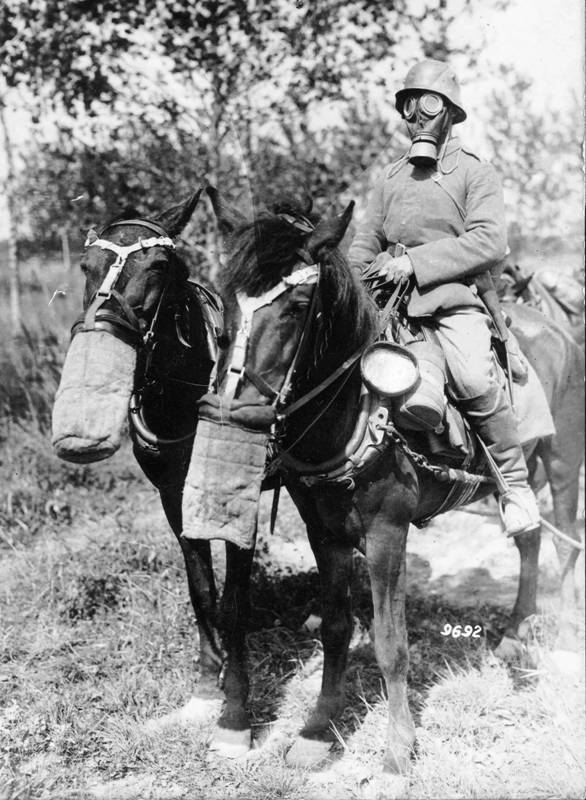
German respirators for man and horses.
Was Germany ultimately defeated by chemical weapons? She was already beaten militarily in the field and starved at home by the blockade: chemical weapons did not have a decisive impact on the outcome. Deaths during the war from chemical weapons are estimated at about 18,000, or less than 0.2 per cent of battlefield deaths. Even allowing for the effectiveness of mustard in causing injury rather than death, this was a negligible contribution. Herein lies the reason why gas was not used on the battlefield during the Second World War: chemical warfare wasn’t as effective as other methods of warfare developed and refined during the First World War. With the end of the war, efforts were made to limit the use of chemical weapons. Under the Treaty of Versailles, Germany was forbidden chemical weapons, along with tanks, aircraft and submarines, and in 1925 the Geneva Protocol aimed at a global prohibition of chemical and bacteriological weapons. Between the wars the use of such weapons from the air on towns and cities dominated public anxieties and in the late 1930s most European nations embarked on the mass supply of gas masks to their civilian populations. Whilst the masks were not particularly good, informed opinion was aware that the concentration achievable with aircraft payloads would be low and thankfully the threat never materialised; however, since 1919 chemical weapons have been used almost exclusively against unprotected victims, usually non-combatants, and favoured by rogue states and terrorists. During the lead up to both Gulf wars the term ‘weapons of mass destruction’ encouraged an entirely false equivalence with nuclear weapons; ‘weapons of mass terror’ has been suggested as a more appropriate term.
In the hospital at Trent Bridge Cricket Ground, antiseptic dressings had little effect on Sawyer Spence’s septic mustard gas blisters and caused him such pain that they were abandoned; instead a treatment was begun with a new paraffin medication developed by Boots the Chemist. By early November 1918 he was at home recovering; he died, age 81, in 1973.
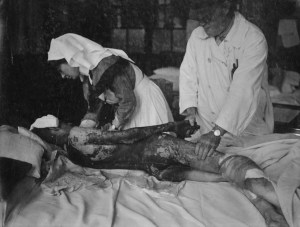
Sawyer Spence suffering extensive mustard gas blisters, Trent Bridge Hospital, Nottingham, 1918. © Jon Spence, used with permission.
Fritz Haber, who used science to create life and to end it, is surrounded by myths. His wife, Clara, herself a doctor of chemistry, was opposed to his chemical warfare work but it remains unknown whether this was the reason, as has been claimed, for her suicide shortly after the first chlorine attack. The oft-quoted description of chemical warfare as ‘a higher form of killing’ attributed to him is almost certainly apocryphal. It is clear however that when the Nazis took power Haber, a Jew who had converted to Christianity, was unable to retain his post as head of the Kaiser Wilhelm Institute for Physical Chemistry. His friend Albert Einstein had concluded many years before that his own future did not lie with identifying himself with the German state. Haber realised this too late; leaving Germany in 1934 he died soon afterwards. A method of pest control using hydrogen cyanide gas invented in 1918 under Haber’s direction and marketed as ‘Zyklon B’ was used by the Nazis to kill over a million people.
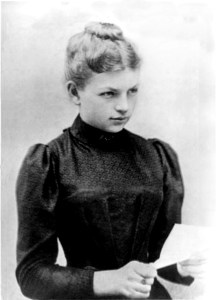
Dr Clara Haber (née Immerwahr) committed suicide on 2 May 1915 while her husband was home on leave after the first gas attack.
See below for bibliography including online sources.
Text © Simon Jones

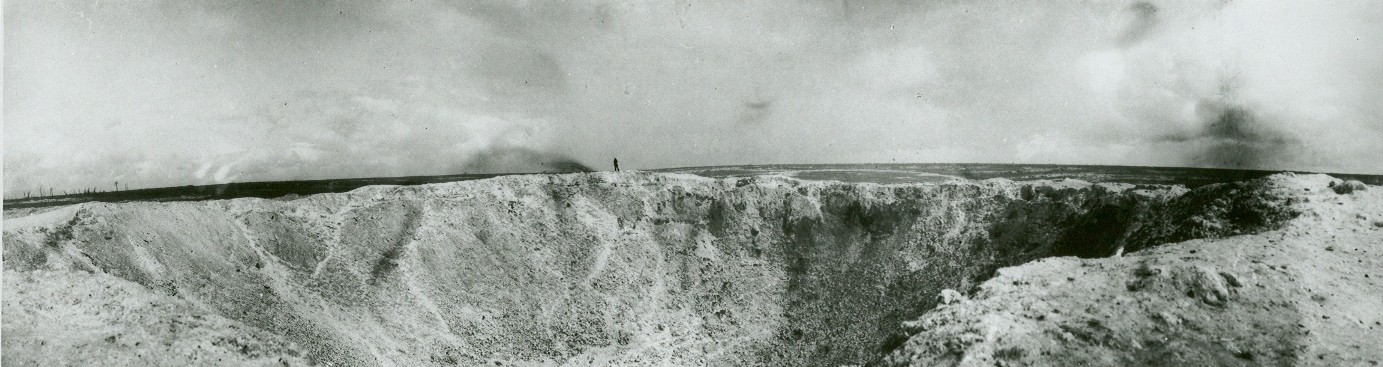
The Lochnagar Mine: how and why it was blown and who were the men who dug it
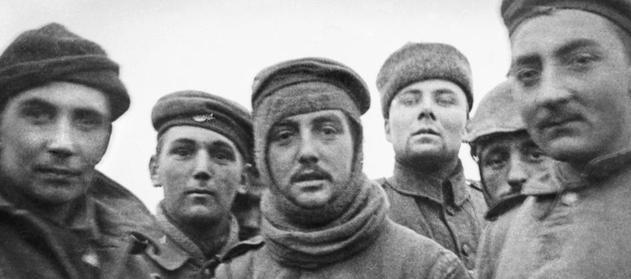
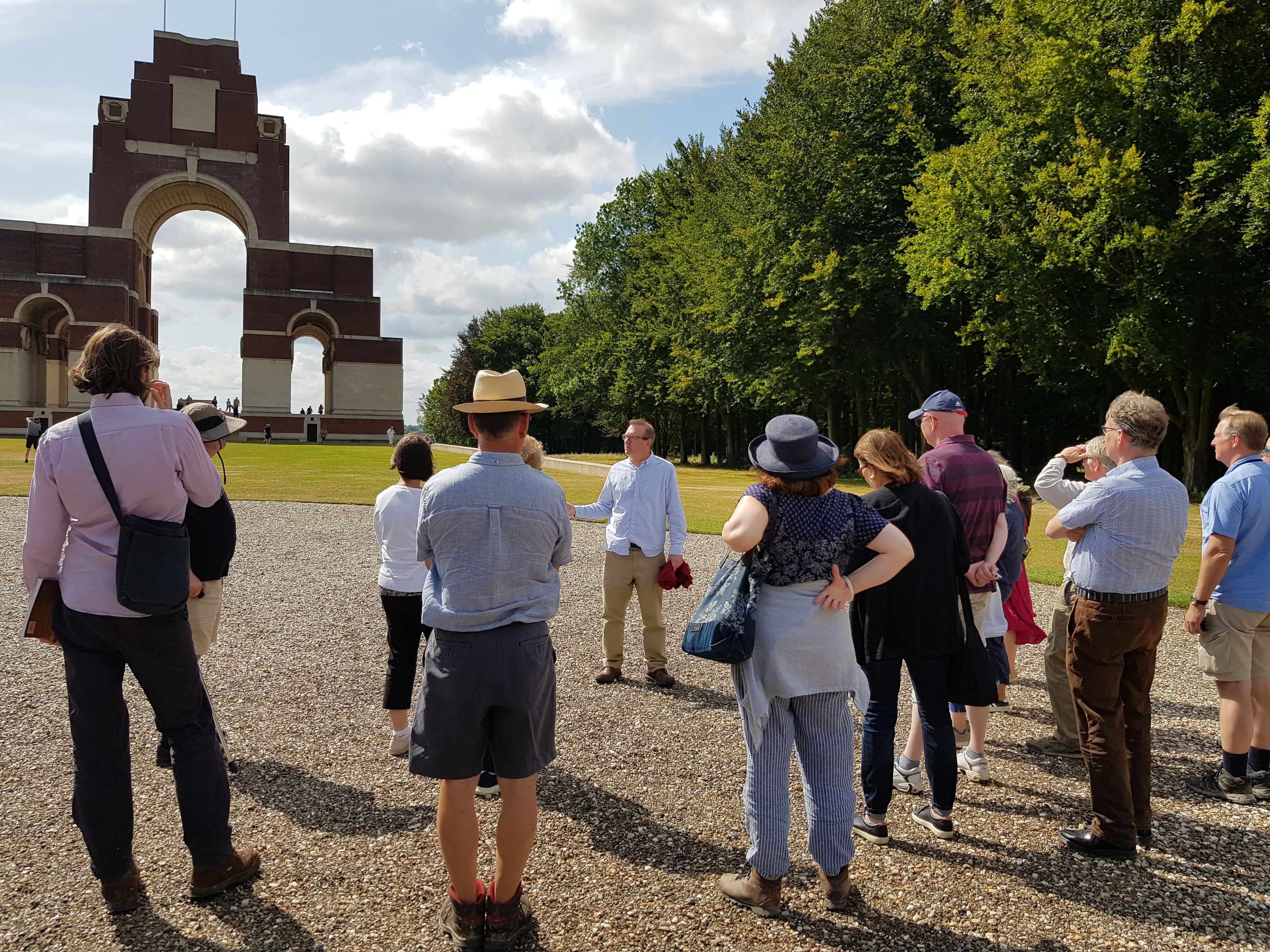
Join me on a battlefield tour with The Cultural Experience:
The Tank War 17th-20th May 2025
The Battles of the Marne and Aisne 6th-11th September 2025
Mons and Le Cateau 31st August – 3rd September 2025
Sources for Understanding Chemical Warfare in the First World War
C H Foulkes “Gas!” The Story of the Special Brigade (1934)
L F Haber The Poisonous Cloud (1986)
R Hanslian Der Chemische Krieg (1937)
S Jones ‘Under a green sea’ The British responses to gas warfare’ The Great War Vol 1 No 4 & Vol 2 No 1 (1989).
S Jones ‘The first BEF gas respirators, 1915’ Military Illustrated Nos 32 & 33 (1991).
S Jones ‘The right medicine for the Bolshevist’: British air-dropped chemical weapons in north Russia 1919’, Imperial War Museum Review No 12 (c1998)
S Jones World War One Gas Warfare Weapons and Equipment (2007)
G Lachaux and P Delhomme La Guerre des Gaz 1915-1918 (1985)
A Lejaille La Guerre des Gaz (website) http://pageperso.aol.fr/guerredesgaz/
A Lejaille ‘La protection française polyvalente contre les gaz de combat’ Militaria Nos 226 (2004), 237 & 241 (2005).
O Lepick La Grande Guerre Chimique (1998)
W G MacPherson (ed.) Medical Services Disease of the War Vol. II (1923).
D Martinetz Der Gaskrieg 1914/18 (1996)
Y Mouchet ‘Les masques à gaz allemands de la Grande Guerre’ Militaria No 220 (2003)
A Palazzo Seeking Victory on the Western Front The British Army and Chemical Warfare in World War I (2000).
A M Prentiss Chemicals in War (1937)
D Richter Chemical Soldiers (1994)
W Zecha “Unter die Masken!” Giftgas auf den Kriegsschauplätzen Österreich-Ungarns im Ersten Weltkrieg (2000).








 More Information about Battlefield Tours






















![British_55th_Division_gas_casualties_10_April_1918[1]](https://simonjoneshistorian.com/wp-content/uploads/2014/02/british_55th_division_gas_casualties_10_april_19181.jpg?w=300)















![P1000764 Kolovrat [Rommel ridgesq]](https://simonjoneshistorian.com/wp-content/uploads/2015/02/p1000764-kolovrat-rommel-ridgesq.jpg)


 Simon Jones Historian