YouTube Talk – Underground Warfare 1914-1918

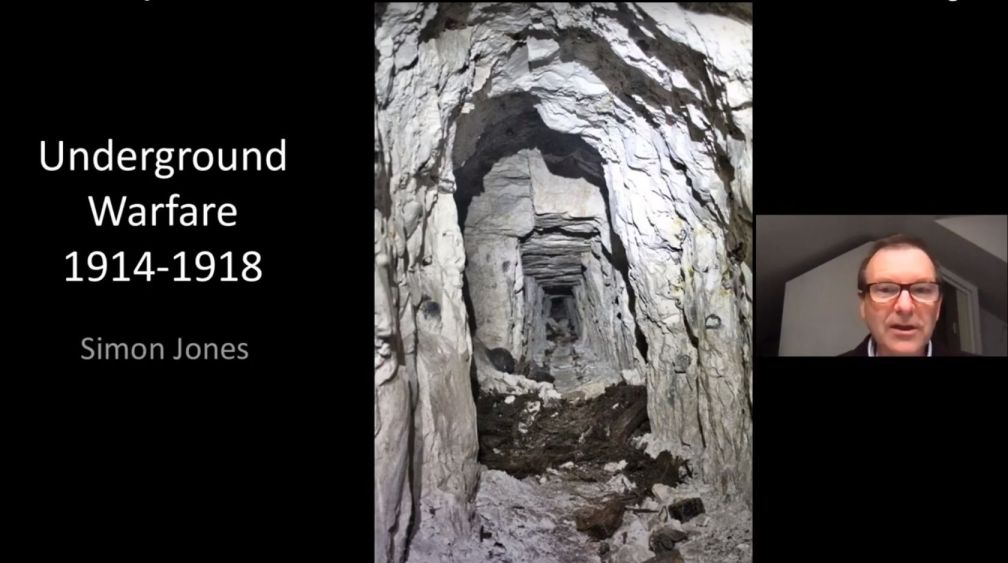
In this presentation I describe the techniques and technology that civilian miners and mining engineers brought to the tunnelling war. Thanks to Subterranea Britannica for providing the platform.


Join me on a battlefield tour with The Cultural Experience.

Simon Jones Battlefield Tour Somme Poets 2019

The Battles of the Marne & the Aisne 1914 – 1918

First & Last Shots 1914 & 1918

Medics & Padres in the Great War

Walking Ypres 1914-1918

Walking the Somme

More Information about Battlefield Tours

The Ypres Salient War Poets: ‘A Bitter Truth’

Ramparts Cemetery Ypres

Ramparts Cemetery (Corinne P/TripAdvisor)

A Battlefield Tour with The Cultural Experience, 7th – 10th July 2022

I have designed this new, four-day tour for The Cultural Experience combining history, literature and art to experience the infamous Ypres battlefield. Through the words of more than twenty British and German writers, we explore the war in the trenches, the dressing stations, the rest areas, and the cemeteries. This is an opportunity to study works of literature and art in the precise locations which inspired them and where they were created. Combined with a rich historical context, travellers can gain a powerful understanding of these works both artistically and as historical testimony.

Full details are on The Cultural Experience website.

We walk ‘Plug Street Wood’, where Roland Leighton picked the violets growing around a corpse to send to his fiancée Vera Brittain, visit the battlefield graves of poets such as Francis Ledwidge and Hedd Wynn, both killed on the first day of the Passchendaele offensive, and look across no man’s land where Henry Williamson took part in the 1914 Christmas Truce. At Vladslo German Cemetery we will see Käthe Kollwitz’s sculptures of grieving parents which kneel before graves including that of her own son. The tour is the result of many years of experience reading, researching and visiting the battlefields as well as teaching literature and art of the Great War at Liverpool and Lancaster Universities.

Käthe Kollwitz sculptures, Vladso German Cemetery

Käthe Kollwitz sculptures, Vladso German Cemetery

What was ‘The Salient’? 

Devastated by four years of shellfire and fighting, for the British the Ypres battlefield, guarding the Channel ports, was the key to the Western Front. The Germans held a natural amphitheatre of high ground, curved like the blade of a sickle with the handle formed by the Messines ridge to the south. This was the ‘Salient’ in which the British were surrounded on three sides, always observed and subjected to lethal shelling.

Paul Nash, The Ypres Salient at Night-Art.IWM ART 1145

Paul Nash, The Ypres Salient at Night (IWM ART 1145)

Sanctuary Wood Trenches Ypres

Sanctuary Wood Trenches

In time when there was less public display of emotion, poetry was a means for soldiers to express and try to come to terms with and express experiences of grief, trauma and intense comradeship. Poetry also became a means whereby soldiers at the front tried to educate those at home about the realities of the war: ‘I died in hell—(They called it Passchendaele)’, says a soldier in Siegfried Sassoon’s poem. Artists such as Paul Nash also saw this as a duty. Angered by the devastation of the Ypres Salient, he wanted his pictures to tell ‘a bitter truth’.

Highlights

  • Powerful war literature and art in a historic Flanders landscape.
  • Little-known cemeteries and sites and the famous Menin Gate, Tyne Cot Cemetery and Talbot House.
  • See where The Wipers Times was printed in Ypres Ramparts.
  • Women writers such as May Wedderburn Cannan and Katherine Mansfield.

May Wedderburn Cannan

VAD nurse May Wedderburn Cannan, third from right (maywedderburncannan.wordpress.com)

Full details are on The Cultural Experience website.

Itinerary

Day 1 – The German experience, Medics and Padres.

Depart London St Pancras by Eurostar to Lille. Drive to Vladslo German Cemetery, Käthe Kollwitz sculptures, works by Ernst Stadler, August Stramm, Gerrit Engelke and Erich Maria Remarque. Essex Farm Cemetery and Canal Bank, where John McCrae wrote ‘In Flanders Fields’, Zillebeke Lake and Railway Dugouts Cemetery, works by Studdert Kennedy, ‘Tubby’ Clayton, Robert Service, and artists Wyndham Lewis and Paul Nash.

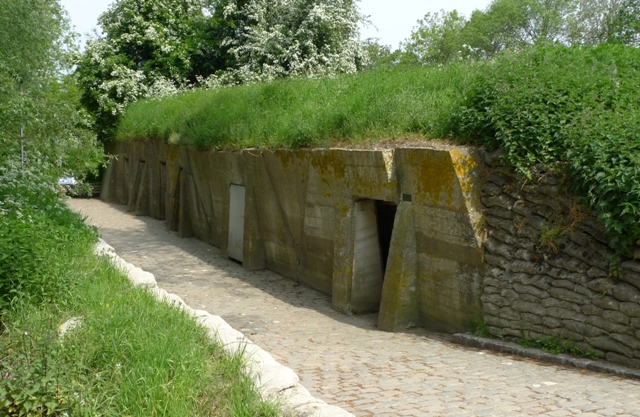
Essex Farm bunkers

Essex Farm Dressing Station bunkers

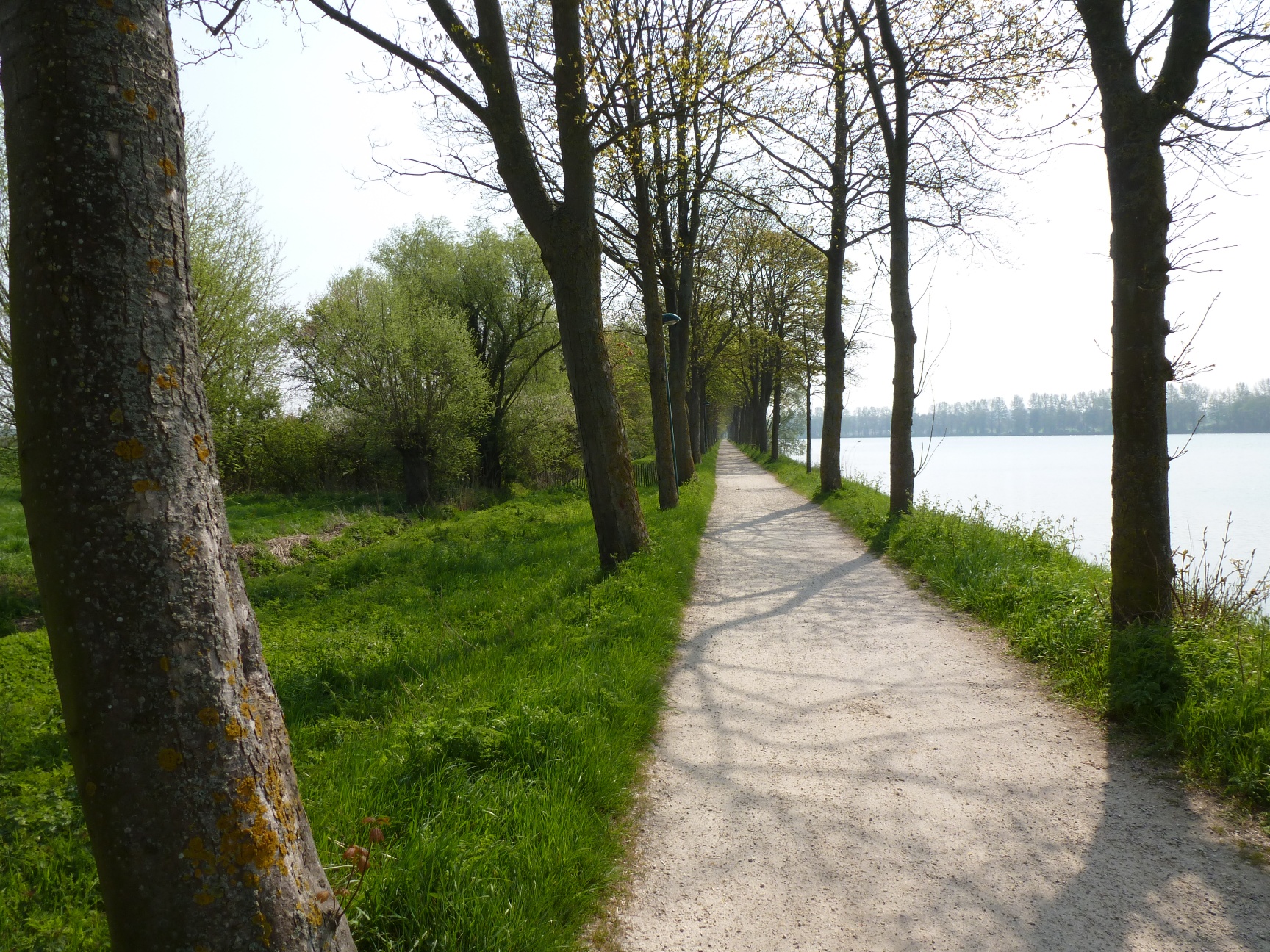
Zillebeke Lake

Zillebeke Lake

Paul Nash, Rain Zillebeke-Art.IWM ART 1603

Paul Nash, Rain Zillebeke (IWM ART 1603)

Day 2 – The Salient and ‘Third Ypres’

In the morning Hell Fire Corner, Menin Road, Sanctuary Wood trenches, works by Edmund Blunden, Herbert Asquith and The Wipers Times. After lunch, the Third Battle of Ypres: Pilckem Ridge, Artillery Wood Cemetery, graves of Hedd Wynn and Frances Ledwidge, works by David Jones, Blunden, John Collinson Hobson, Edmund Campion Vaughan and Ivor Gurney. Tyne Cot Cemetery where the poets J E Stewart, E F Wilkinson and W R Hamilton are commemorated. Evening Menin Gate Last Post Ceremony.

Shell craters, Sanctuary Wood

Shell craters, Sanctuary Wood

Edmund Blunden

Edmund Blunden

Edmund Campion Vaughan's bunker, St Julien

Edmund Campion Vaughan’s bunker, St Julien

Day 3 – Behind the Lines

To Vlamertinghe Military Cemetery and chateau, the grave of Harold Parry and works by Robert Nichols and Blunden. Poperinge, the prison cells and Talbot House soldiers’ hostel, Blunden, Vaughan, R H Mottram and Ford Madox Ford. After lunch, drive south to Ploegsteert Wood and walk to the cemeteries, works by Roland Leighton, Vera Brittain, Katherine Mansfield, Henry Williamson and Alfred Ollivant.

Talbot House Poperinge

Talbot House, Poperinge

PloegsteertWoodCemetery(CWGC)

Ploegsteert Wood Cemetery (CWGC)

Roland Leighton

Roland Leighton

Day 4 – Walking Ypres Town

A day spent on foot. Rudyard Kipling and the War Graves Commission at Ypres Reservoir Cemetery including family inscriptions, Ypres Cathedral and Cloth Hall, William G Shakespeare, Blunden and Edith Wharton. Visit to In Flanders Fields Museum. Menin Gate, works by Charles Sorley, Robert Graves, E W Hornung, Anna Gordon Keown, C E A Philipps, J C Hobson, W S S Lyon, Siegfried Sassoon and Eric Haydon. Walk the Ramparts, The Wipers Times, Gilbert Frankau, Ramparts Cemetery, R W Sterling. Aftermath and loss, May Wedderburn Cannan, Margaret Sackville, Carola Oman and Marian Allen. Return to Lille for Eurostar.

Peter Kollwitz grave marker, In Flanders Fields Museum

Peter Kollwitz grave marker, In Flanders Fields Museum

Ramparts Cemetery (CWGC)

Ramparts Cemetery (CWGC)

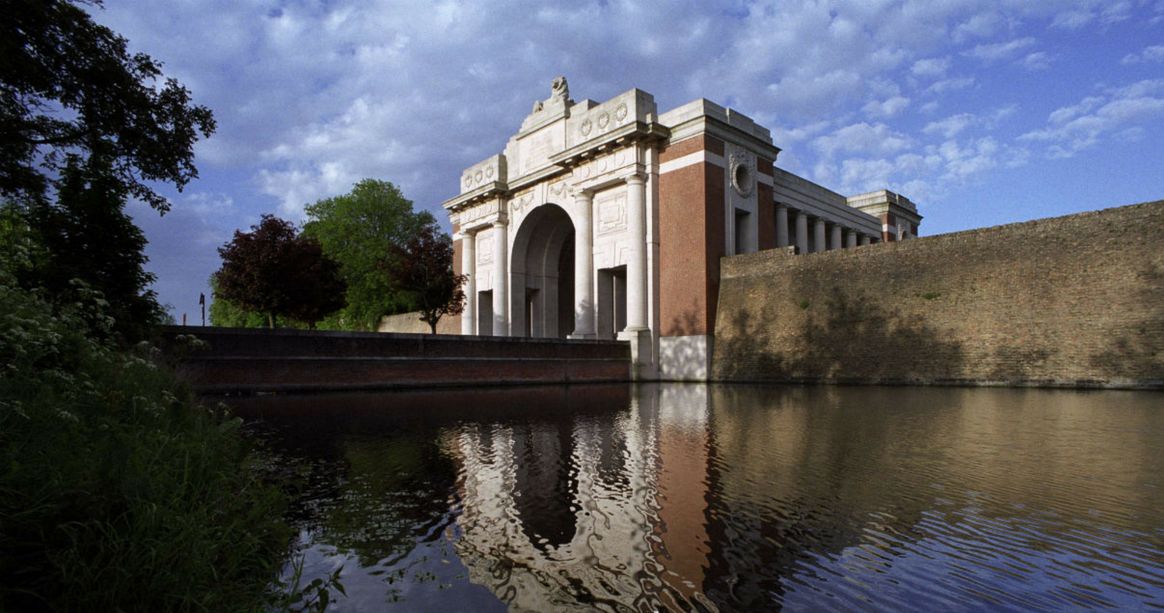
Menin Gate

The Menin Gate (CWGC)

Full details are on The Cultural Experience website.


Join me on other battlefield tours with The Cultural Experience:

Tunnellers

The War Poets: Words, Music and Landscapes

First & Last Shots

Medics & Padres

Walking Ypres

Walking the Somme


EB-Literary Executors for the Vera Brittain Estate, 1970 and The Vera Brittain Fonds, McMaster University Library-CropBWenh

Where and how was Edward Brittain killed? The death in action of her brother Edward, in Italy in June 1918, forms the final tragedy of Vera Brittain’s memoir Testament of Youth.


Vincent Faupier19698175Res

Who was Ivor Gurney’s ‘The Silent One’? The night attack by the 2/5th Glosters on 6-7 April 1917


John Nash Over the Top SimonJonesHistorian

‘It was in fact pure murder’: John Nash’s ‘Over the Top’


North Russia 1919: Britain’s first air-dropped chemical weapons

Grantham N Russia RE Lib resDuring the closing stages of the military intervention in North Russia in 1919, British chemical munitions were improvised as effective aerial bombs for the first time in history. Here is a shorter version of my article published by the Imperial War Museum in 1999.

In July 1917, the Germans introduced a new type of chemical munition.  The Blue Cross shell was a ‘mask-breaker’ which could penetrate a soldier’s respirator filter causing temporary incapacity from choking and severe sinus irritation. The wearer would also tear off the gas mask and succumb to the effects of simultaneously fired lethal gas shells. The chemical was diphenylchlorarsine (DA), embedded in solid form in a glass bottle in the explosive of the shell. It would be pulverised into a fine dust by the detonation but the particles were mostly too large to be really effective.

Blue Cross Shell

The German ‘Blue Cross’ chemical shell containing DA in a glass bottle.

A more successful method was discovered by a British Gas Directorate officer at GHQ who placed a pinch of DA on his stove: the smoke from the heated chemical caused the evacuation of the entire building. The British developed a thermogenerator which heated the chemical to create a highly toxic smoke lasting for about two minutes. They also identified an improved substance, diphenylaminechlorarsine (DM or Adamsite), and the two thermogenerators were loosely known as the ‘M Device’. Though the effects were not thought to be permanent, test conditions caused in human subjects ‘the most appalling mental distress and misery’ and pain such that soldiers ‘had to be prevented from committing suicide; others temporarily went raving mad…’.

Q 16329-cr-generator-br

The ‘M Device’ Smoke Generator (IWM Q 13629)

Brigadier-General Foulkes, the Director of Gas Services in the British Expeditionary Force, hoped to use the M Device to implement his ‘favourite plan’ of discharging chemical weapons on a stupendous scale before a major attack. Troops wearing a respirator with a special filter which protected against the smoke would ignite and throw the smoke bombs before capturing positions on which the defenders were incapable of resistance. The Armistice in November 1918 however prevented such an attack from taking place.

M Device Foulkes-cr

Aerial view of a field trial of the M Device
(from Foulkes, GAS! The Story of the Special Brigade, 1934).

In early 1919, a North Russia Relief Force was assembled to enable the withdrawal of British forces, sent to Murmansk and Archangel in 1918 to prevent military stores from falling onto German hands, which was now threatened by the Bolshevik Red Army. The force was to be equipped with chemical munitions employed by both the Royal Artillery and the Special Brigade of the Royal Engineers. Winston Churchill, Secretary of State for War and Air, offered the commander of the force, Major-General Ironside, the ‘very secret’ M Device which he should only use ‘if specially necessary’. Ironside asked how well it worked in areas ‘closely shut in by forest’ where the wind was non-existent. This question was to be answered by sending a Special Brigade expert , Major Thomas Davies, who would sail in advance of the M Device to explain the new weapon.

Davies was a Tasmanian chemical engineer with extensive experience of gas attacks on the Western Front. His health damaged by poison gas, he had nevertheless helped to develop the M Device because of his firm belief that it would end the war. However, a road accident prevented Davies from sailing in advance the despatch to Archangel of 50,000 M Devices in May 1919. By July, Davies and nineteen other Special Brigade officers had also arrived at Archangel without knowing whether it was suitable for use in that theatre.

Map of European Russia Showing Railways Waterways Situation in Russia from Information Received up to Aug 12th 1919-macrepo_4080-crbr

The Murmansk and Archangel fronts, August 1918.
(Detail from https://digitalarchive.mcmaster.ca/islandora/object/macrepo%3A4080)

Prior to visiting the front, Davies planned to make an attack using 15-20,000 M Devices per mile but he found it thickly wooded, with the only clear area a 30 yard wide strip along which the railway line was constructed, permitting little or no breeze to carry the smoke towards the enemy. The terrain could not have been more different to the open agricultural land of northern France and the use of the M Device to cover the withdrawal of the North Russia force was nothing like that envisaged by Foulkes in his plans for a great break through assault. From late July to mid-August, Davies attempted to use the M Device in conjunction with infantry raids but always the wind strength and direction was always unsuitable.

Q 92426-SERVICE OF MAJOR MOORE VC 2ND BATTALION, THE HAMPSHIRE REGIMENT, NORTH RUSSIA 1919

Men of the 2nd Hampshires, Archangel front, 1919.
Davies tried unsuccessfully to carry out a raid using the M Device with this battalion.
© Imperial War Museum Q 92426

Undeterred by the lack of wind, Davies began trials to improvise M Device bombs which could be dropped from the air. When the Royal Air Force refused to allow its aircraft to be used, Davies obtained permission from Ironside. His Adjutant, Lieutenant Alderson, made twenty flights testing bomb designs until he was injured in a crash when DM got into cuts on his arms, causing skin eruptions. The trials were halted until Davies contrived to use newly-assembled aircraft at Archangel but the proximity to houses meant that DM had to be substituted for brick dust, a highly unpleasant task which fell on his officers.

Q 16330-cr

The ‘M Bomb’ made by adding a retarding vane and padded nose cone to the M Device.
© Imperial War Museum Q 16330

Eventually, Davies perfected a vane and retarder to control the descent of the bomb and a padded nose to prevent damage on impact. His servant, a plumber, made the prototypes and Ordnance Workshops in Archangel and a Royal Navy repair ship ultimately manufactured fittings for 1,500 bombs.

Thomas Davies and his servant (who is nowhere named in the records) display their M Bomb, North Russia 1919.
© Imperial War Museum Q 16330

slides-007

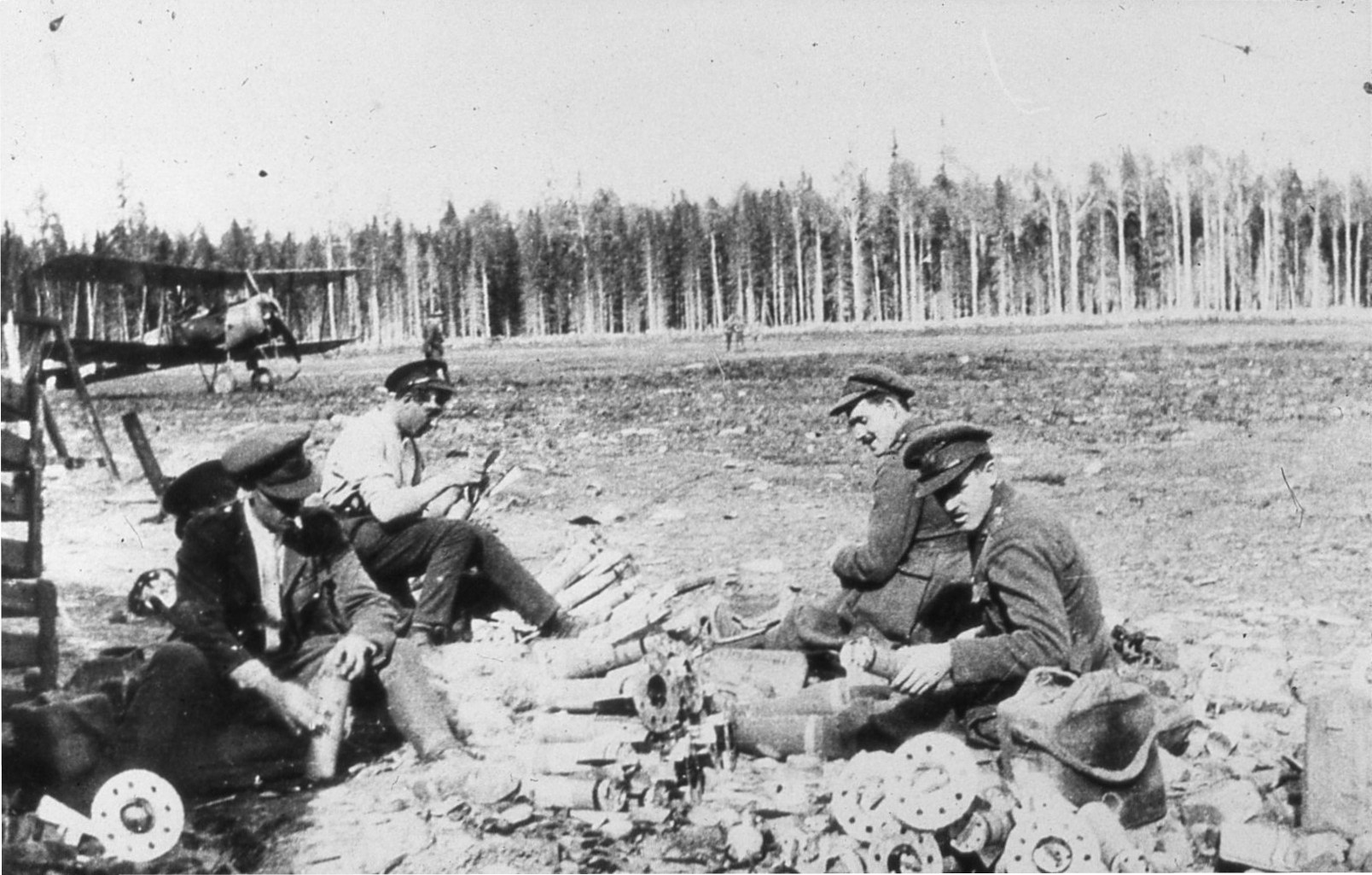
Special Brigade officers and Davies’ servant (shirtsleeves) assembling M bombs at Oberskaya Airfield on the Archangel front, 27 August 1919.
(UK National Archives WO106/1170)

Ironside wished to use the ‘M Bombs’ to support an attack on 10th August. Bomb racks were prepared on DH9 and DH9A aircraft but bad weather prevented their use. Eventually, on 27th the first M Bombs were used on the villages of Emtsa and Chunova, as preparation for an attack by Russian forces. At 12.30pm, 57 were dropped on Emtsa railway station, followed by another 62 at 7.30pm. The airmen reported the town obscured by the smoke and saw panicked troops fleeing into the surrounding woods. Red Army prisoners later described the effects. Private Kashevnikoff said that, when three aircraft dropped ten bombs about 40 yards from him, the smoke made his eyes water, he coughed badly, suffered head pains, and was ‘walking about as if drunk’. Thirty men of his company were also affected although he said that none were sent to hospital or died. He surrendered two days later, finding he was now frightened of shell fire.

slides-005-crbr

The first DH9 aircraft to take off from Oberskaya airfield carrying M Bombs, 27 August 1919.
Six bombs were carried externally (arrowed), 34 internally.
(UK National Archives WO106/1170)

The next day, 62 bombs were dropped on Emtsa and 69 on Plesetskaya. Four bombs fell near Private Leeposhkin, one about 10 yards away, causing him head pains, watering eyes, a sore throat, breathing difficulties and copious vomiting. Unable to stand, he lay down until carried into a barracks. Sickness and coughing prevented him from sleeping and he surrendered after three days.  On the day of the actual attack, on 29th, mist prevented further bombing but Russian troops captured Emtsa, taking 550 prisoners and all the forward artillery. The railway station remained held by an armoured train and bombing with the M Bombs was resumed in the evening.  Nine days later, a Special Brigade officer found a number of civilians in Emtsa ‘somewhat gassed’, while prisoners described gassed men lying prostrate on the ground, bleeding from the nose and mouth. Some still had fits of bleeding and were ‘in quite a useless state’.

Q 16329-cr bomb

A spent M Bomb after dropping.
© Imperial War Museum Q 16329

The village of Chunova was again bombed at the end of August and early September although the actual attack was postponed. Two more villages were bombed on 4th September in preparation for raiding. The attackers were warned not to enter the ‘smoked area’ until one and a half hours after the last bomb had been dropped, to avoid cellars, not to drink water and avoid skin contact with earth where the bombs had dropped. If the smoke was inhaled, they were told that a chloroform solution or cigarette smoking gave relief.  The tactics were refined, with the bombs dropped in a semicircle around the windward edges of the villages and some in the trees to the leeward where it was anticipated the victims would flee.  When Brigadier-General Grogan learned that only three of the expected six bombing aircraft would be available he limited the attack to the village of Pocha. Four aircraft bombed Pocha, the smoke obscuring it from view, and all fire quickly died away beneath the drifting clouds but resistance from outside the poisoned area caused Grogan not to launch the infantry attack.

Q 16148

General Rawlinson (light coat) with Ironside (dark coat) interrogating a Bolshevik prisoner, September 1919.
© Imperial War Museum Q 16148

The M Bombs were soon relied on by commanders to incapacitate the Red Army troops before the launch of the small-scale attacks. On 7th September, General Rawlinson, recently arrived as Commander-in-Chief in North Russia, inspected prisoners poisoned by the bombs and reported to the War Office that the M Bombs had been mainly responsible for the success of operations around Archangel.  The lack of fatal cases however left the chief Medical Officer sceptical about the effect of the ‘gas’. He visited Emtsa with the Consulting Physician who examined 46 affected prisoners and reported that the symptoms were temporary with most beginning to feel normal again after several days. This was to miss the point that temporary incapacity was all that was needed for the capture of positions. Davies examined the same prisoners and reported to Rawlinson:

I consider the results excellent and a definitive proof that in the Smoke Generator we have an extraordinary powerful weapon [sic].

Ironside also reported the bombs ‘a great success’, with the caveat that the results were small and local, ‘there is no doubt that the moral [i.e. psychological] effect on the enemy was very great and materially assisted the operations.’

Q 16759-Fairy 3c seaplanes preparing for flight from Lake Onega, Medvedje-Gora, 1919

Fairy IIIC seaplanes preparing for flight from Lake Onega, 1919.
© Imperial War Museum Q 16159

With Ironside’s operations around Archangel ending, on 9th September, six of Davies’ officers were sent with 250 M Bombs to assist the force around Murmansk, 150 miles to the northwest. The force commander, General Maynard, had been informed that Rawlinson was ‘very anxious for you to use this Gas’. Maynard planned to use the M bombs in an attack in mid-September to cover his withdrawal. Fairey IIIC seaplanes, based on Lake Onega, would each carry 40 bombs.

High winds negated the effect of bombs dropped in 12th and 13th. The village of Mikheeva Selga, attacked with 16 bombs on 13th and 30 the following day, was captured without resistance. On 14th, 30 bombs were dropped on Lijma and in still air the effect was reported by the RAF observer as ‘very good indeed’. A Special Brigade officer, Lieutenant Grantham, visiting the targets five days later found that strong defences appeared to have been hurriedly abandoned. After speaking to British officers and Bolshevik prisoners he concluded that the effect was ‘totally demoralising’. Maynard’s advance covered 20 miles in a day and further attacks were briefly postponed ‘until the arrival of more gas’.  Prisoners did not exhibit the usual symptoms of poisoning and the ‘moral’ effect seemed caused troops to abandon their positions.

Grantham N Russia RE Lib res

Special Brigade officer Lieutenant Grantham holding M Bombs, standing on the float of a Short 184 Seaplane, Lake Onega, September 1919.
© Royal Engineers Museum

High winds negated the effect of bombs dropped in 12th and 13th. The village of Mikheeva Selga, attacked with 16 bombs on 13th and 30 the following day, was captured without resistance. On 14th, 30 bombs were dropped on Lijma and in still air the effect was reported by the RAF observer as ‘very good indeed’. A Special Brigade officer, Lieutenant Grantham, visiting the targets five days later found that strong defences appeared to have been hurriedly abandoned. After speaking to British officers and Bolshevik prisoners he concluded that the effect was ‘totally demoralising’. Maynard’s advance covered 20 miles in a day and further attacks were briefly postponed ‘until the arrival of more gas’.  Prisoners did not exhibit the usual symptoms of poisoning and the ‘moral’ effect seemed caused troops to abandon their positions.

Q 16818-Bolshevik prisoners at Lijma Station waiting for instruction, 15th September 1919

Bolshevik prisoners at Lijma Station the day after capture following an M Bomb attack, 15th September 1919.
© Imperial War Museum Q 16818

Q 16821-A British sentry on the main street of Lijma, 16th September 1919

A British sentry on the main street of Lijma, 16th September 1919.
© Imperial War Museum Q 16821

On the 15th, the bombs again led to a Bolshevik withdrawal. The following day, however, advance by British forces ceased, to be continued by White Russian forces alone.  An attack on 20th without M bombs was ‘half-hearted’. On 22nd two seaplanes dropped forty bombs each, the smoke enveloped a village, surrounding trenches and a headquarters. No Bolshevik fire was reported but it was unclear if an attack was made. On 17th, the British dumped 47,000 remaining M Devices in the White Sea but seem to have left some for the White Russian forces after their final departure from North Russia on 12 October.

M Bomb test-001-cr

An M Device tested from a motorboat on Lake Onega, September 1919, photographed by Pilot Officer Blampied.
(Author/ B C Blampied)

On 23rd September, one of Davies’ officers, Major Saunders, inhaled smoke during a demonstration of the M Device to the general commanding the White Russian forces at Murmansk. He quickly suffered pains in his legs, head and back, then extreme debility, anaemia and diarrhoea.  In England three months later he could not lie down without feeling giddiness while another officer was still hospitalised with lassitude and fatigue four months after being exposed. The longer-term effects of DM exposure were felt by other Special Brigade officers. Davies had been incapacitated while demonstrating the M Device on 9th September. In March 1920 doctors found him:

pale, nervous, and suffering from various ‘phobia’. He would like to go back to Australia but dare not go on board ship.

DM, one of the few major novel chemical warfare agents developed by the British during the First World War, failed to live up to expectations. As was often the case, a new chemical warfare agent failed to behave as predicted when used in the field. Heralded as offering a breakthrough, its effect in practice was limited and local. In 1937 the British downgraded its status as a principal chemical weapon after trials found it less effective than the standard tear gas.

All references are in the full version of this article published in the Imperial War Museum Review, available via this link.


Join me on a battlefield tour with The Cultural Experience:

Simon Jones Battlefield Tour Somme Poets 2019

The War Poets: Words, Music and Landscapes, 10th-13th July 2023

First & Last Shots 1914 & 1918

Medics & Padres in the Great War

Walking Ypres 1914-1918

Walking the Somme, Summer 2023

More Information about Battlefield Tours


sawyer-spence

Understanding Chemical Warfare in the First World War


e4 105mm mustard

Yellow Cross: the advent of Mustard Gas in 1917


P1000901crop

The most effective chemical attack ever staged: the gas attack at Caporetto, 24th October 1917


Myths of Messines

For the centenary of the Battle of Messines of 7-14 June 1917 I have written four blogs examining often-repeated misconceptions about the battle. Click the links below to read them.

Times 08061917 LG claims to hear Messines minesCrop

Click: The Big Bang Heard in Downing Street:’ How far away were the mines heard and felt?


Hausler miner 9June1917

Click: Did the Messines Mines Really Kill 10,000 Germans?


7694acropEnhdeSat

Click: Killed by their own mine? Were the soldiers in Spanbroekmolen Cemetery killed by the falling debris of the mine?


H15258

Click: The Lost Mines: how many unexploded mines remain beneath the Messines ridge battlefield?


Buy signed copies of The War Underground 1914-18 and World War I Gas Warfare (Osprey Elite Series)PXL_20240524_113844426-cr


Join me on a battlefield tour with The Cultural Experience

Simon Jones Battlefield Tour Somme Poets 2019

The Battles of the Marne & the Aisne 1914 – 1918

First & Last Shots 1914 & 1918

Medics & Padres in the Great War

Walking Ypres 1914-1918

Walking the Somme

More Information about Battlefield Tours


Underground Warfare

Buy a signed copy of Underground Warfare 1914-1918 at a reduced price.

Myths of Messines: Killed by their own mine?

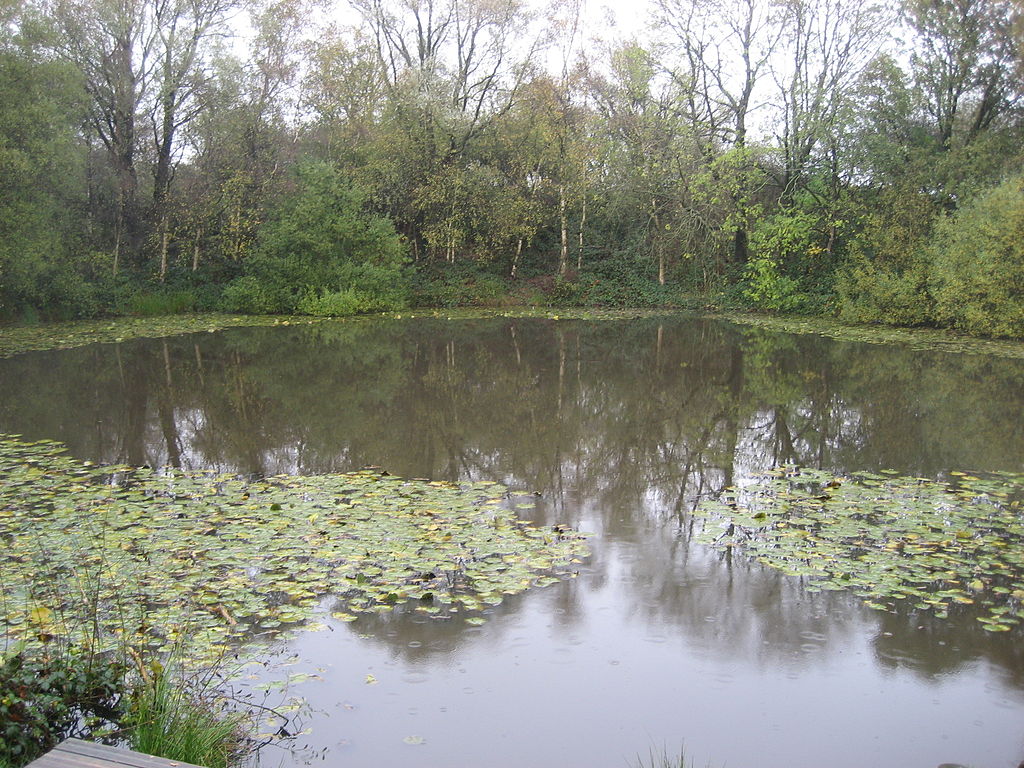
There is an often-repeated claim that many of the British soldiers buried in a cemetery on the Messines Ridge battlefield were killed by the falling debris of their own mine, 150 yards away at Spanbroekmolen.  What is the truth behind this claim?

Lone Tree Cem CWGC

Lone Tree Cemetery, Belgium, where many of the British soldiers are said to have been killed by the British mine at nearby Spanbroekmolen. (© Commonwealth War Graves Commission)

The signal for the advance at the Battle of Messines was the detonation of nineteen mines, to be fired at Zero Hour at 3.10am on 7th June 1917. The decision to fire them exactly at Zero, rather than to allow time for the debris to fall, resulted from a disastrous error made at the opening of the Battle of the Somme on 1st July 1916, when one of the mines was fired ten minutes in advance and served to warn the German defenders in the entire sector of the imminent attack.

7694acropEnhdeSat

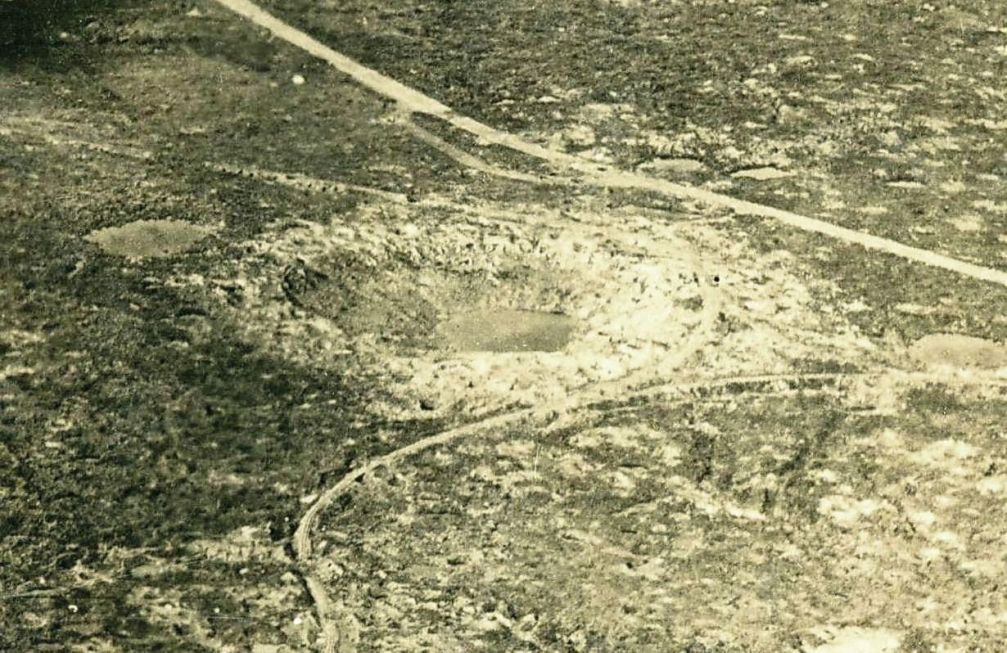
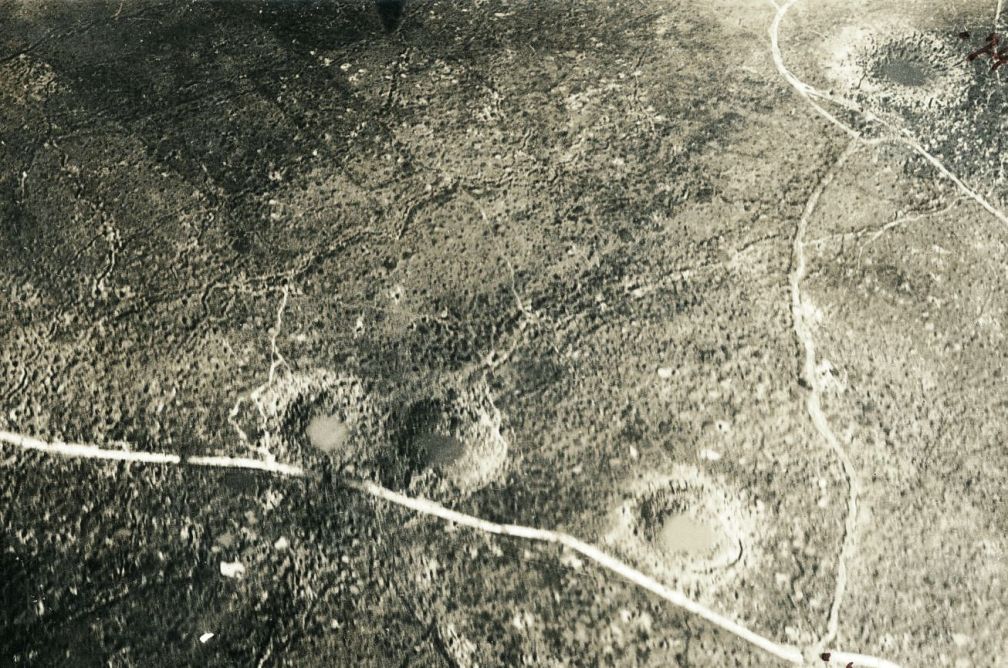
The three Kruisstraat mine craters with the Spanbroekmolen crater to the north.

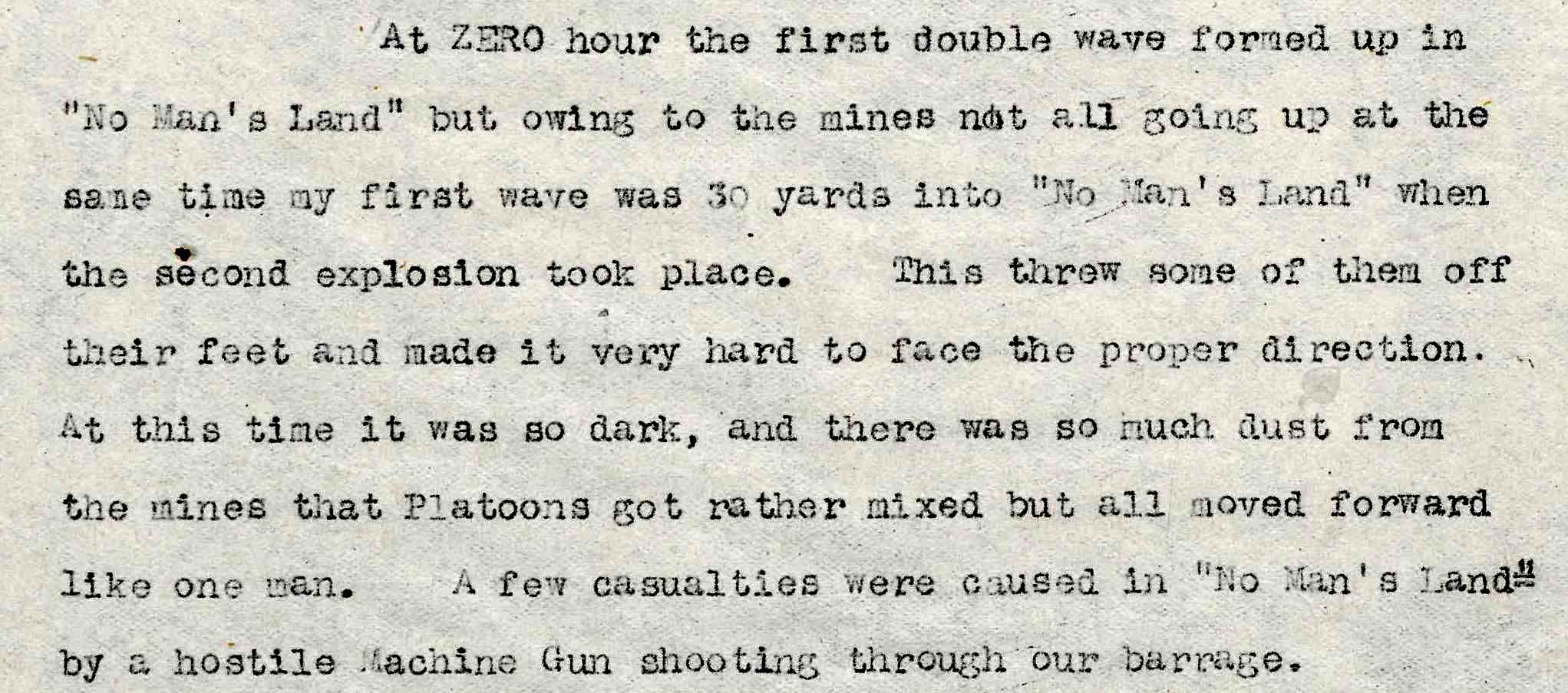
To fire the mines exactly at Zero was a risk. Although efforts were made to synchronise exactly the detonation of the Messines mines, in the event there was a delay of up to 30 seconds between the explosions. The first wave of attackers advancing to the Spanbroekmolen mine was comprised of men from the 14th Royal Irish Rifles but there are no eyewitness accounts from this unit to confirm that they suffered any loss from the mine. The after-action report by the battalion commander records confusion caused by the slight variation in the times of detonation. When a mine detonated, the men got up to attack from where they were lying ready in no man’s land but, as they advanced, another exploded in front of them, throwing them off their feet and causing them to lose direction in the dust and darkness.[1]

43849_2511_1-00231-Report cropMid

Part of the report by Lt.-Col. G. R. H. Cheape, Commanding 14th Battalion, Royal Irish Rifles, 12/6/1917. (TNA WO95/2511)

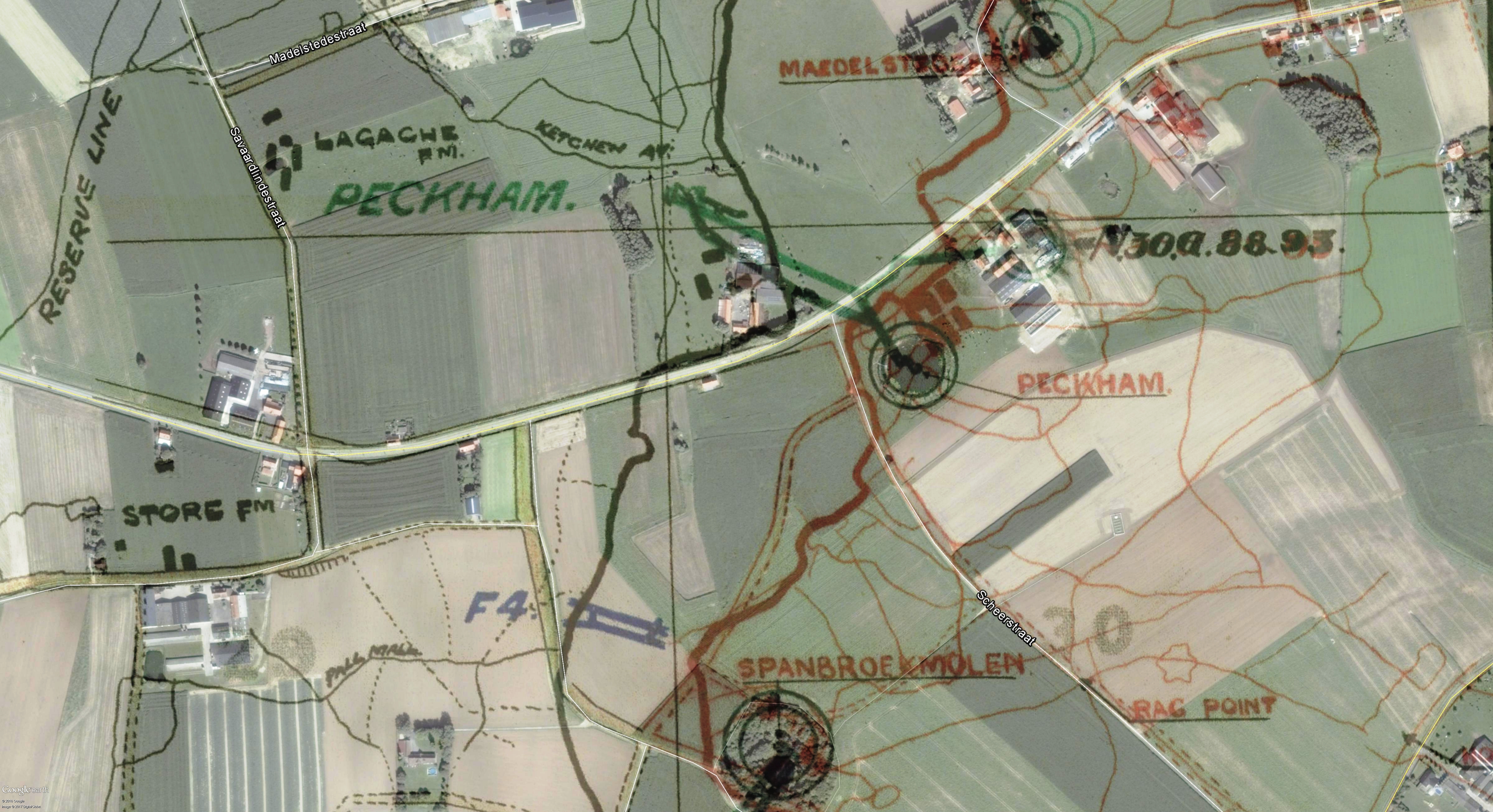
The detonation of the Spanbroekmolen mine was also witnessed by an officer of the Tunnelling Companies, Major Ralph Stokes, who was at the tunnel entrance about 570 yards away. He recorded that the  Peckham mine, 500 yards to the northeast, detonated 20 seconds before Spanbroekmolen.[2]  It seems therefore that the Peckham mine detonation caused the 14th Royal Irish to stand up and begin to advance only to be caught by the shock wave of the Spanbroekmolen. The absence of a reference to casualties from the Spanbroekmolen mine in the CO’s report does not mean that none occurred among the 14th Royal Irish.

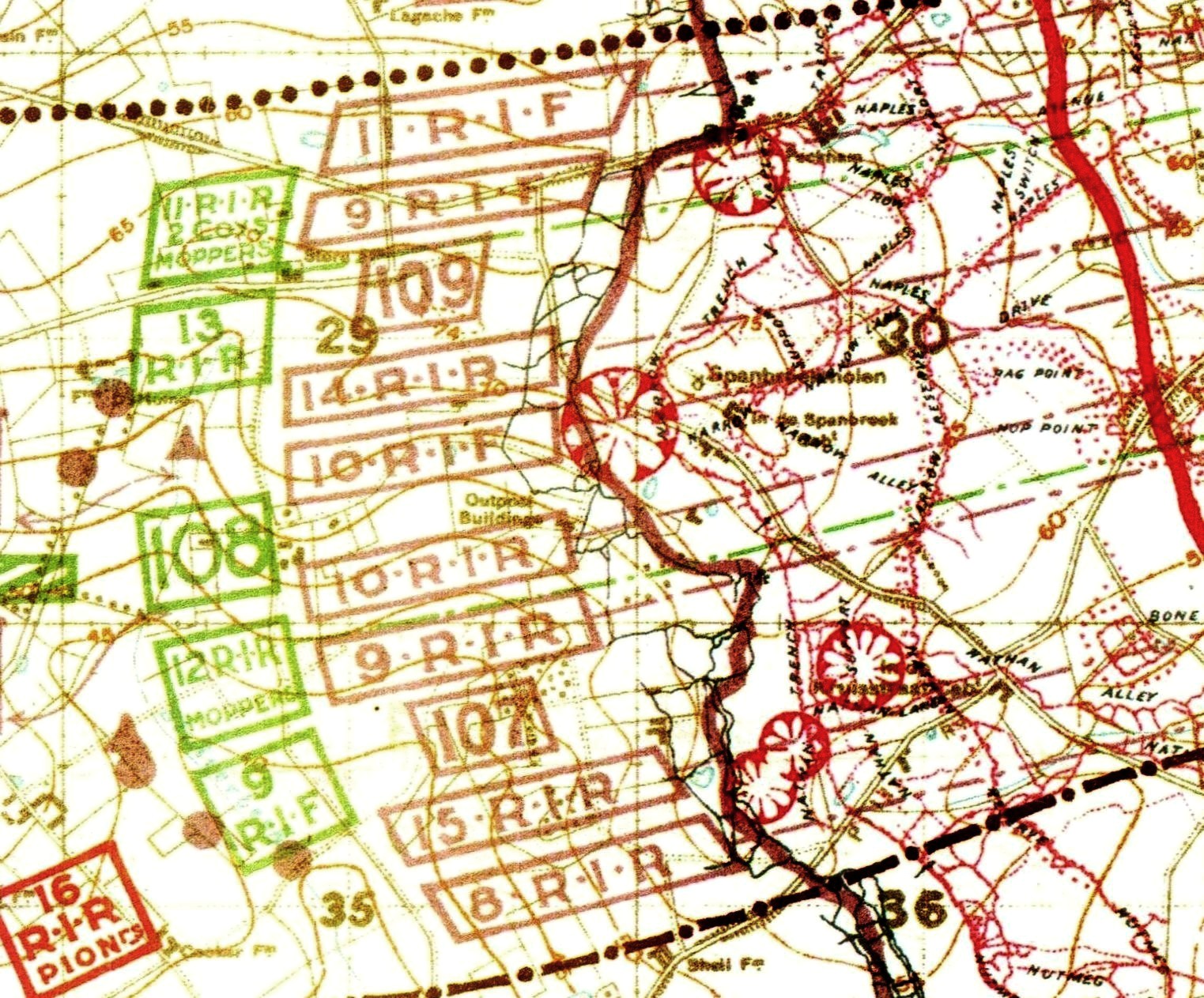
36 Div Deployment

The attack by the 36th (Ulster) Division at Messines on 7th June 1917. The first and second waves are shown alongside one another whereas the 14th Royal Irish Rifles led the 10th Royal Inniskilling Fusiliers attacking at Spanbroekmolen and the 8th Royal Irish Rifles led the 15th attacking Kruisstraat, where three mines were blown. (Detail from a map in the Harington Papers, King’s Regiment Collection, National Museums Liverpool)

However, the origin of the story of the Spanbroekmolen casualties may be traced to an account of the attack in a widely-read book published in 1978, They Called It Passchendaele, in which mines at Kruisstraat, 650 yards to the southeast, were confused with  the Spanbroekmolen mine. The author, Lyn MacDonald, quoted from an account by Lieutenant T. Witherow, 8th Battalion, Royal Irish Rifles, describing how his battalion also advanced prematurely (perhaps again owing to the Peckham mine firing before the others) and the death of a Lance-Corporal by falling mine debris:

We’d made it through the machine-gun fire and had almost got to the German positions, when a terrible thing happened that nearly put an end to my fighting days. All of a sudden the earth seemed to open and belch forth a great mass of flame. There was a deafening noise and the whole thing went up in the air, a huge mass of earth and stone. We were all thrown violently to the ground and debris began to rain down on us. Luckily only soft earth fell on me, but the Lance-Corporal, one of my best Section Commanders, was killed by a brick. It struck him square on the head as he lay at my side. A few more seconds and we would have gone up with the mine.[3]

Witherow’s 8th Royal Irish at Kruisstraat was separated by another battalion from the 14th Royal Irish Rifles attacking at Spanbroekmolen. Stokes recorded that a group of three mines at Kruisstraat went off two seconds after the Spanbroekmolen mine (i.e. 22 seconds after the Peckham mine). [4]  References in the text of They Called It Passchendaele indicate that Lyn MacDonald appeared unaware that Witherow’s battalion was far closer to the mines at Kruisstraat than to that at Spanbroekmolen.[5] A footnote in the book to Witherow’s account compounds the error:

Many of the Irishmen, both Southerners and Northerners, who were killed by the fall-out from the Spanbroekmolen mine lie where they fell in tiny Lone Tree cemetery, just down the hill from the Spanbroekmolen mine crater.[6]

Men of the 8th Royal Irish were indeed buried in Lone Tree Cemetery, even though they were killed some distance to the south, and it is quite possible that Witherow’s Lance-Corporal was buried there. No men from Northern Ireland, that is from the 36th (Ulster) Division, were killed by the Spanbroekmolen mine, the closest attackers being a third of a mile to the north.  Unless further eyewitness accounts come to light, there is no evidence that more than one British soldier was killed by the debris falling at Kruisstraat, and none that any were killed at Spanbroekmolen.

1024px-Lone_Tree_Crater_2009

The Spanbroekmolen crater, known today as the Lone Tree crater or Pool of Peace. (Wikimedia Commons)


See below for references & credits.


Buy signed copies of The War Underground 1914-18 and World War I Gas Warfare (Osprey Elite Series)PXL_20240524_113844426-cr


Peckham-enh

Myths of Messines: Four Misconceptions about the 1917 Battle Re-examined


References:

[1] War Diary, 14th Battalion, Royal Irish Rifles, TNA WO95/2511.

[2] Maj. R. S. G. Stokes RE Visits Diary, 7-8/8/1917, TNA WO158/137.

[3] Lyn MacDonald, They Called It Passchendaele, (London 1978), pp. 46-7; the informant may be identified as Thomas Hastings Witherow (1890-1989). MacDonald does not give details of the source for the account but it may be a typescript memoir of which a copy is held in the Liddle Collection, University of Leeds https://library.leeds.ac.uk/special-collections-explore/30002/witherow_t_h.

[4] Maj. R. S. G. Stokes RE op. cit.

[5] MacDonald, op. cit., pp. 39-40, 46-7.

[6] MacDonald, op. cit., p. 47.

Credit: Lone Tree Cemetery from Commonwealth War Graves Commission.


Underground WarfareBuy a signed copy of Underground Warfare 1914-1918 


Times 08061917 LG claims to hear Messines minesCrop

Myths of Messines: ‘The Big Bang heard in Downing Street’


Hausler miner 9June1917Myths of Messines: Did the Messines Mines Really Kill 10,000 Germans?


H15258

Myths of Messines: The Lost Mines of Messines


Myths of Messines: The ‘Lost Mines’

How was it that in 1955 a massive mine charge blew up in a Belgian field? When nineteen mines were detonated along a six mile front at the opening of the Battle of Messines on 7 June 1917, six more huge explosive charges totalling over 80 tons were left to lie dormant and forgotten deep beneath the battlefield. For decades, until the records in the British archives were examined, the number of ‘lost’ mines and their location remained unknown.[1]

Abandoned: the Birdcage Mines

The charge that went off was in fact one of four, planted close together on the far southern flank of the attack front. Laid with great effort by miners of 171st Tunnelling Company, they were at the end of two 700 feet long tunnels beneath a German salient known as the Birdcage which jutted towards the British lines. The charges of 20,000, 26,000, 32,000 and 34,000lbs, laid at between 65 and 80 feet depth, were designed to utterly destroy the Birdcage. Laid in the spring of 1916, they were intended for an the attack on the Messines Ridge originally projected to take place in June. But this attack, already scaled back after the German assault at Verdun, was postponed when the decision was taken in July to continue the Somme attack. The Battle of Messines was not to take place for another year.

GE Birdcage offensive schemes3crop2

The cluster of four Birdcage mines on a British plan. The German trenches are red, British galleries green, British front line black, over a modern aerial photograph. To the north are the Factory Farm and Trench 122 mines which were fired in the battle. (WO153/909 The National Archives /GoogleEarth)

When the new attack was ordered for June 1917, the four mines were not required but were kept in readiness. The 3rd Canadian Tunnelling Company had taken over the mines from 171st, and Lieutenant B C Hall was immediately ordered to inspect the Birdcage galleries to ascertain whether the mines could be blown in case of counterattack. Exhausted after the successful detonation of two mines nearby, he found the shaft damaged but was able to climb to the bottom. He found the detonator leads to be intact but, looking down the gallery, he could see that the timber props had all splintered in the middle, giving it the appearance of an hourglass or letter ‘X’. He was just able to squeeze through by crawling along the lower portion of the X, recalling that:

The going was very slow, extremely hard work and it was stiflingly hot.

He reached a point 400 feet beneath no man’s land, where the tunnel branched, but could go no further and with difficulty managed to turn around.[2] Two weeks later, the War Diary of the 3rd Canadian Tunnelling Company reported that the tunnels were being kept dry by pumping and baling but that the charges were not likely to be used.[3]

E01513

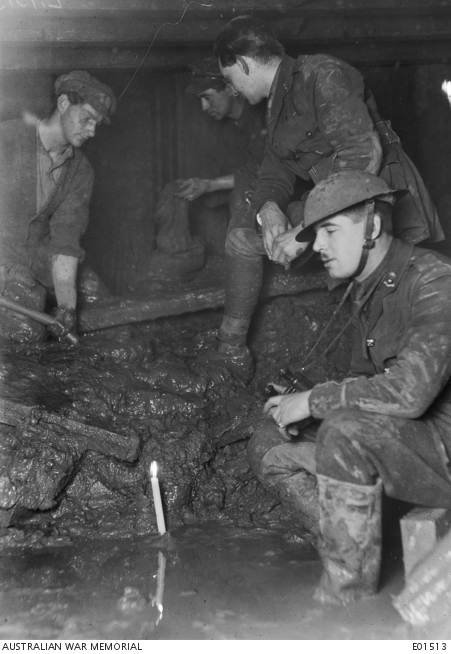
Tunnellers excavate a dugout in the Ypres Salient. The mine galleries were much smaller than this. (Australian War Memorial E01513)

How Lost were the ‘Lost’ Mines?

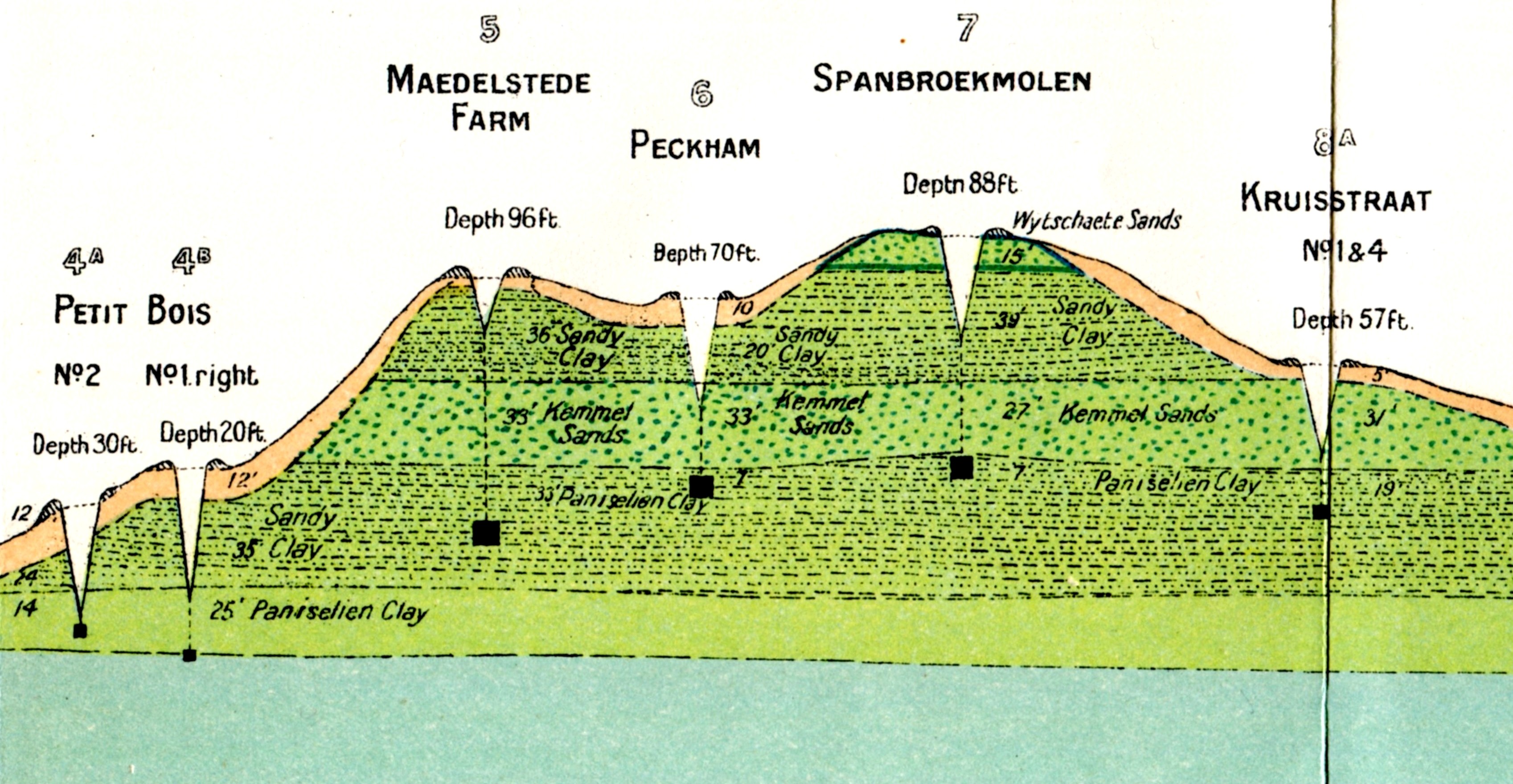
Two other mines were laid for the Battle of Messines but were ‘lost’ when it proved impossible to maintain access to them, owing to German activity and the extremely difficult geological conditions. The secret of the Messines mines was that they were laid in clay, known as ‘blue clay’, or a mixture of sand and clay, known as Paniselien or ‘bastard’ clay, which were impermeable to water. The thick bands of clay around 70 to 150 feet below ground are the cause of the high water table and waterlogged sands in Flanders. If a shaft could be sunk through the wet sand into the clay, then dry tunnels could be dug, but sinking a shaft required both great experience and special steel caissons or tubbing to keep out the tremendous pressures. Once a horizontal gallery was begun in the dry clay, there was still a danger of the clay membrane above breaking and the whole gallery flooding with a sudden inrush of sand and water.

Geological Work-004crop2contrCrop

The central of the nineteen Messines mines in the geological section shows how they were laid in the Paniselien or ‘bastard’ clay, close to the running sand and above the deeper blue clay.

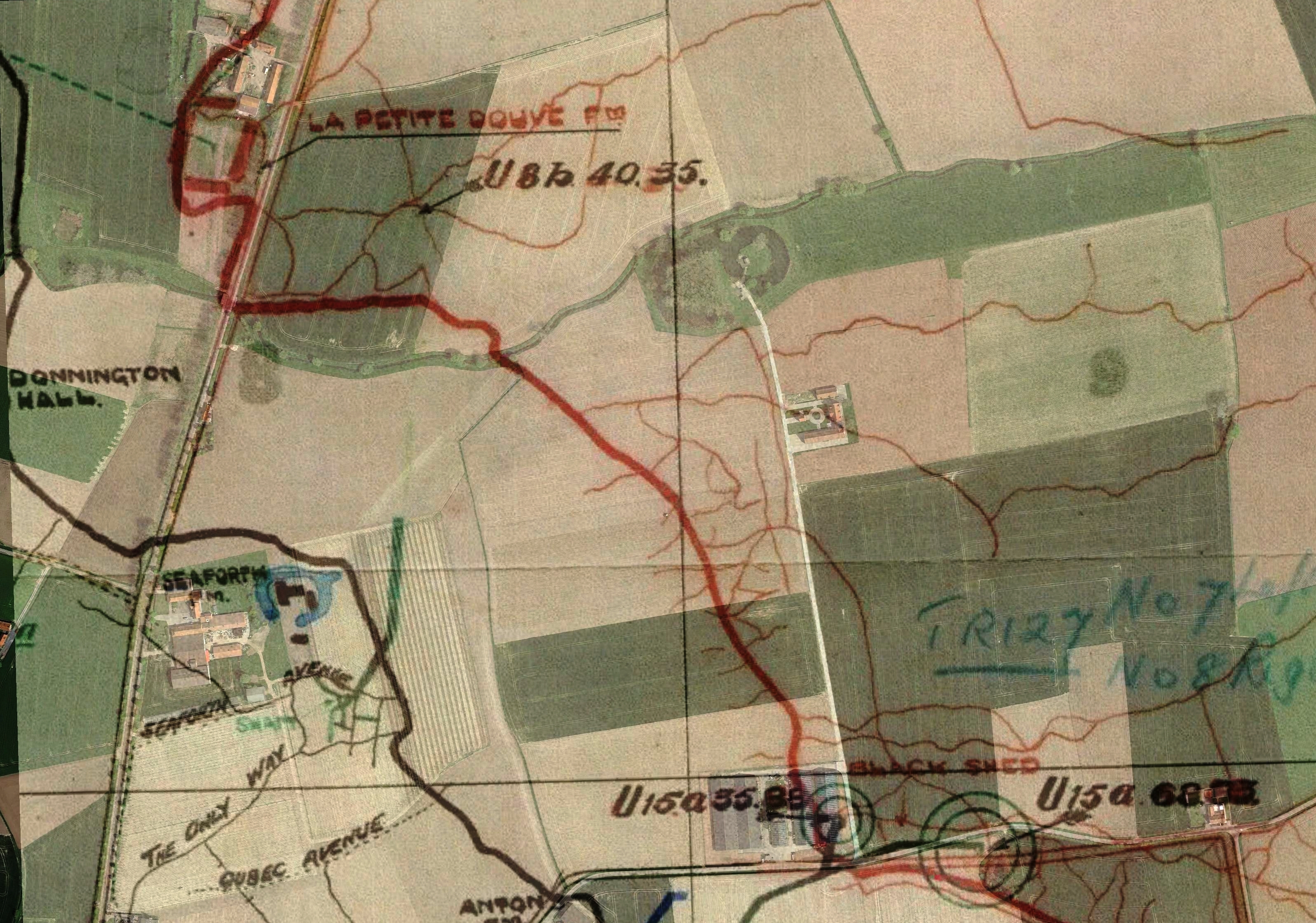
Lost through enemy action: the La Petite Douve mine

The shaft for a gallery aimed at a German position in the ruins of La Petite Douve Farm was started by the 3rd Canadian Tunnelling Company in March 1916. It was taken over by 171st Tunnelling Company who with much difficulty managed to sink it to 80 feet depth and drove a gallery 865 feet beneath the ruins. In mid-July they charged it with 50,000 pounds of explosives, then ran a branch tunnel to the left to prepare a second charge chamber. The Germans were suspicious and sank two shafts to search for the British tunnels but lined them with timber not steel, through which the water constantly forced its way in. On 24 August the British heard the Germans working so close to their branch gallery that they seemed about to break in. To have fired a charge to destroy the German working would probably also have detonated their main charge, and so 171st laid a small charge sufficiently large to rupture the clay membrane which would flood the workings with water and sand but leave their main charge intact. They could hear the Germans clearly, laughing and talking, and on 26th detected them breaking into the chamber where they had laid the smaller charge. The British immediately detonated it, killing nine Germans underground and sending a large cloud of grey smoke up the shaft in the German positions. The main British charge was undamaged and 171st laid a 1,000 pound charge in the branch gallery ready to blow again. However, the Inspector of Mines at GHQ was concerned that this would escalate underground warfare in the sector and lead to the loss of the main charge. The Germans did retaliate with a heavy charge two days later which smashed 400 feet of the main British gallery and killed four men engaged in repairs. It also cut off access to the 50,000 pound charge but, as it was clear to the British that further activity was pointless, 171st was forced to abandon the gallery and the mine became ‘lost’.

GE Petit Douve offensive schemesCorrCrop2

La Petit Douve mine on a British plan, top left. The German trenches and the farm ruins are red and the British galleries in dashed green, over a modern aerial photograph which shows the location of the rebuilt farm slightly to the north. (WO153/909 The National Archives /GoogleEarth)

Lost to quick sand: the Peckham branch mine

The liquid wet sand was also particularly troublesome at a drive towards a position at Peckham Farm to the south. When the clay was exposed to the air it swelled with such force that it splintered the usual supports, necessitating the use of 7″ x 7″ timbers. After driving a gallery, started in December 1915, 1,145 feet beneath the farm the British laid a charge of 87,000 pounds, then attempted to drive branch galleries to a second objective but twice had to abandoned them, the Tunnellers escaping with their lives from the rapid inrush of water and sand. The third attempt appeared more successful until the ground again gave way. Eventually however, a 20,000 pound charge was laid by creating several small chambers. When the electric pumps broke down, access to the large and small charges was lost and the gallery had to be re-dug for 1,000 feet, with steel joists now replacing the wooden timbers, until eventually in March 1917 connection was again gained with the larger charge. The smaller charge however was judged to be too difficult to regain and was abandoned.

GE Peckham offensive schemes3corr

The Peckham mine crater and the ‘lost’ mine to the northeast. The German trenches and farm ruins are red and the British galleries in green, over a modern aerial photograph which shows the location of he rebuilt farm on top of the unexploded mine. (WO153/909 The National Archives /GoogleEarth)

How Dangerous are the ‘Lost’ Mines?

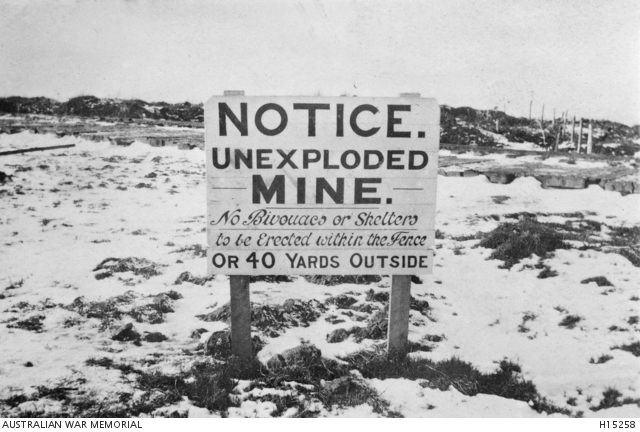
The Messines charges were carefully waterproofed by packing the explosives in tins covered in tarred canvas. The detonators were sealed in bottles and the leads protected by rubberised canvas hoses inside coiled steel. It was perhaps this armoured hose running up to the surface that carried the electrical current to the detonators of one of the Birdcages charges 65 feet below ground, from a lightning strike nearly forty years after it was laid. It caused the detonation of the easternmost of the four mines but thankfully the only casualties were cows, an electricity pylon and some roadway. The other three Birdcage mines still lie nearby beneath the former battlefield. After the war La Petite Douve Farm was rebuilt about 100 yards to the north of the location of the old farm, still uncomfortably close to the abandoned 50,000 pound mine. The farm close to Peckham mine was rebuilt 100 yards to the northeast, exactly over the location of the ‘lost’ 20,000 pound mine.

H15258

The location of this warning sign is not known but it may have been placed over the Birdcage mines after the Battle of Messines. (Australian War Memorial H15258)

See below for the notes to this article.


Click to contact me


Buy signed copies of The War Underground 1914-18 and World War I Gas Warfare (Osprey Elite Series)

PXL_20240524_113844426-cr


The Story of the Lochnagar Mine

Lochnagar-tunnels-Screenshot-SimonJonesHistorian


Join me on a battlefield tour with The Cultural Experience

Simon Jones Battlefield Tour Somme Poets 2019

The Battles of the Marne & the Aisne 1914 – 1918

First & Last Shots 1914 & 1918

Medics & Padres in the Great War

Walking Ypres 1914-1918

Walking the Somme

More Information about Battlefield Tours


sawyer-spence

Understanding Chemical Warfare in the First World War


Notes

[1] Sources used for this article may be found in my book Underground Warfare 1914-1918 (Barnsley 2010).

[2] B. C. Hall, Round the World in Ninety Years, (Lincoln, 1981), p. 66.

[3] War Diary 3rd Canadian Tunnelling Company, 22/6/1917, Library and Archives Canada [accessed 30 April 2017].

Detail from geological section of Second Army Offensive Mines 7/6/1917 from The Work of the Royal Engineers in the European War, 1914-19. Work in the field under the Engineer-in-Chief, B.E.F., Geological Work on the Western Front, (Institution of Royal Engineers, Chatham, 1922)


Times 08061917 LG claims to hear Messines minesCrop

Myths of Messines: ‘The Big Bang Heard in Downing Street’


More articles on the Home page.


Underground Warfare

Buy a signed copy of my book direct from me.

1917 Practice Tunnels on Salisbury Plain

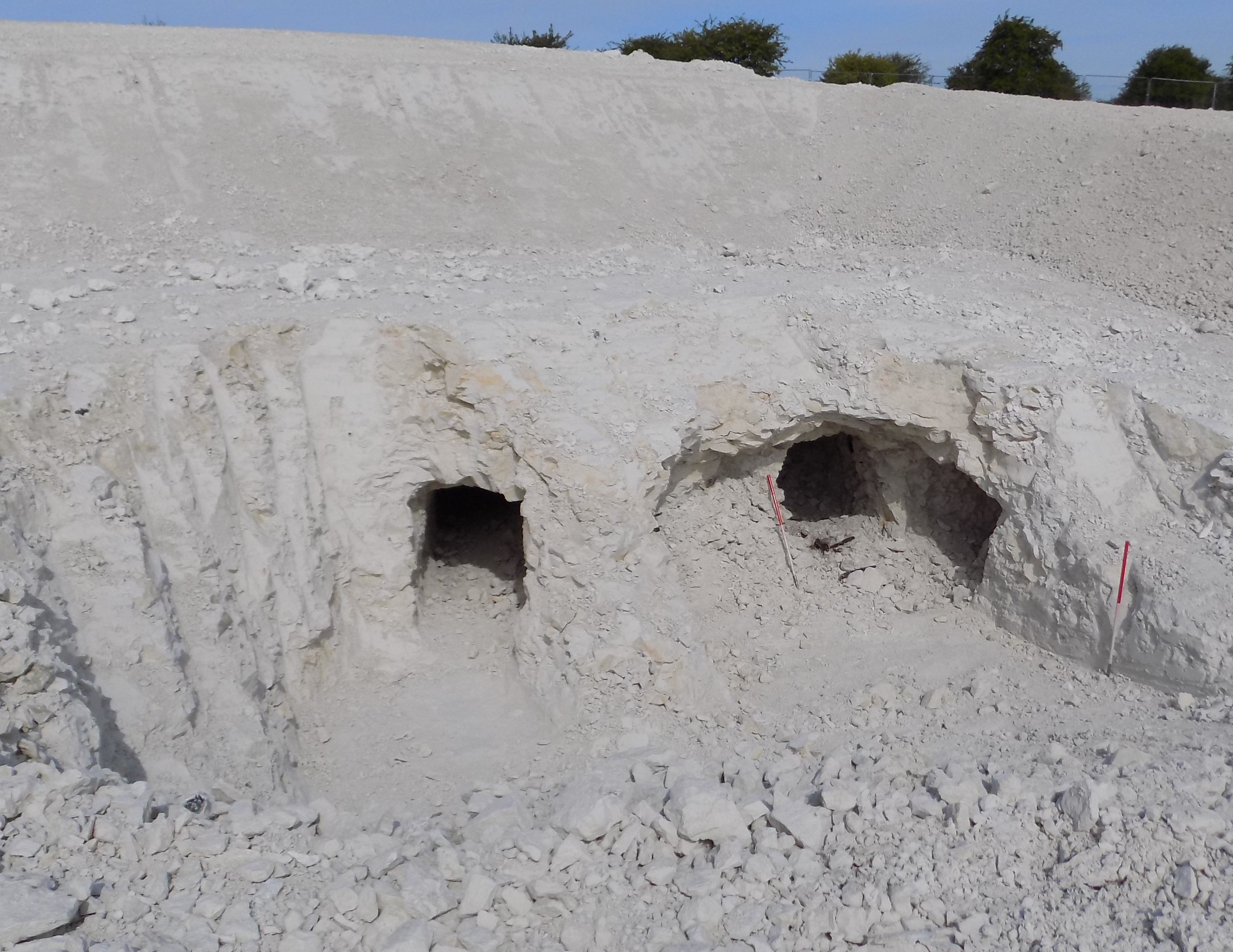
These tunnels from the First World War have only recently been uncovered. Constructed close to Larkhill Camp, they are part of a large number of trench networks created on Salisbury Plain for troop training during 1914-1918. Almost every camp had a system of practice trenches aiming to replicate what would be found at the front. entrances crop DSCN2925

In April 2017 I was lucky enough to be invited to view the last parts of the tunnels found before they were covered to make way for a housing development. My thanks go to archaeologists  Martin Brown and Si Cleggett.

timbering DSCN2918

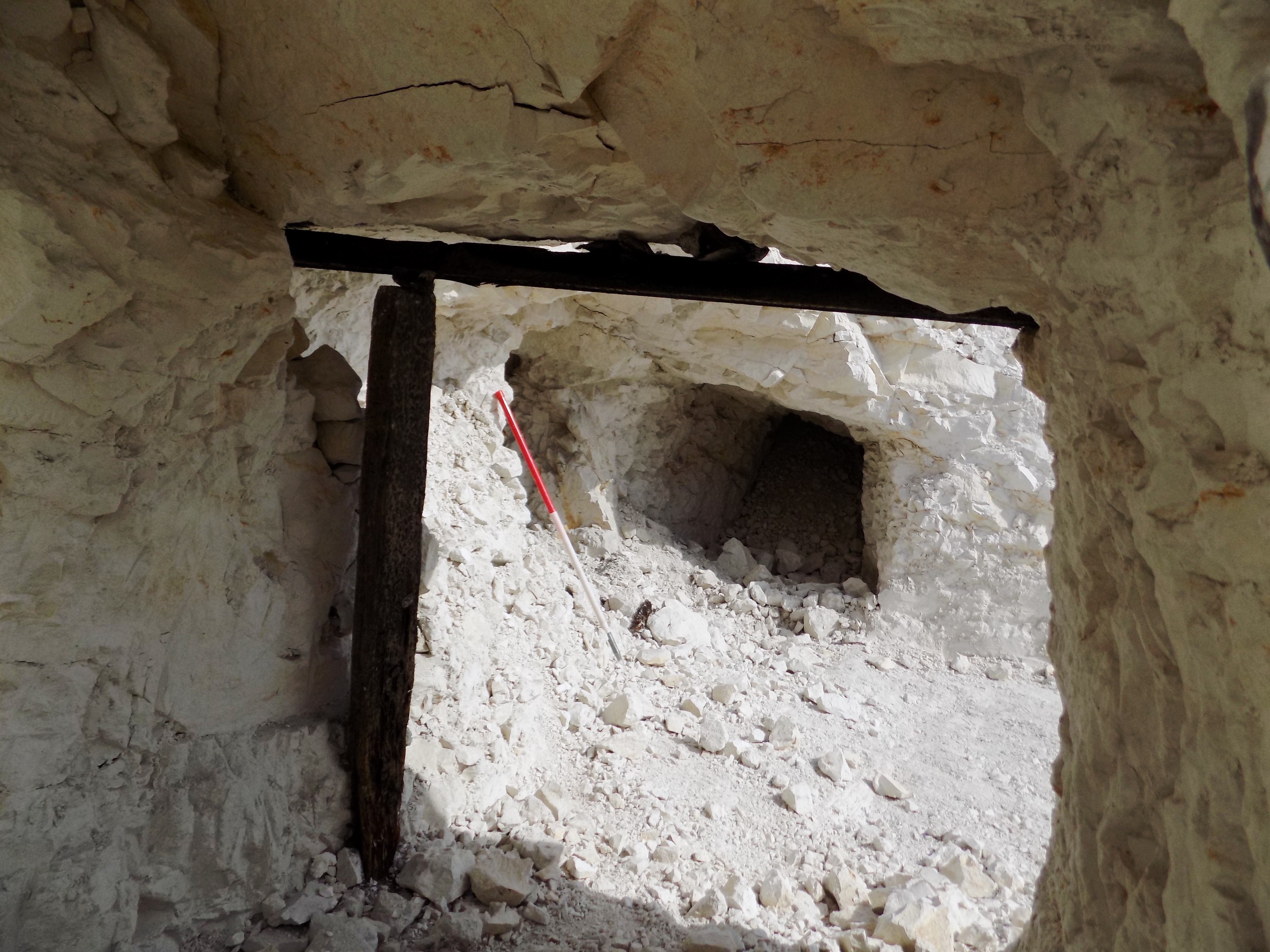
The galleries are low in height and comparatively shallow, no more than 25 feet beneath the surface, reminiscent of those dug at the front early in the war in 1915.

Peter Doyle via Twitter ez04lSEW

(Photo © Peter Doyle)

They do not appear to be the work of professional miners and were probably dug either by an Engineer Field Company or Infantry Pioneers.  It is probable they were being developed into dugouts.

soot and timber crop DSCN2930

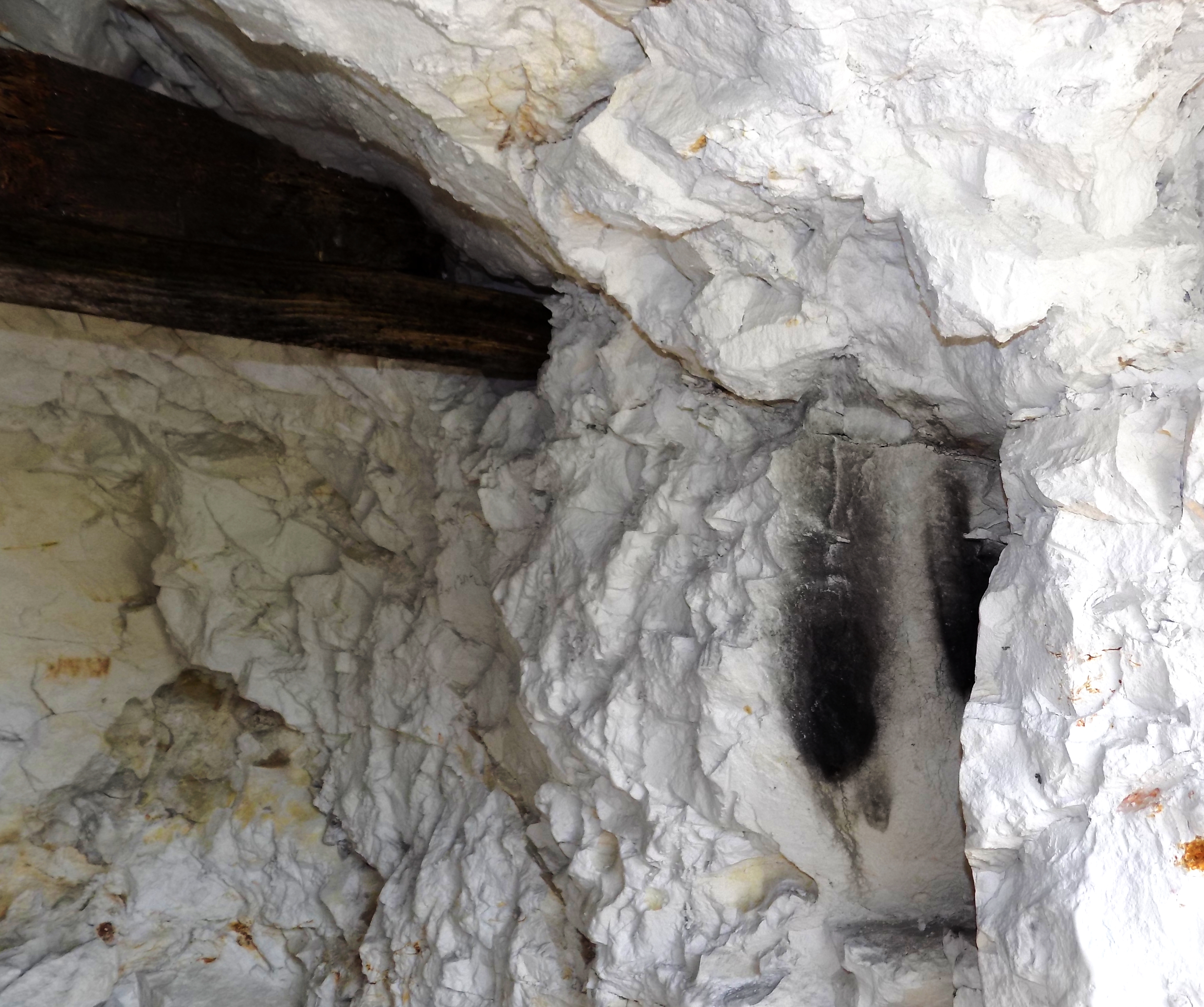
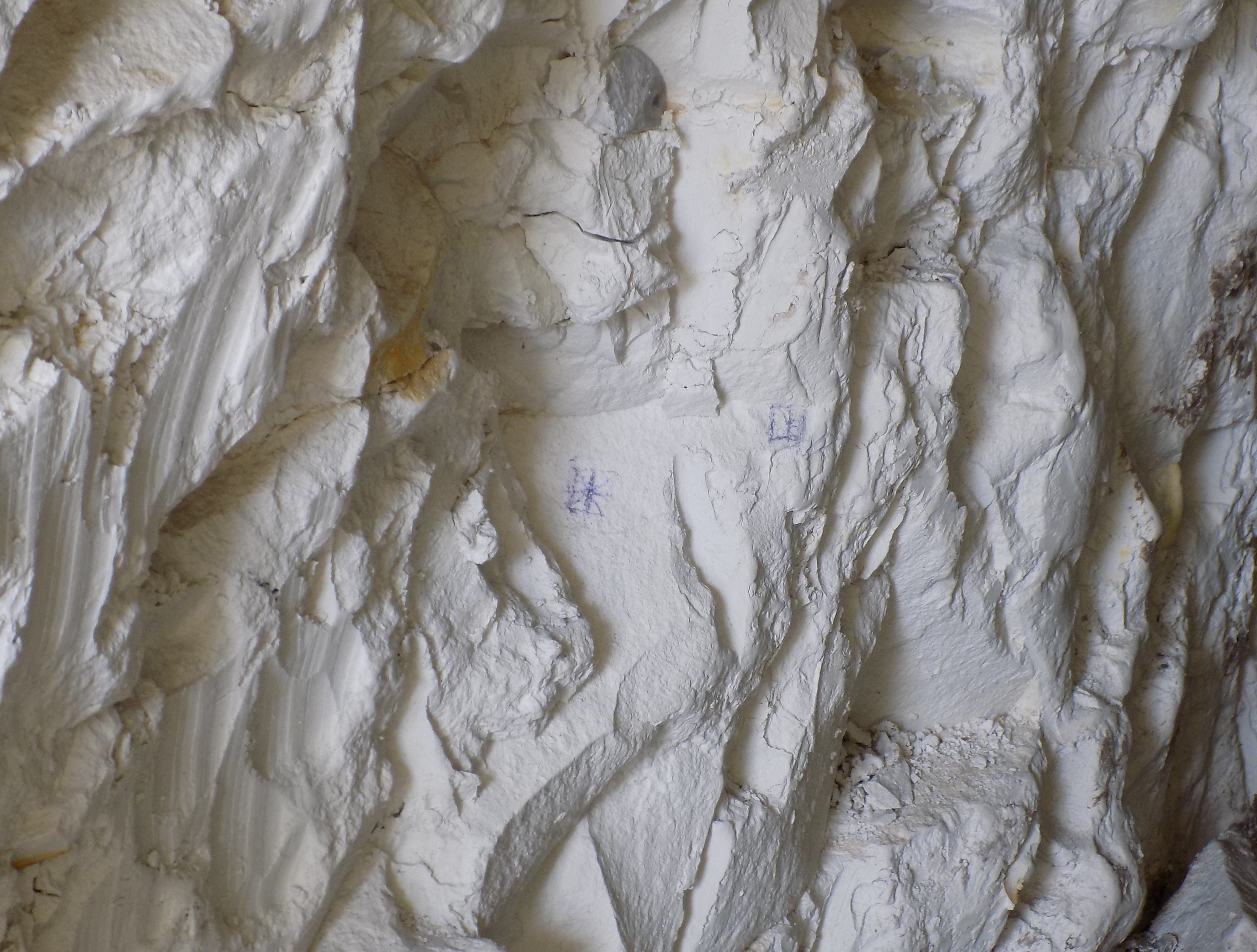
The tunnelled galleries were cut with a flat headed pick or mattock and feature an unconventional form of timbering with just one vertical prop and the other end of the sill slotted into the chalk wall. Soot from a candle can be seen on the wall to the right.

flags crop DSCN2946

Tiny Union flags drawn on the wall a hundred years ago were easily missed.

Wilts names crop DSCN2931

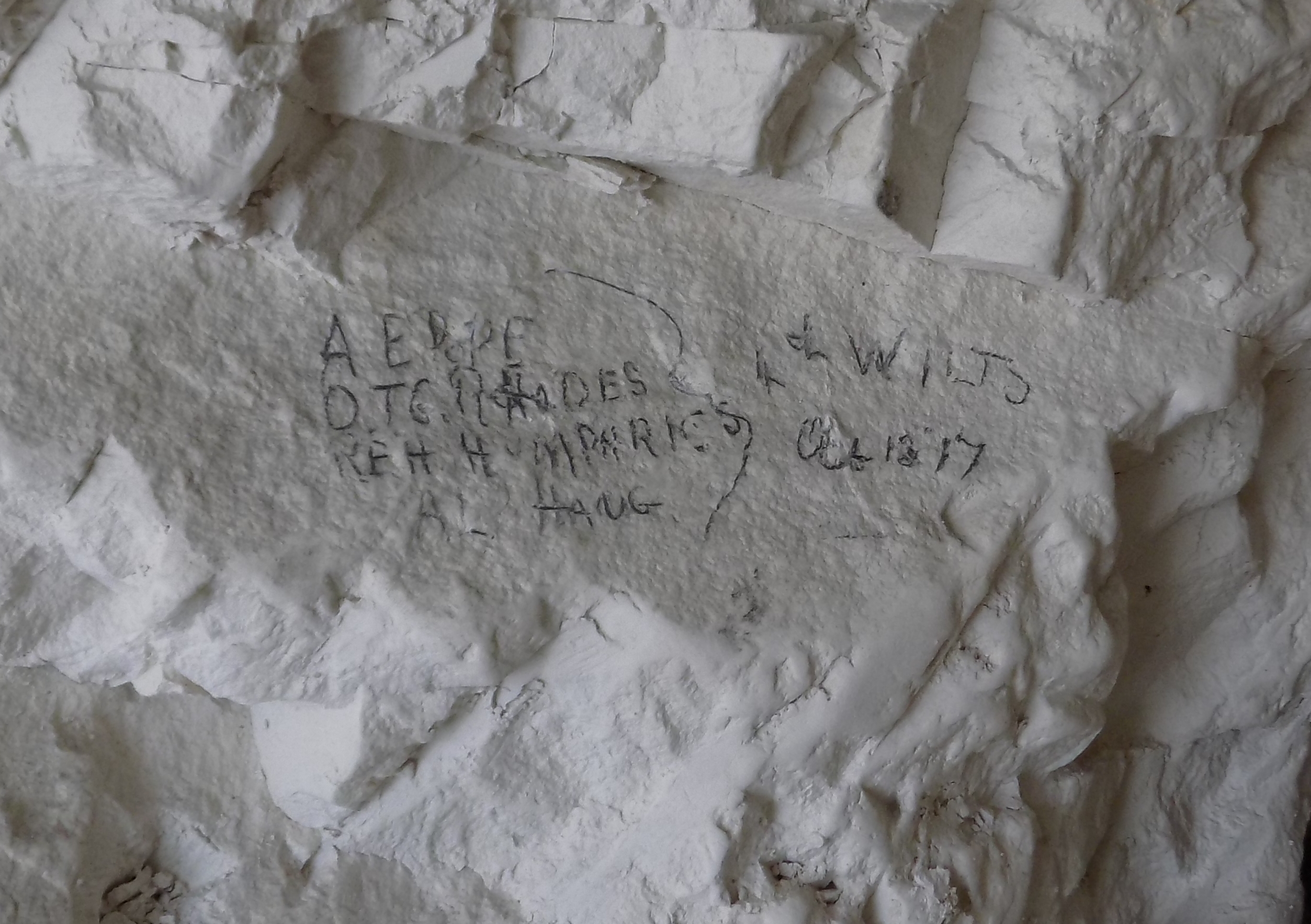
Four men of the 3/4th Battalion Wiltshire Regiment left their names on 13th October 1917. At least one of them, Oswald Thomas Gardiner Rhodes, served overseas and survived the war.

plans DSCN2969

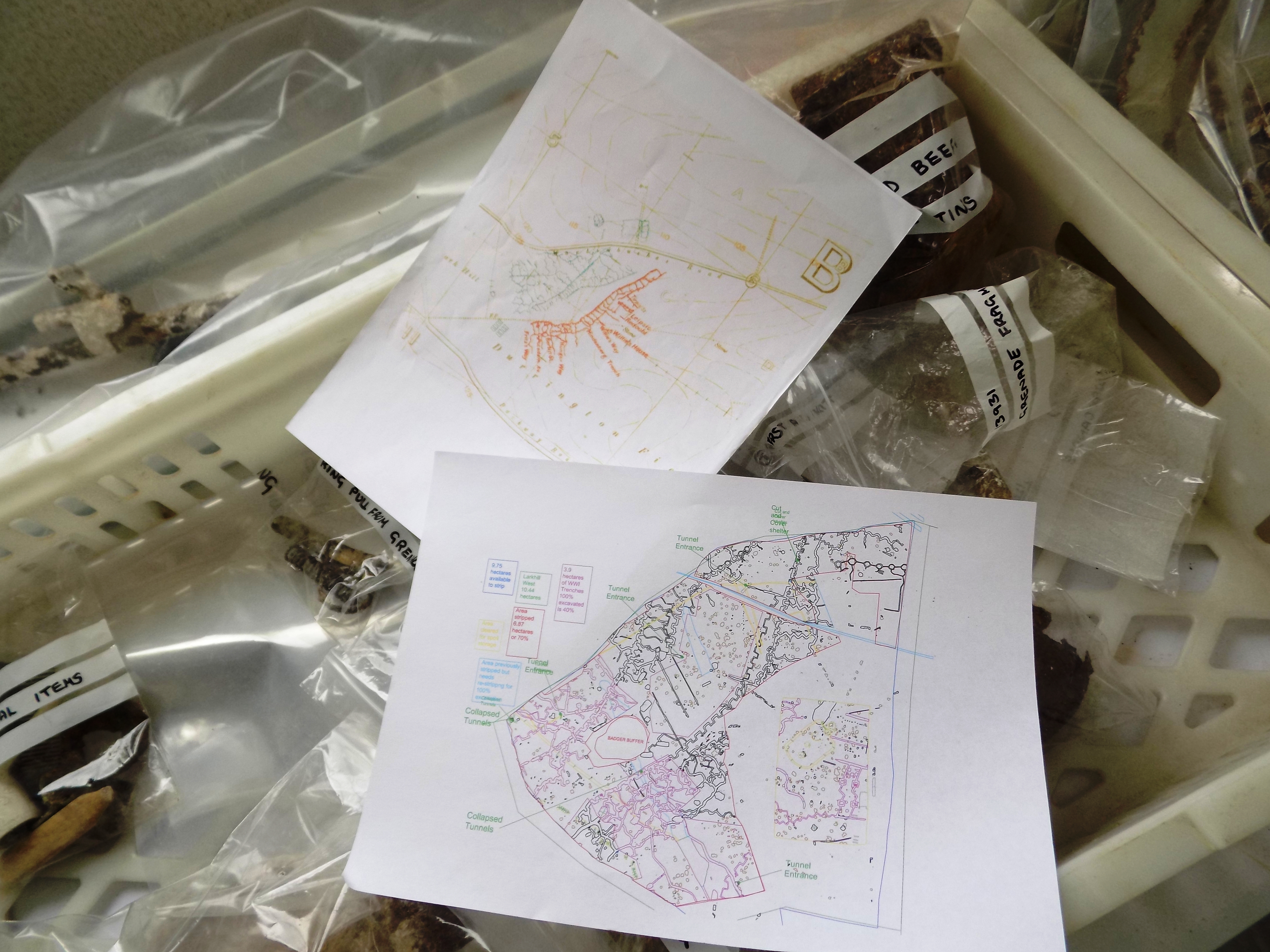
The site has been laser surveyed and compared to a 1917 trench map. What was found had clearly been developed beyond that shown in the map as successive units extended the trenches and tunnels.

CLE crop DSCN2967

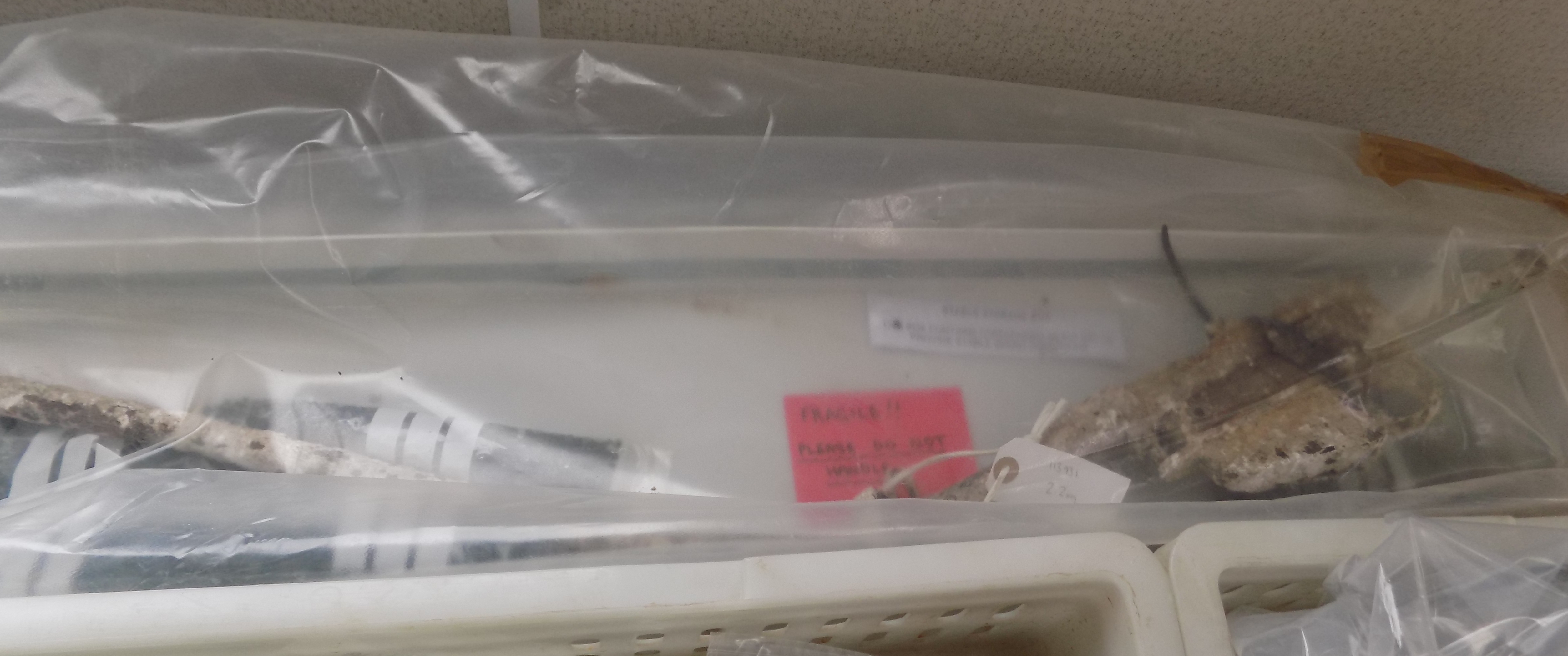
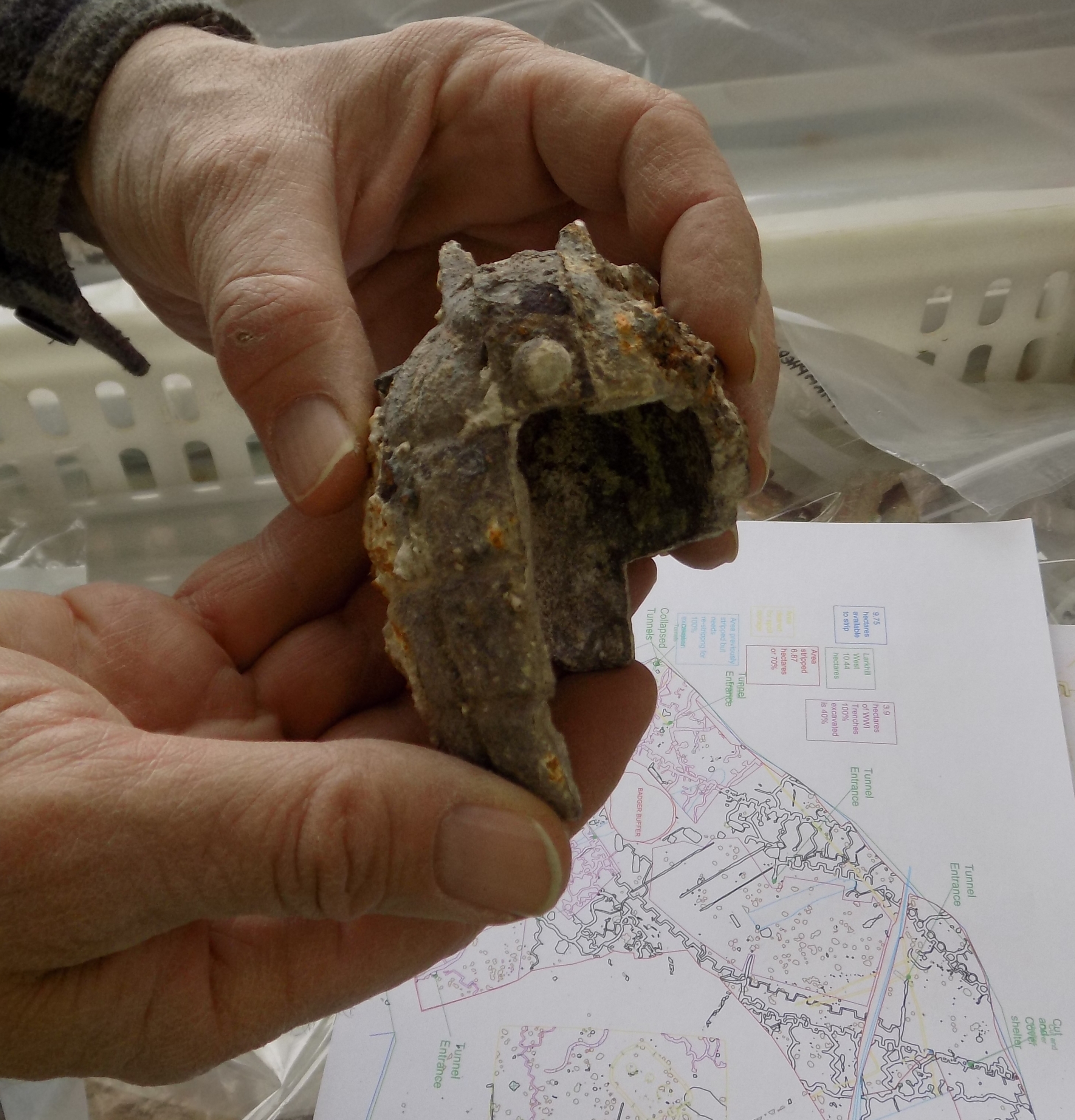
The artefacts bear witness both to training activity and the daily lives of soldiers spending several days at a time in the trenches. Here can be seen a British Long Lee Enfield rifle, commonly used for training and possibly damaged by shellfire.

grenade DSCN2968

A broken practice grenade. Finds included both live and inert grenades.

cigs crop DSCN2965

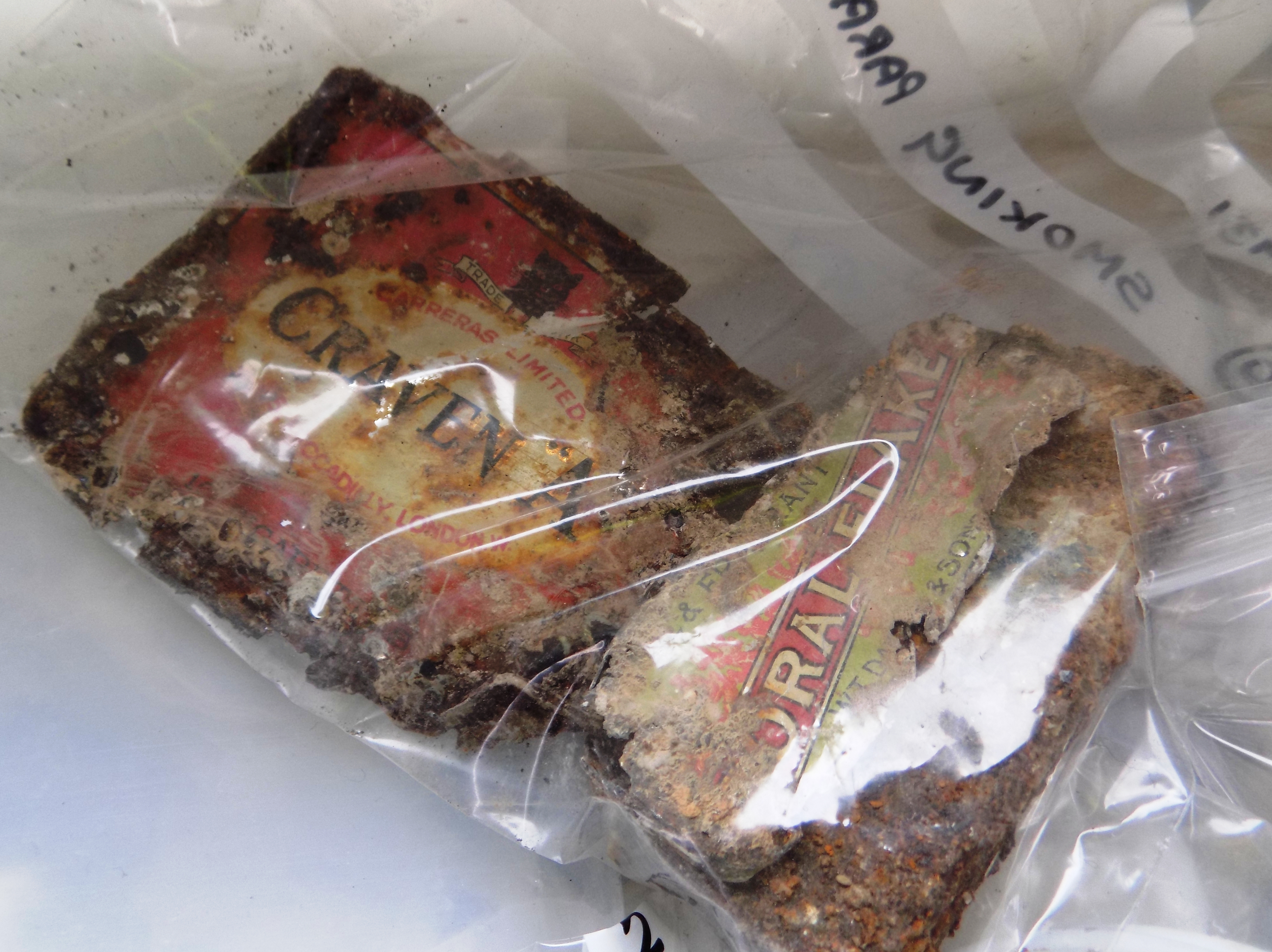
Tins which contained Craven A cigarettes and Coral Flake tobacco. The trenches were believed to have been filled in soon after the First World War and contained much detritus including cigarette and ration tins.

8th R Berks Sutton Veny 26 Div 1915cropRes

8th Royal Berkshire Regiment training at Sutton Veny, 1915 (Photo © Simon Jones).

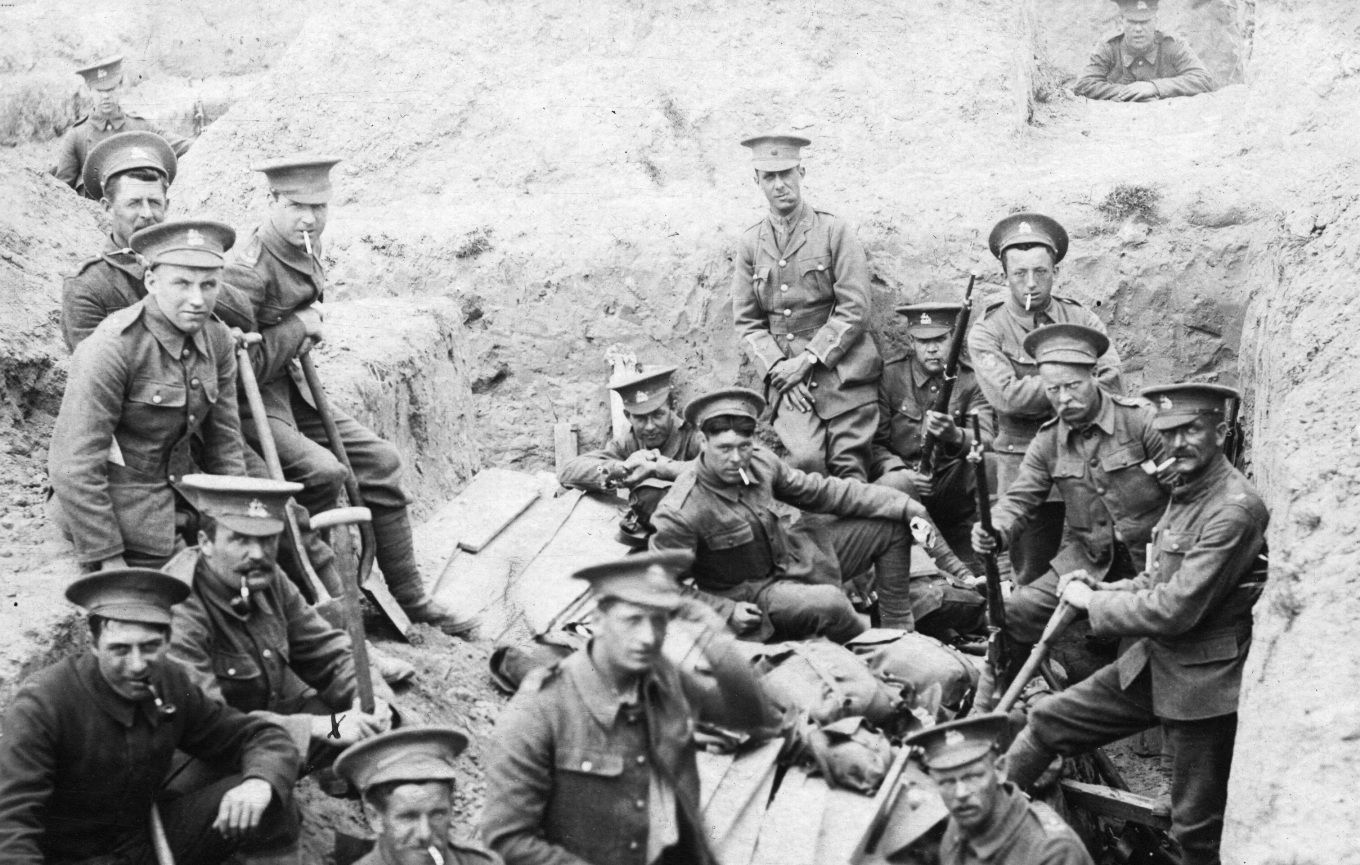
Research into Salisbury Plain during 1914-1918 and discoveries such as this are changing the understanding of its importance in preparing soldiers for battle. By 1916, training was highly realistic, incorporating the latest tactics.  In particular, Major-General Monash’s 3rd Australian Division trained here August to November 1916 making use of the opportunity for highly realistic training in conjunction with artillery and aircraft. The proximity of gunnery and aviation schools facilitated co-operation with the infantry to develop the ‘all-arms’ battle which became a highly effective feature of British fighting methods in 1918.

Vote for this excavation as Current Archaeology Rescue Project of the Year. 

Article in Current Archaeology.


H15258

The Lost Mines: how many unexploded mines remain beneath the Messines ridge battlefield?


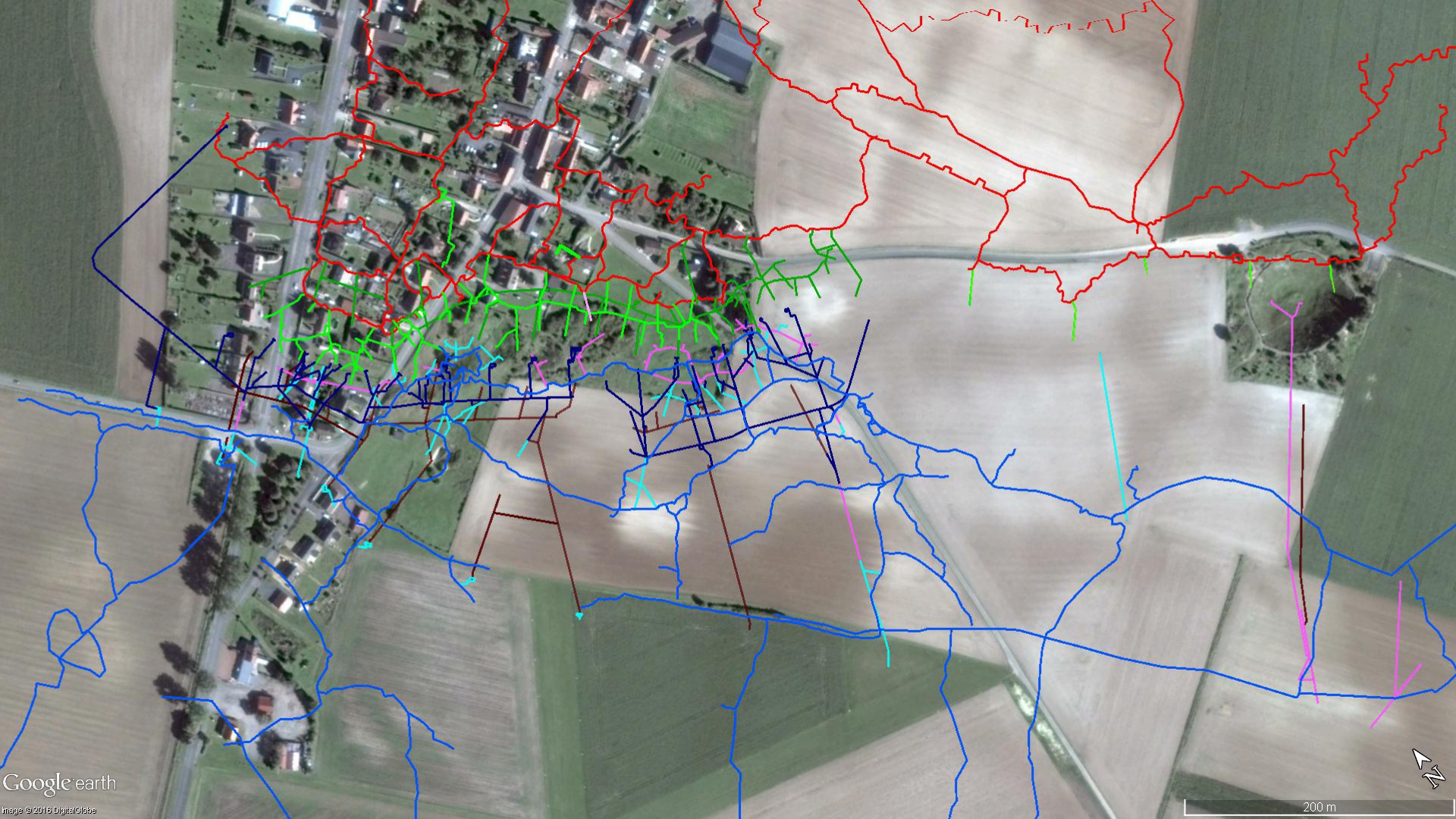
British and German mine systems at La Boisselle. (c) GoogleEarth and Simon Jones

The Lochnagar Mine


joe-cox-and-tom-hodgettsres

Shirebrook Miners in the Tunnelling Companies


Join me on a battlefield tour with The Cultural Experience

Simon Jones Battlefield Tour Somme Poets 2019

The Battles of the Marne & the Aisne 1914 – 1918

First & Last Shots 1914 & 1918

Medics & Padres in the Great War

Walking Ypres 1914-1918

Walking the Somme

More Information about Battlefield Tours

Myths of Messines: ‘The Big Bang Heard in Downing Street’

When nineteen underground mines were detonated at the opening of the Battle of Messines south of Ypres in Belgium, at 3.10 a.m. on 7 June 1917, the sound is frequently said to have been heard in 10 Downing Street by the Prime Minister, David Lloyd George.[1]  There is evidence that the earth tremor caused by the explosion of around one million pounds of explosives was felt at a great distance.  Charles Barrois, a geologist in Lille, 12 miles away, later told his Australian counterpart, Sir Edgworth David, that the effect was such that people rushed from their houses thinking that there was an earthquake.[2] Tremors were detected by seismographs near Utrecht, at 130 miles distance, and on the Isle of Wight, 180 miles away.[3]

02-caterpillar-crater-hill-60

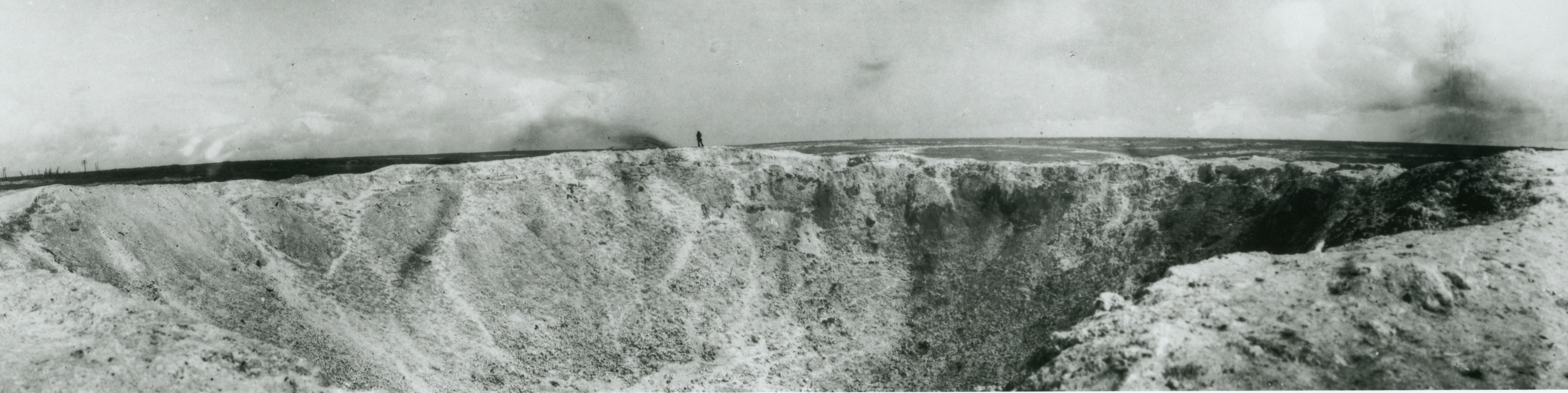
The Caterpillar Crater, the result of 70,000 pounds of explosives laid 100 feet beneath the German lines. It is one of the 19 Messines mines detonated at 3.10am on 7th June 1917.

The claim that the mines were heard in Downing Street appears to have originated as a report in The Times the following day which stated that Lloyd George heard them at his home at Walton Heath in Surrey. This was 140 miles from the mines and, by coincidence, the same distance as Downing Street. The Prime Minister was said to have given orders to be called at 3 a.m. and with others had ‘heard clearly the tremendous shock’.  The report further stated that at the same time ‘persons in the neighbourhood of the premier’s official residence in London also heard what they judged to be heavy guns across the Channel’.[4]

Times 08061917 LG claims to hear Messines mines

The Times, 8 June 1917.

The science journal Nature repeated the claim that the Prime Minister had heard the explosions but, a fortnight later, printed a correction after receiving information from two Royal Engineer officers who had witnessed the detonations. One, a mile away from the mines, described the noise as ‘not so very great’, while the other, eight miles away, ‘saw the flash, waited for the noise, and heard only a slight “phit.”‘[5]

Other observers left accounts which enable a clearer idea to be gained of what might have been heard in England, if it was not the sound of the mines. Another Royal Engineer officer, a Tunneller Brian Frayling, observing from Kemmel Hill two miles away, described the tremor as ‘a violent shaking of the ground’ with a distinct interval before columns of flame rose.[6]  The Tunnelling officer Hugh Kerr ‘saw the whole area leap into the air – a never to be forgotten sight.’ But he expressed the view that to have heard the mines in London was ‘bunkum or wishful thinking!’ and ‘due to lively imagination’. It was the guns, he said, which had made the sound: ‘What about the barrage! That was a noise!’[7]

Eyewitnesses describe a sequence of three events: a powerful earth tremor from the mines, flames streaking into the air, and then the artillery opening fire.  For the first time in an attack, the detonation of the mines was used by the gunners as the signal for the opening of the British barrage and, within a few seconds, more than 2,000 guns opened fire. Only in describing the guns do the eyewitnesses describe a noise.  An artillery officer, Ralph Hamilton, watching the detonation of the Hill 60 and Caterpillar mines, experienced the tremor, the flames and then the guns:

First, there was a double shock that shook the earth here 15,000 yards away like a gigantic earthquake. I was nearly flung off my feet. Then an immense wall of fire that seemed to go half-way up to heaven. The whole country was lit with a red light like in a photographic dark-room. At the same moment all the guns spoke and the battle began on this part of the line. The noise surpasses even the Somme; it is terrific, magnificent, overwhelming. [8]

DSCF6990 noiseCrop

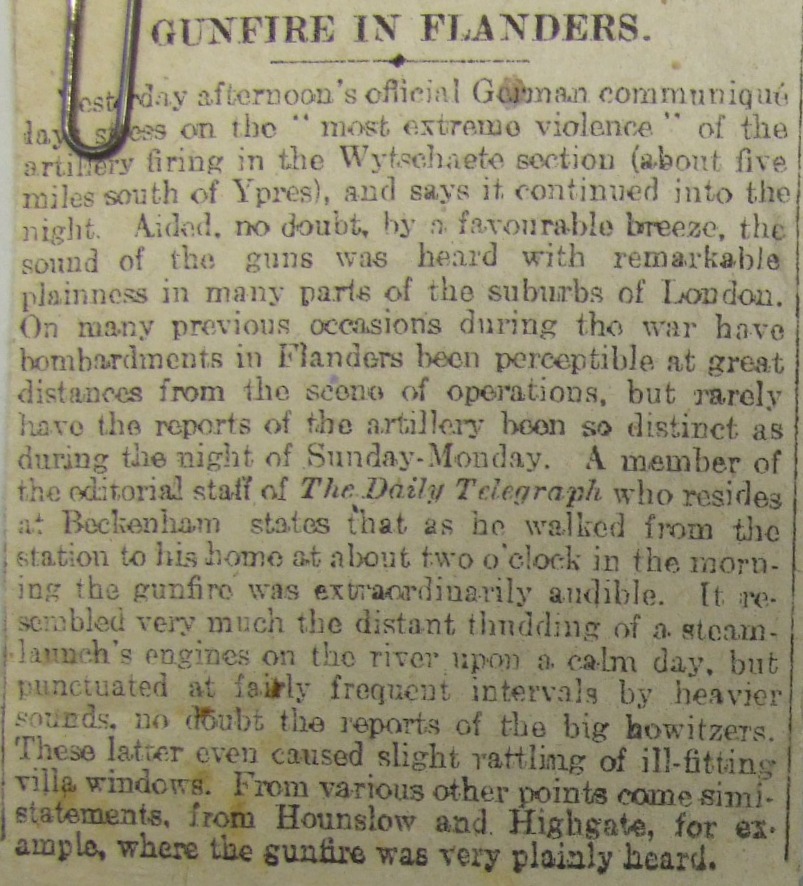
The Daily Telegraph, 5 June 1917.

There is much evidence that gun fire from the Western Front was audible in England during the First World War, including in the days before the Messines attack was launched. The Daily Telegraph reported that one of their staff had heard it clearly, in a southeast London suburb at 2am of 4 June, resembling ‘the distant thudding of a steam-launch’s engines on the river upon a calm day’, punctuated by heavier sounds thought to be large howitzers which caused a ‘slight rattling of ill-fitting villa windows’.  In other parts of London, ‘from Hounslow to Highgate’, gunfire was plainly heard.[9]

If Lloyd George heard something at Walton Heath therefore, it seems more likely that it was the synchronised firing of more than 2,000 guns.

See below for references.


Buy signed copies of The War Underground 1914-18 and World War I Gas Warfare (Osprey Elite Series)PXL_20240524_113844426-cr


Hausler miner 9June1917

Myths of Messines: Did the Messines Mines Really Kill 10,000 Germans?


H15258

Myths of Messines: The ‘Lost Mines’


Lone Tree Cem CWGC

Myths of Messines: Killed by their own mine?


Underground Warfare

Buy a signed copy of Underground Warfare 1914-1918 at a reduced price


Notes to ‘The Big Bang Heard in Downing Street’:

[1] The internet, passim.

[2] Tunnellers’ Old Comrades Association Bulletin, No.  1, 1926, pp. 11-12.

[3] Koninklijk Nederlandsch Meteorologisch Instituut, Seismische Registrierungen in De Bilt, Vol. 5, 1917 (Utrecht, 1920), p. 41; Nature, No. 2485, Vol. 99, 14/6/1917, p. 312.

[4] The Times, 8/6/1917.

[5] Nature, No. 2485, Vol. 99, 14/6/1917, p. 312; Nature, No. 2487, Vol. 99, 28/6/1917, p. 350.

[6] Brian Frayling, ‘Back to Front’ by B.E.F. TS memoir Brian Frayling, Royal Engineers Museum and Archives.

[7] H. R. Kerr, letter to Alexander Barrie 8/3/1962, Barrie Papers, RE Museum & Archives.

[8] Ralph G. Hamilton, The War Diary of the Master of Belhaven (London 1924), p. 304; see also the account ‘Messines’ by ‘Tunneller’, Tunnellers’ Old Comrades Association Bulletin, No. 5, 1930, p. 23.

[9] The Daily Telegraph, 5/6/1917.


Q3999 cropThe Story of the Lochnagar Mine


Who was Ivor Gurney’s ‘The Silent One’? The night attack by the 2/5th Glosters on 6-7 April 1917

Vincent Faupier19698175Res

© Vincent Faupier.

In Ivor Gurney’s poem about his experiences in the First World War ‘The Silent One’, the musician and poet describes a failed night time attack in which a non-commissioned officer is killed and left hanging on the uncut barbed wire. With the attack held up, Gurney is politely asked by an officer to try to get through a possible gap in the wire but, with equal politeness, he declines.

The poem has been described by his biographer as ‘this most truthful report from the battlefield’.[1] Although he was writing in the 1920s, the preciseness of the details suggest that Gurney was recalling an actual event.  In 2010, while I was guiding a group on a literature-themed tour of the Western Front, we visited the place where Gurney was wounded during an attack on the night of 6th – 7th April 1917 and we realised that this was clearly the event that Gurney was describing in ‘The Silent One’.[2]  It was one of many minor attacks made by the British as they pursued the German withdrawal from the Somme battlefield to the Hindenburg Line. Typically the Germans held positions for a few days, inflicting casualties with machine guns, before pulling back. The British attack had been planned for two days earlier only to be cancelled. Every such attack required soldiers to prepare themselves mentally for death or wounds and Gurney described his feelings to his friend Marion Scott:

           My state of mind is — fed up to the eyes; fear of not living to write music for England; no fear at all of death.

He hoped a ‘Nice Blighty’ would come soon, by which he meant a wound serious enough to require treatment in the UK.[3]  A fortnight after the attack had taken place, Gurney wrote again to Marion Scott, explaining that he was indeed ‘wounded: but not badly; perhaps not badly enough’ for he did not have a Blighty wound but was in hospital in Rouen.

           It was during an attack on Good Friday night that a bullet hit me and went clean through the right arm just underneath the shoulder…[4]

Guney Rouen May 1917 Gloucestershire Archives

Ivor Gurney in Rouen while recovering from the wound in his right arm received during the attack of 6- 7 April 1917. (The First World War Poetry Digital Archive, University of Oxford (www.oucs.ox.ac.uk/ww1lit); © The Ivor Gurney Archive, Gloucestershire Archives).

GBM-WO363-4-007407751-00204cropEnh

Part of Ivor Gurney’s service record showing the date of his wound on 7 April 1917, the abbreviation indicating ‘gunshot wound right arm’. (National Archives WO363 via Findmypast.com).

The attack was made by two battalions of Gurney’s Brigade. On the left was the 4th Battalion Oxfordshire and Buckinghamshire Light Infantry while on the right was Gurney’s battalion, the 2/5th Gloucestershire Regiment.  The Glosters (as they were known) attacked with two companies, Gurney’s B Company was on the left and C Company on the right. The 59th Division was also supposed to attack to the left of the Ox and Bucks.

GE street Vadancourt Cem Gurney3crop

The right of the position along which the 2/5th Glosters deployed for the attack on the night of 6th April 1917, about 1,000 yards from the German positions. Neither the farm nor the cemetery were there at the time. (GoogleEarth).

The Germans held trenches along high ground, protected in front by belts of barbed wire which were concealed from British observation by a depression. The speed of the German retreat left the British without maps of the German positions and this lack of information contributed to the failure of the attack.[5]  On the night of 6th, Good Friday, the attackers moved forward to a position about 1,000 yards from the German positions. The night was wet and very dark with no moon. Their orders were to deploy by 11pm and they will have lain down and waited for the British guns to open up.  Gurney’s B Company occupied a line about a third of a mile in width. 
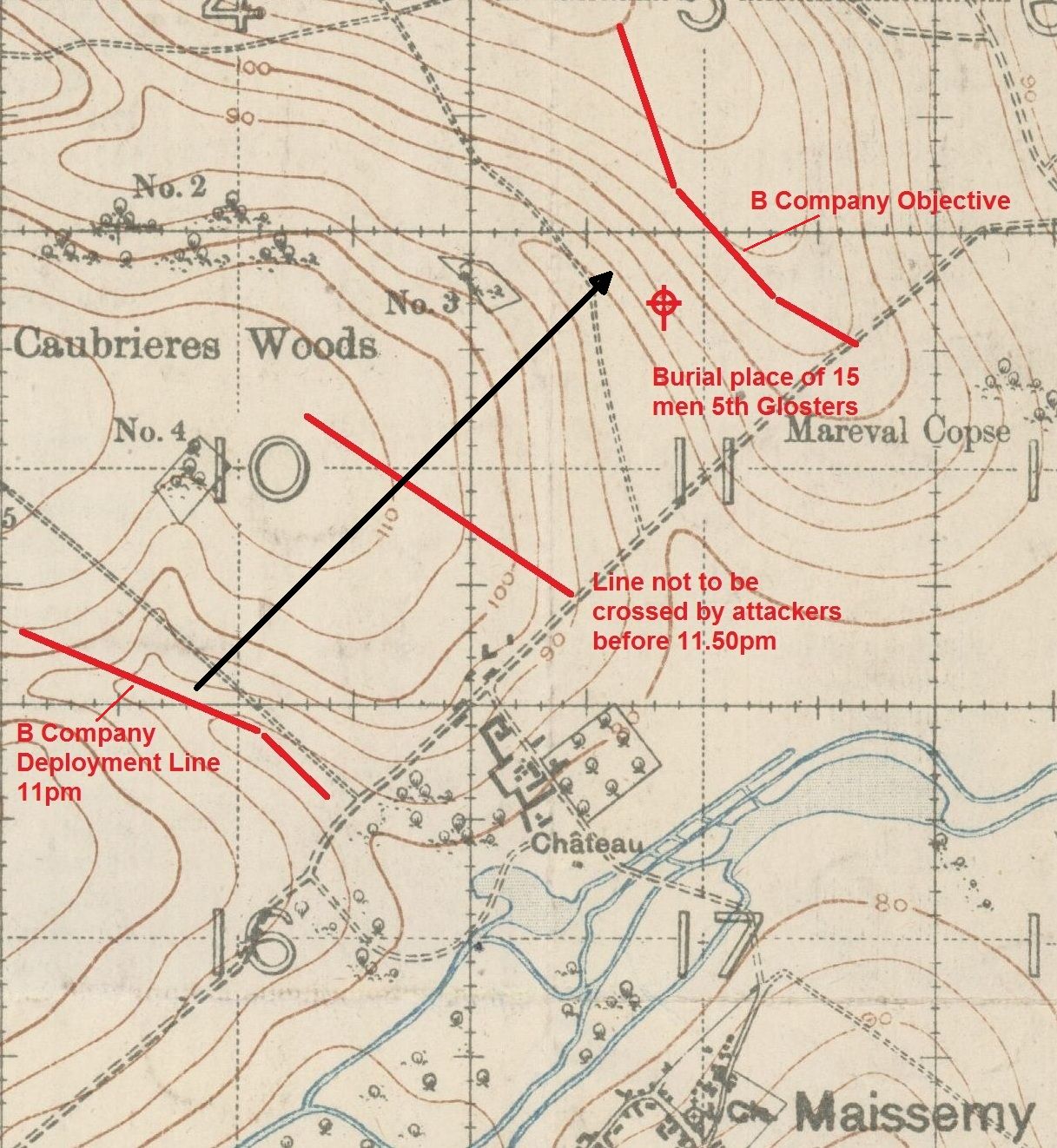
TM 62c SE 2A 30011917crop3annotLabelscropArrow1

British Trench Map with the attack of 6th-7th April 1917 marked. This map, corrected to 30th January 1917, did not show the German trenches or wire; woods are also incorrectly plotted. (Map: McMaster University Creative Commons).

At midnight, the artillery began a forty-minute bombardment of the German positions, building to an intense fire for the final five minutes. The Brigade commander afterwards stated that the British shells fell short but there were no reports of any British casualties from this cause.  At 12.40am two companies from each of the two battalions rushed forward and the British guns advanced their targets by 100 yards every four minutes: this formed a ‘creeping barrage’ that the attackers were supposed to follow.

Lieutenant Brown, of the Ox and Bucks attacking to the left of Gurney’s Company, said that his men started ‘in quick time’; as they neared the German positions, they broke into a rush towards the wire and some were shouting. There were shouts heard also from the Germans and two or three were seen to climb out of their trenches and run away. But the attackers did not see the German wire until they were right on it: they found that the shelling had missed it, it was uncut, about ten yards deep and about five feet high.  The Germans at once targeted their wire with machine guns and grenades, in the darkness sparks flew where the bullets hit. Brown reported that his own light machine guns were unable to suppress the German fire; consulting with Gurney’s Glosters on his right, he found that they were also held up.

Gurney’s men too had found the wire uncut: Lieutenant Pakeman was reported in the Glosters’ War Diary to have:

rallied his men and made 3 efforts to get through, though himself wounded. He led his men up to the wire & cut a certain amount himself.

Pakeman was to be awarded the Military Cross for his part in the unsuccessful attack, the citation recording that:

He led his company in the most gallant manner and personally tried to cut gaps in the enemy’s wire. Later, although wounded, he remained at his post.

The War Diary also mentions that in C Company, Sergeant Davis ‘distinguished himself cutting a gap large enough for 5 men to get through. All of whom were killed.’ This man was Lance-Sergeant Frank Davis, awarded the Disguised Conduct Medal with the citation:

He led his platoon in the most gallant manner, and personally tried to cut a gap in the enemy’s wire. He was severely wounded.

GE street 11.50pm line towards German cem Gurney2

The area attacked by the Glosters. The German trenches were just beyond the crest line which is marked by trees on the right. The German wire was above and behind the area of trees in the middle ground (Cooker Quarry). The track is where the Glosters and Ox and Bucks withdrew before their second attempt to get through the wire. (GoogleEarth).

These attempts to get through the wire were fruitless and the two battalions withdrew to a partially sunken track to reorganise.[6] Brown again spoke to the commander of the Glosters’ B Company and they decided to make another attempt to get through the wire. Taking place at about 1.30am, this also failed and they withdrew to the track.  This withdrawal and failed second attempt is described by Gurney’s two final lines:

retreated and came on again,

Again retreated a second time, faced the screen.

Brown again conferred with the two Glosters company commanders and an officer of the 59th Division to his left: none had got through the wire and they decided to withdraw on the grounds that it appeared impossible.[7]

43849_3066_0-00665CropContr

2/5th Glosters War Diary entry for 7 April 1917. (National Archives, WO95/3066).

The 2/5th Glosters’ War Diary records that 15 men were killed from the battalion, and seven officers and 27 men wounded, including Lieutenant Pakeman. Six of the wounded were evacuated, one of whom will have been Gurney.[8]  The bodies of the dead, originally buried near to the German wire, were moved to Vadencourt British Cemetery in 1919.[9]

Vincent Faupier19698175Res

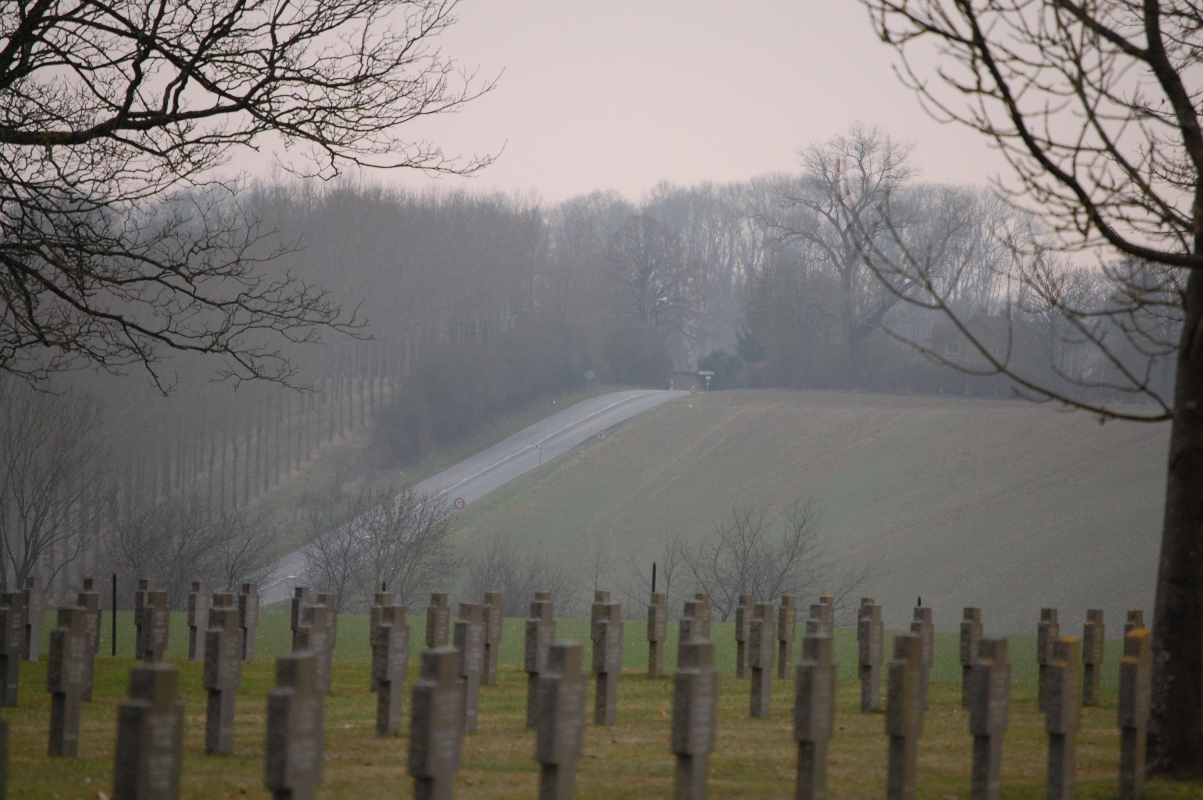
A German cemetery is now on the site of the German trenches attacked by the Glosters. This view looks back across the ground over which they advanced and shows the dead ground in front of the German positions which apparently prevented the artillery from bombarding the German wire. © Vincent Faupier.

The German resistance was part of a holding operation and when more British troops repeated the attack, on the night of the 8th – 9th April, the Germans were found to have withdrawn.  A study of this short battle suggests that Gurney’s recall of events was precise and accurate and that his capacity for intense self-examination provides valuable insights in respect of his admission of his refusal to attack and the way that this was apparently accepted by his superior officer. Such disobedience of an order in the face of the enemy could have resulted in Gurney receiving the death penalty. Instead, the incident appears to illustrate the circumstances whereby, in a heavily civilianised British army, officers preferred  to lead by example, rather than compelling their men to carry out a task that they themselves would not. It also suggests circumstances in which orders were a matter of negotiation where disobedience in certain situations would be accepted.

Two individuals are described in the poem. It is impossible definitely to identify the probable officer who unsuccessfully asks Gurney, with ‘the politest voice – a finicking accent’, whether he might find a way through but he may have been Lieutenant Pakeman, decorated for his part in the attack. In 1916, Sidney Arnold Pakeman was a history master at Marlborough College, having graduated from Sidney Sussex College, Cambridge. After the war he became Professor of History at the University of Ceylon and died in London in 1975.

It is possible to offer a more confident identification for the other soldier. The poet characterises him by his Buckinghamshire accent and his  non-commissioned officer’s stripes:

Silent One MS detail Gloucestershire Archives

The opening of ‘The Silent One’ from Gurney ‘Best Poems’ notebook. (The First World War Poetry Digital Archive, University of Oxford (www.oucs.ox.ac.uk/ww1lit); © The Ivor Gurney Archive, Gloucestershire Archives).

            The Silent One

Who died on the wires, and hung there, one of two  –

Who for his hours of life had chattered through

Infinite lovely chatter of Bucks accent:

Yet faced unbroken wires; stepped over, and went

A noble fool, faithful to his stripes  – and ended.

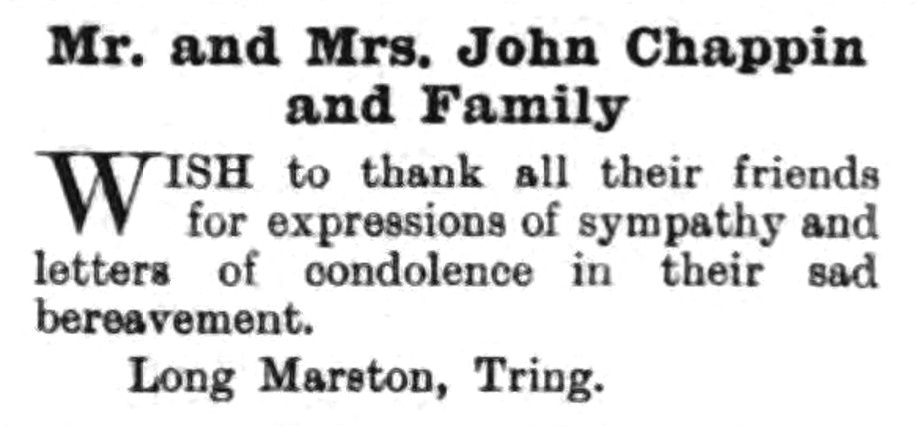
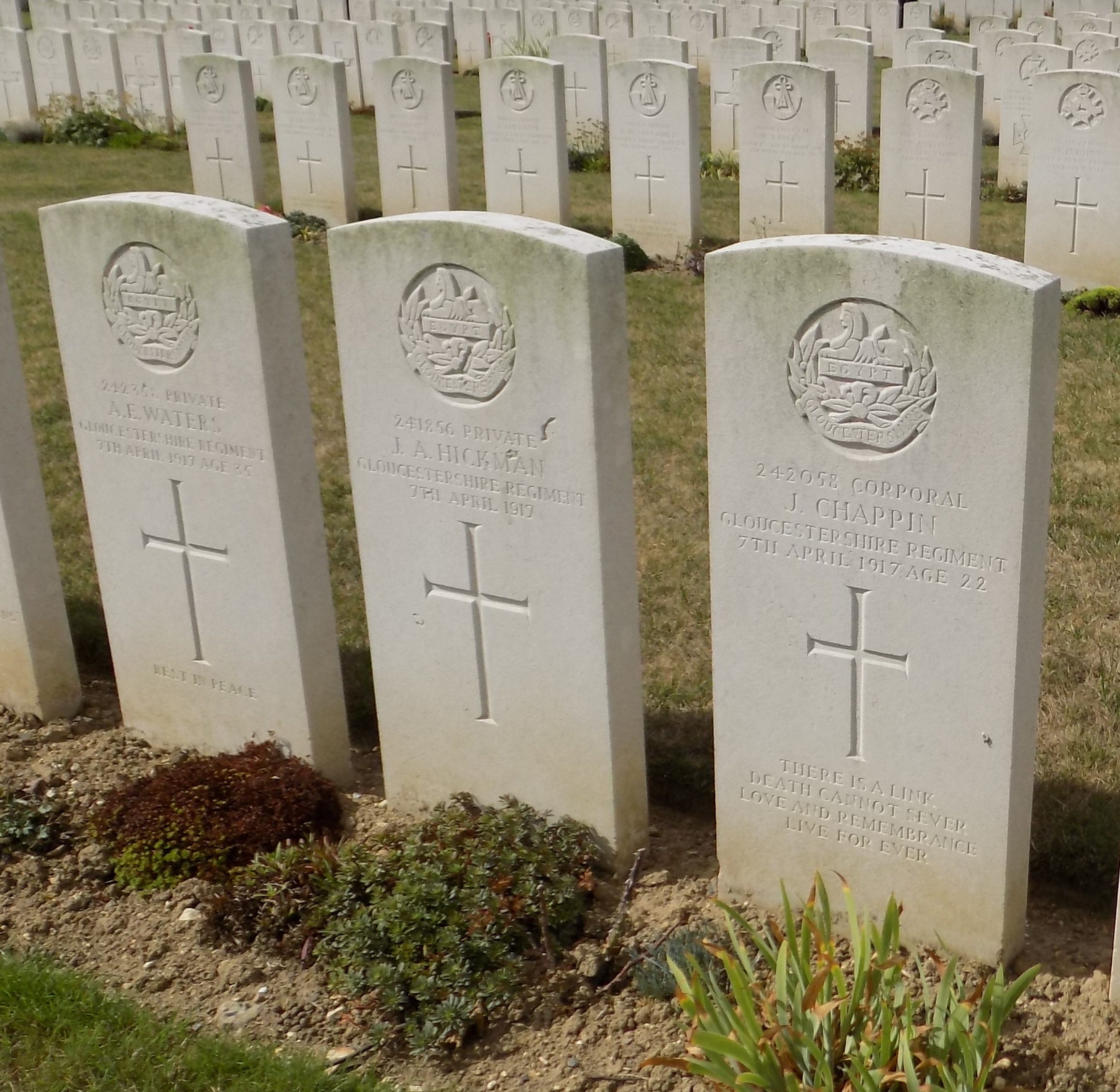
In April 1917 Gurney’s battalion still had a strong Gloucestershire identity and, of the fifteen killed in the attack, all but four were born or enlisted in the county or in Bristol.[10] None was strictly from Buckinghamshire but one, a corporal, was born in Long Marston, Hertfordshire, in an area closely enclosed on three sides by the boundary of Buckinghamshire. It was in the Bucks Herald newspaper that the parents of a dairy worker, Corporal James Chappin, placed two announcements on 26th April 1917:Bucks Herald April 28, 1917aCropEnh2cl

Bucks Herald April 28, 1917cropenh

The Bucks Herald, 26th April 1917 (via FindMyPast.co.uk).
DSCN3058cr

DSCN3059cr2

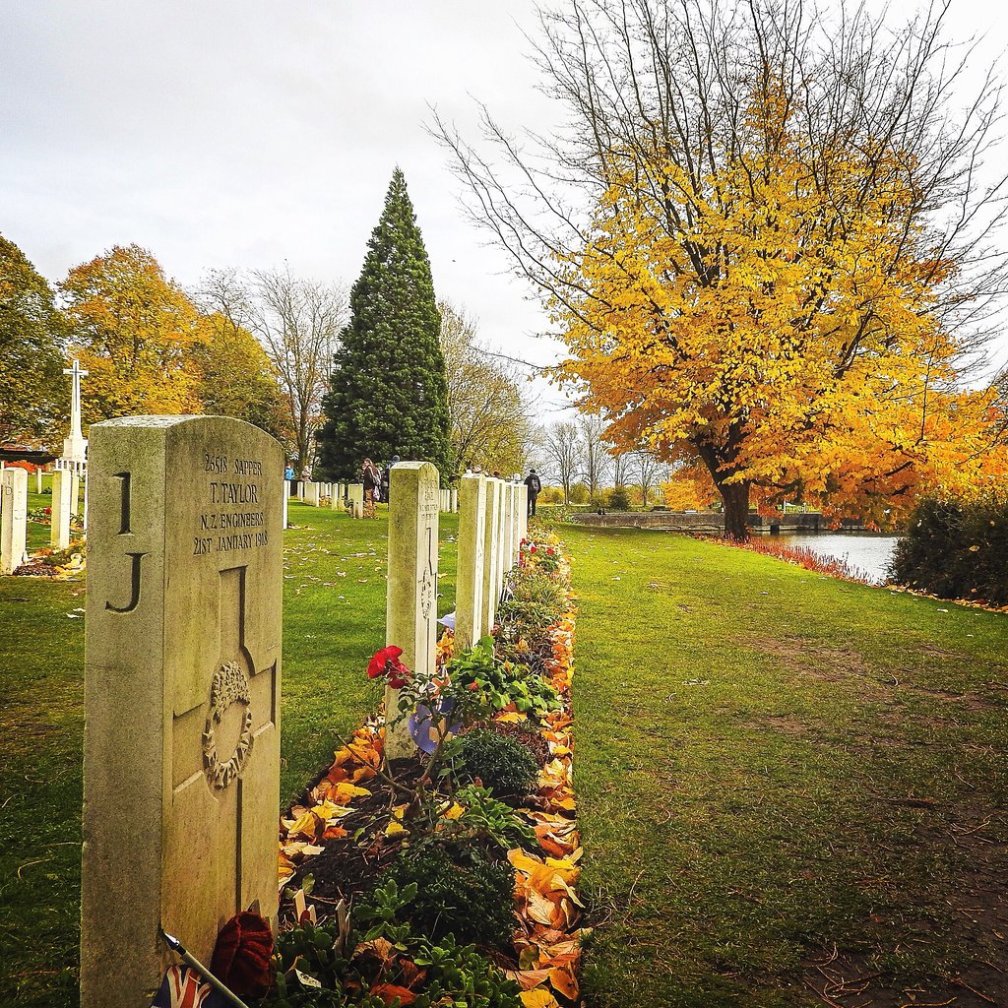
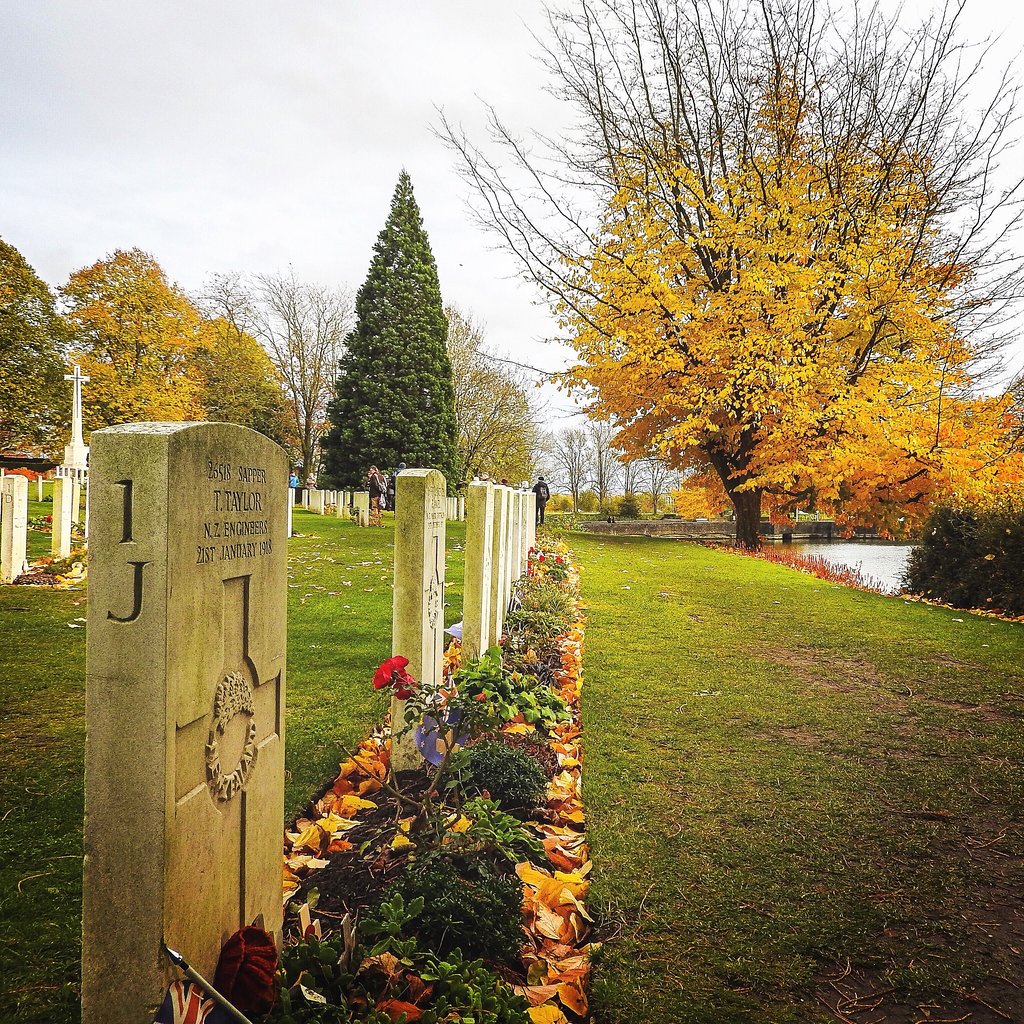
The grave of James Chappin in Vadancourt British Cemetery with the inscription chosen by his next of kin.
Headstone bearing inscription 'Ivor Gurney, Composer Poet of the Severn and Somme 1890 - 1937'.

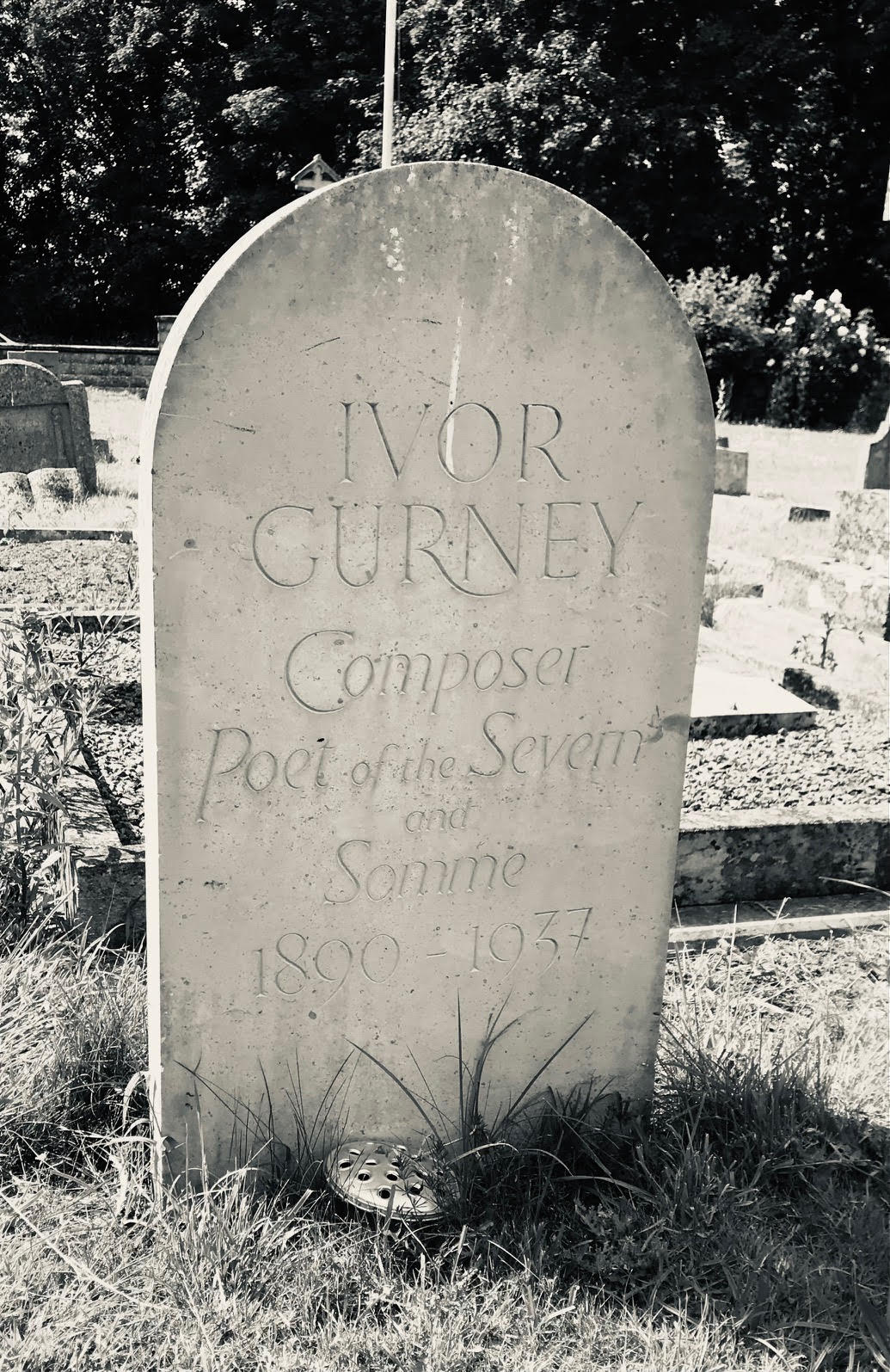
The grave of Ivor Gurney in St Matthew’s Churchyard, Twigworth, Gloucestershire (Phillip Dutton).

Text © Simon Jones.  See below for Notes.


Join me on a battlefield tour with The Cultural Experience. We cut out delays at Dover by travelling via Eurostar from London St Pancras to meet our coach in Lille:
Simon Jones Battlefield Tour Somme Poets 2019

The War Poets: Words, Music and Landscapes, 6th-9th July 2023

First & Last Shots 1914 & 1918

Medics & Padres in the Great War

Walking Ypres 1914-1918

Walking the Somme, Summer 2023

More Information about Battlefield Tours


Notes.

[1] Michael Hurd, The Ordeal of Ivor Gurney, (Oxford, 1984), p. 203.

[2] My thanks to Mrs. Joyce Kendell for pointing out the resemblance.

[3] R. K. R. Thornton (ed.), Ivor Gurney War Letters, (London, 1984), pp. 152.

[4] Letter postmarked 14/4/1917, Ivor Gurney War Letters, op. cit., p. 154.

[5] The latest map found is Sheet 62cS.E. Edition 2A Trenches, corrected to 30/1/1917. Later maps (2nd February 1918) shows a series of fire trenches on the crest and forward slope which, if German, would have been there on Good Friday 1917. The positions of small woods are shown incorrectly on the earlier maps.

[6] Brown discovered that the 59th Division on his left had not attacked and its troops were crowding into his sector. See note below.

[7] A report by 184th Brigade states that a third attempt was also held up before the withdrawal was made. ‘Report on attack on German trenches on night 6/7th April, 1917′; ‘Report on Operations carried out by 184th Infantry Brigade from the time of taking over from 183rd Infantry Brigade to the time of relief by 35th Division’; Lieutenant K. E. Brown, (commanding A Company, 4th Battalion Oxfordshire and Buckinghamshire Infantry) ‘Report on attack on German trenches on 6/7th April 1917′, War Diary GS 184 Infantry Brigade, National Archives WO95/3063.

[8] War Diary, 2/5 Battalion Gloucestershire Regiment, National Archives, WO95/3066.

[9] CWGC Burial Return via CWGC.org.

[10] Soldiers Died in the Great War, (HMSO, 1921) digitised version searched via Ancestry.co.uk.

Photograph of Ivor Gurney in uniform and detail of ‘The Silent One’ ms are from the First World War Poetry Digital Archive, accessed April 3, 2017, http://ww1lit.nsms.ox.ac.uk/ww1lit/collections/item/6942, http://ww1lit.nsms.ox.ac.uk/ww1lit/collections/item/6931.


John Nash Over the Top SimonJonesHistorian

‘It was in fact pure murder’: John Nash’s ‘Over the Top’


P1100978 WP433resEnh

Where and How did Edward Brittain Die?


Edward HarrisonEdward Harrison, who gave his life to protect against poison gas


Contact Simon Jones

Underground Warfare 1914-1918

I am able to offer signed copies of my book Underground Warfare 1914-1918 for £20 UK (including 2nd Class postage) or £25 Europe or £37 Rest of the World (including international standard postage). Contact me for payment details (PayPal preferred).
Underground Warfare

Reviewed by Dr Wayne Osborne for War History Online. Reviewed on The Great War Blog. Reviewed on Daly History Blog
Reviewed in the Journal of the Western Front Association:

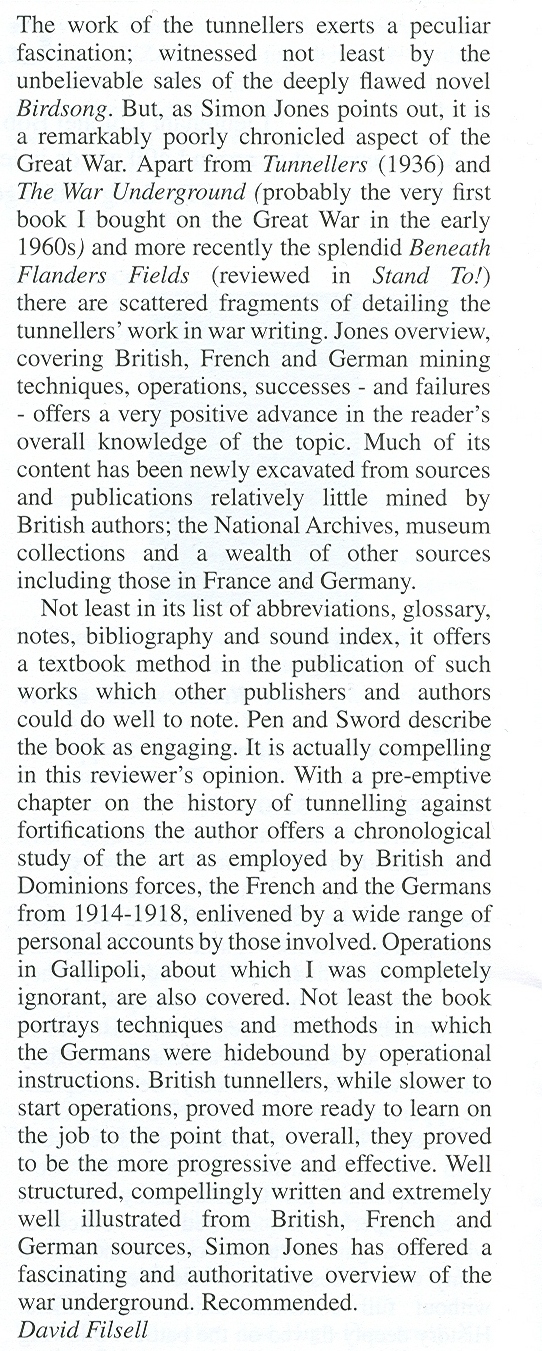
Simon Jones Underground Warfare review1Simon Jones Underground Warfare review2


Buy a signed copies of The War Underground 1914-18 and World War I Gas Warfare (Osprey Elite Series)PXL_20240524_113844426-cr


Join me on a battlefield tour with The Cultural Experience

Simon Jones Battlefield Tour Somme Poets 2019

The Battles of the Marne & the Aisne 1914 – 1918

First & Last Shots 1914 & 1918

Medics & Padres in the Great War

Walking Ypres 1914-1918

Walking the Somme

More Information about Battlefield Tours


H15258

Myths of Messines: The Lost Mines


Q 11718

Understanding the 1914 Christmas Truce


Q 49394

The Lochnagar Mine