André Laffargue was a French infantry officer wounded at the age of 24 during an attack on Neuville-Saint-Vaast on 9 May 1915. While recovering he wrote a pamphlet, Étude sur l’attaque dans la période actuelle de la guerre (Study of the attack in the current period of the war), containing his reactions to the fighting in which he had participated since August 1914.[1] Surrounded by misconceptions, his ideas are said to be the origin of the idea of infiltration tactics, used with great success by the Germans in 1918, in which opposition was by-passed and encircled.[2]
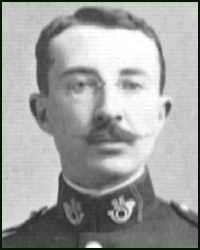
André Laffargue (30).
Laffargue went on to write another pamphlet in 1916, Conseils aux Fantassins pour la Bataille (Combat advice for troops), [3] and tactics manuals which appeared in many editions between the 1930s and 1950s.[4] His writing is vivid, sometimes appears self-serving when he relates his own experiences as a lesson in leadership, but is filled with practical advice relating to the impact of combat on soldiers. He makes his points using eye-witness descriptions of the actual experiences of himself and others and illustrates them with his own drawings. His writing is also imbued with the prevailing French army doctrine of the spirit of the offensive and his Conseils ends with a poem ‘En Avant!’ by the Revanchist leader Paul Déroulède. His belief that the human will of the attacker had to prevail over the firepower of the defender, and that casualties had to be accepted, can nowadays appear unsettling:
In order that the assault may be unlimited, the sacrifice being resolved upon, it must be pushed through to a finish and the enemy drowned under successive waves, calculating, however, that infantry units disappear in the furnace of fire like handfuls of straw.[5]
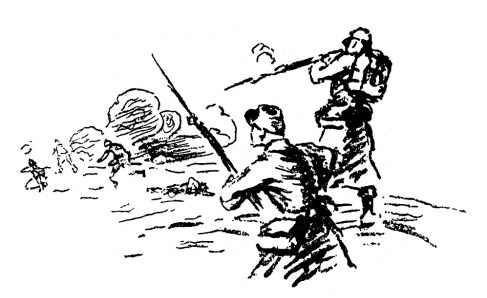
A drawing by Laffargue from Conseils aux Fantassins pour la Bataille.
The attack of 9 May 1915, in which the French Tenth Army attacked on a 19 kilometre front, opened the Second Battle of Artois and was the largest launched on the Western Front since the onset of trench warfare. The result had an influence on French tactical and strategic ideas as profound as the Battle of Neuve Chapelle had on those of the British. This was because of the advance of 4.5 kilometres in the first hour and a half by the 77th and Moroccan Divisions of Pétain’s XXXIII Corps, which reached almost to the summit of Vimy Ridge.[6] The French assault foundered when reserves could not be brought up to reinforce the beleaguered attackers. Laffargue’s regiment, part of the 39th Division of the XX Corps, attacking to the right of the Moroccan Division, achieved a more modest but still significant advance of 1.5 kilometres. This attack affected Laffargue profoundly both because of what it did achieve but also the opportunity that was lost.
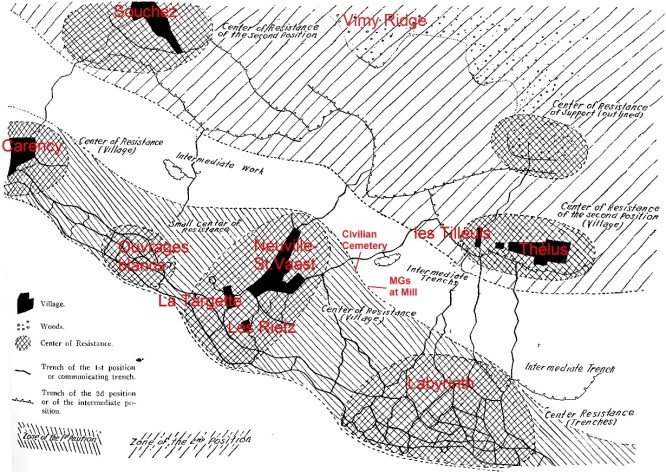
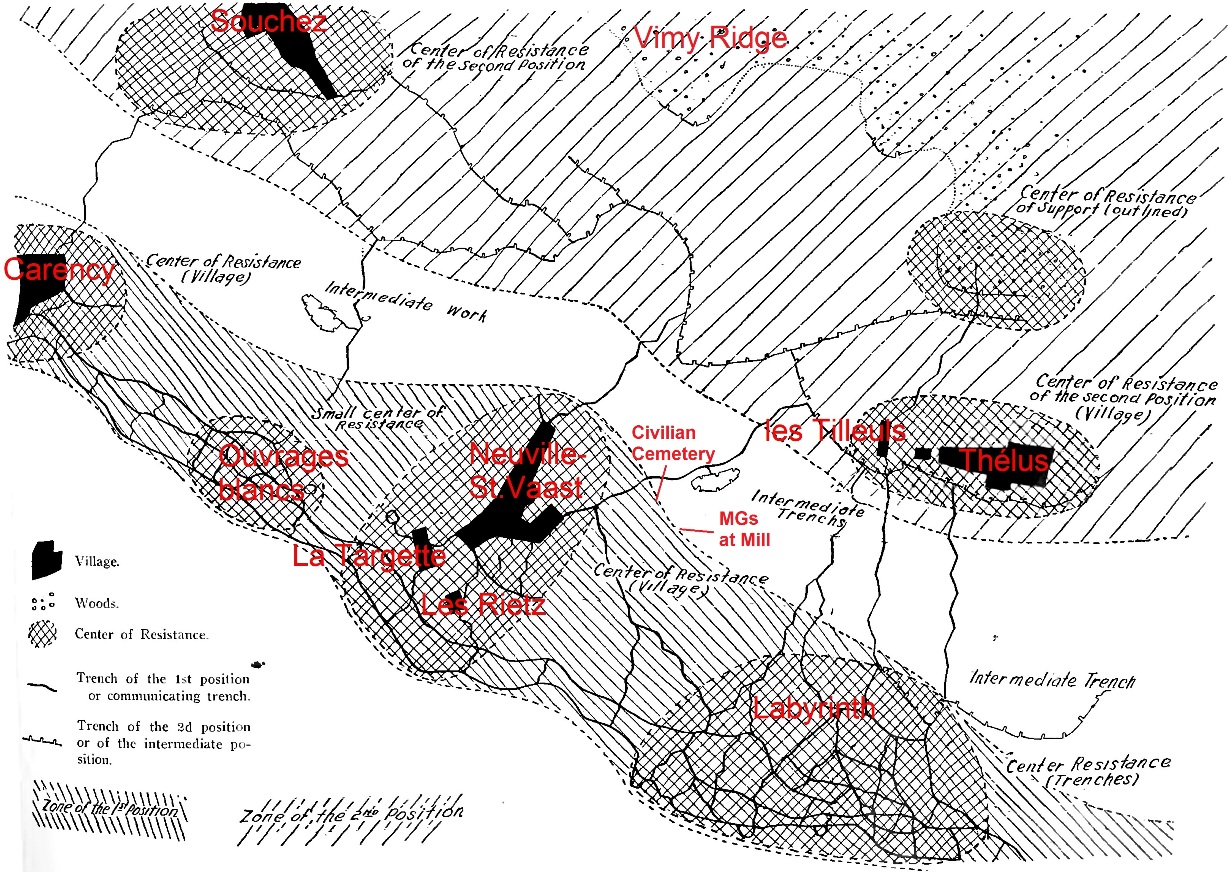
Laffargue’s Plate II from Étude sur l’attaque, giving an example of a German defensive organisation and a notional attack, actually corresponds to the area assaulted on 9 May 1915 (I have added the locations). The distances between the first and second German lines are shown greater than they were and the map cannot be scaled. (From the US edition, The Attack in Trench Warfare, based on Laffargue’s originals).
Three weeks before the attack, French general headquarters (GQG) issued a set of tactical instructions the importance of which has only very recently been understood. Drawn up following a study of after-action reports from the fighting thus far, the instructions were issued under the title But et conditions d’une action offensive d’ensemble (Goal and Conditions for a General Offensive Action), or Note 5779. These specified that attacks should be made only after methodical and detailed preparation including a proper bombardment of the positions to be attacked. The aim above all was to achieve a breakthrough of the German defences. Fire by field artillery however was restricted to four rounds per minute, even though the 75mm gun could achieve 15, to limit barrel wear. Significantly, Note 5779 also called for the artillery to increase its range progressively after Zero in front of the infantry advance in apparently the first reference to the ‘rolling’ or ‘creeping’ barrage, later a standard attack tactic and one of the key innovations of the military revolution of 1914-1918. The artillery would also defend the infantry after it had taken the first enemy trench and bombard the second and third German positions prior to their being attacked by the French infantry. Note 5779 was important in a second respect in that the first waves of attacking infantry were to avoid enemy strong points and push on to more distant objectives. Follow-up waves would include trench-cleaners (nettoyeurs de tranchée) whose role was to mop-up any enemy left in the captured trenches and emerging from dug-outs. Note 5779 thus contains an early version of infiltration tactics which pre-dates Laffargue’s pamphlet.[7]
Preparations for the Attack
Prior to the attack, the French pushed forward their front line to narrow the distance of no man’s land across which their attackers would have to assault. This was done by driving forward saps at the head of which ‘T’ trenches were dug and sometimes linked to form a new front line. This sapping was standard siege warfare practice and the new lines were referred to in the accepted manner as ‘parallèles de départ’ (the British would call them ‘jumping off trenches’). Laffargue states that these were dug at night to within 300m of the German front line and describes how he was almost shot by a nervous and inexperienced sentry from a neighbouring company of his own side.[8]
Planned shelling of the German positions before the day of attack was disrupted by poor weather which also twice caused the postponement of the assault from 7 and 8 May. The bombardment of the German front line was by field artillery and also mortars firing large, finned projectiles (aerial torpedoes) while heavy artillery bombarded the positions further back. On the day of the attack there was a four-hour bombardment, targeting in turn the German wire, machine guns, trenches and listening posts. The rate of fire was gradually increased for each gun from two rounds to three rounds, and finally four rounds per minute during the final ten minutes.
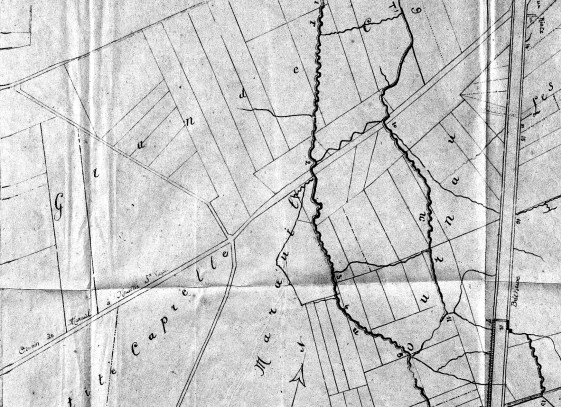
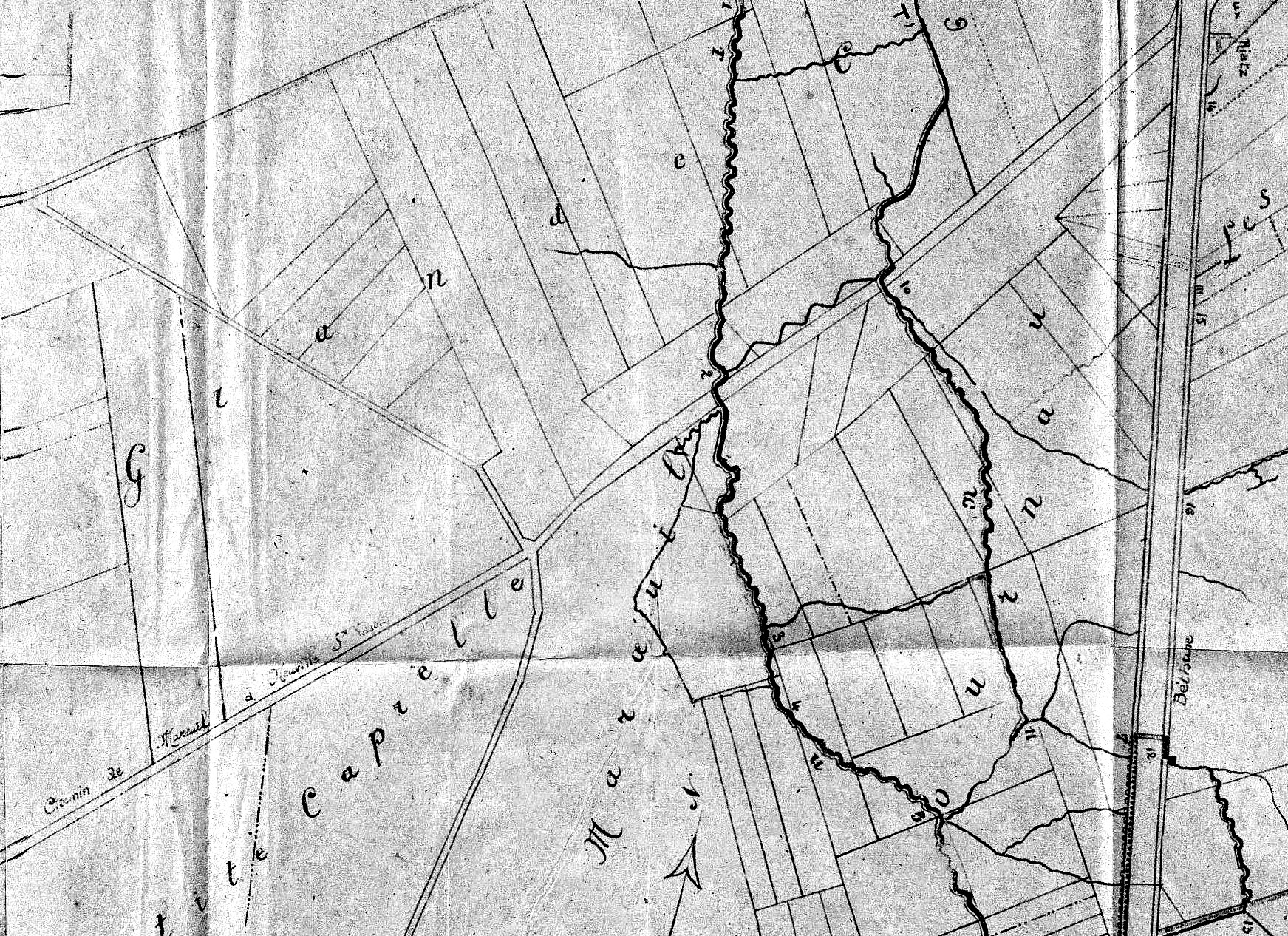
Section of the German front line taken by Laffargue’s Regiment on 9 May 1915. The chemin de Marœuil (D55) runs through the first and second trench, which are about 100m apart. The machine-gun which enfiladed Laffargue’s company was in the sap immediately south of the road, above the ‘l’ in ‘Marauil’. His Company assaulted the trenches south of the D55. The French National Cemetery of La Targette now sits over the area of the German trenches immediately north of the D55.
(Journal des Marches et Operations, 60e régiment d’artillerie de campagne, 3e batterie, Service historique de la défense, 26 N 1012/6/34).
Laffargue was extremely concerned prior to the attack at the prospect of German machine gun positions, not destroyed by the bombardment, which would open up on his men when they attempted to cross no man’s land. With binoculars, he scoured the German lines for the characteristic low horizontal rectangular loophole and paid particular attention to locations where they might be sited. He discovered what he believed to be one to the left of his sector, at the end of a German sap driven out into no man’s land immediately south of the Marœuil road, capable of enfilading 600m of front across which his men would have to advance. He fretted with impatience and continually sought out the artillery observer but, despite bombardment by 75mm field guns, it remained intact. The low trajectory of the 75 made destroying dug-in positions extremely difficult and this was only partly remedied by fitting steels discs, called plaquettes Malandrin, to the noses which enabled them to be fired at a higher, more plunging, trajectory like a howitzer. To the right front of Laffargue’s company, the German positions were bombarded additionally with the large mortars which were more successful at destroying machine-gun emplacements but to the left Laffargue feared that this one loophole would be left intact at the opening of the attack. He gave Sergeant Ferry, who was an excellent shot, a packet of armour-piercing bullets and told him to use them on the German steel plates protecting the machine guns if any opened up when the attack began. What was needed, he says, was artillery, such as an 80mm mountain gun, placed in the trench itself which could deal in turn with all the machine gun positions.
The attack orders of Laffargue’s 77th Infantry Brigade specified that each of the two battalions leading the attack should deploy two companies in the first line. The orders detail specialist troops to accompany the various waves but do not specify the use of trench-cleaners, as described in Note 5779, to deal with Germans emerging from dug-outs in captured positions once the waves have passed over.[9] This was to have serious consequences during the attack. Laffargue describes the infantry formation to be adopted which varied according to the distance to be crossed before reaching the enemy positions. For an objective more than 100 metres away he describes how the attack was made by waves comprising entire companies in just two long lines. The first line was formed of skirmishers with five paces between each man. The best skirmishers were calm and resolute soldiers who were good shots; older reservists were better suited for this duty, being ‘well-seasoned’ and less ‘intent on preserving their own lives’. Laffargue himself joined this skirmish line. Fifty metres behind came the line of attack, in a single rank, elbow to elbow or with one pace between each man. The officers were in front but Laffargue specified that NCOs should be four metres behind to act as file closers, calling men out by name if they lost alignment. This form of attack would have been familiar to a soldier of the army of Napoleon I one hundred years before. It had been all but abandoned by the British army during the Boer War but had only been partially abandoned by the Germans in the Drill Regulations of 1906.[10] Laffargue does not accept any other tactical formation than the line because he believes that it is the only way to induce men to advance on strong defences. He justifies the close-order attack on the grounds of timeless principles:
…the march in line is as old as war itself. The alignment holds each in his place, carries along those who hesitate, holds back the enthusiasts, and gives to everyone the warm and irresistible feeling of mutual confidence.[11]
The men in the line of attack were not to open fire as this would disrupt the alignment. Laffargue acknowledges that this was a great deal to expect and the skirmishers were therefore permitted to fire as they advanced and were taught to do so with their rifles held at the hip.[12]
The Attack
Laffargue describes the moment of attack:
The artillery preparation, roaring on the horizon like a furious storm, ceases sharply, and a tragic silence falls over the field of battle. The infantry leaves its parallels in a single movement, at a walk, magnificently aligned, crowned with the scintillation of thousands of bayonets.[13]
As the four sections of his Company rose to attack, the dark loophole which had so concerned Laffargue lit up with fire and a machine gun ‘scythed’ down the two sections on the left, the 1st and 2nd, which’melted away’. Sergeant Ferry calmly knelt down, probably confident that he could silence the machine gun with a few shots of armour piercing ammunition. He was instantly hit by a bullet through the forehead.[14] On the right, however, where the mortars had done their work, Laffargue’s 3rd and 4th Sections were able to press forward unhindered. They advanced first at a walk, then at slow double time, aligned as on parade. Behind, Laffargue heard through the machine gun fire constant shouts of encouragement from the line fillers to keep the younger, more agitated, men in line: ‘Thus rushing like a wall, we were irresistible.'[15]
At the German wire
The 3rd and 4th Sections reached the first German barbed wire, about 220m away, without hindrance and without having opened fire. They threw themselves to the ground, exhausted by the effort. Laffargue could clearly see the flat grey caps of Germans firing from their front line 80m away. Determined to make them keep their heads down, he instinctively shouldered his rifle and fired, and immediately his men followed suit. The smell of explosive spread suddenly over the battlefield and their bullets ploughed into the German parapet. Individually, his men crawled through gaps in the wire and continued firing on the other side but the full force of German machine guns, firing at ground level, ‘engulfed us in their hissing blanket, riddling our ranks’.[16]
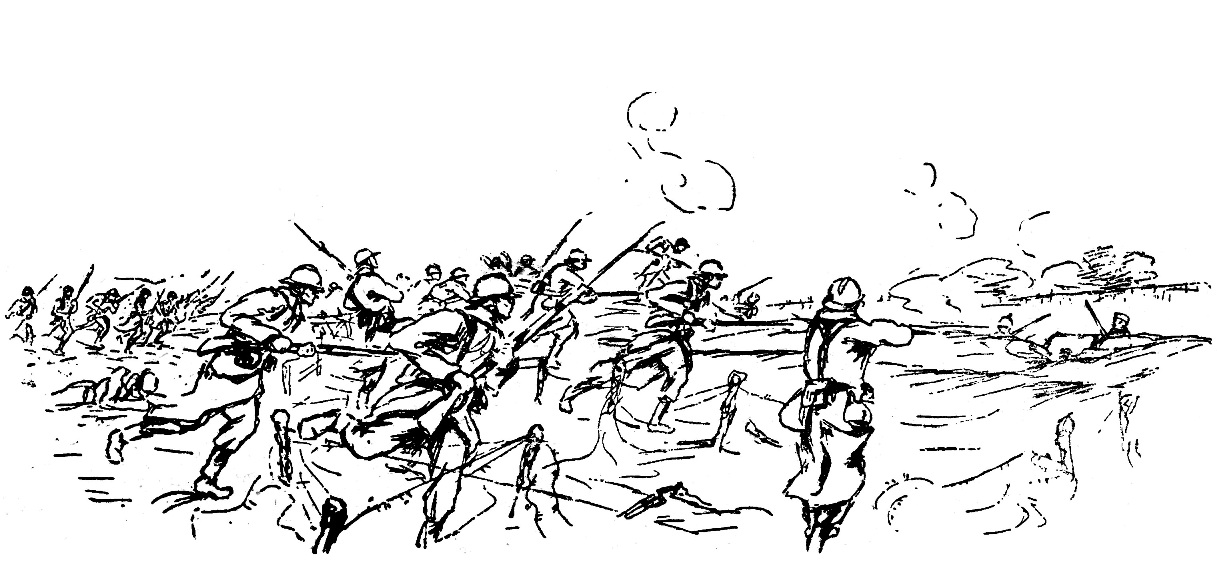
Unable to achieve fire superiority, Laffargue’s explanation of his actions in the midst of battle illustrates the way in which the French Army’s cult of the offensive was strongly linked to devout Roman Catholicism. He was suddenly struck that their only choice to halt the devastating fire was to attack. He turned and with a shout that tore his throat, cried, ‘Cease fire! Forward!’ but, in the deafening fire, couldn’t hear his own voice. The only way to get his men to stop firing and advance was to throw himself forward and risk being hit by his own side’s rifle fire. For a moment, the thought of their bullets ripping into his back caused him to waver but, after a second of dreadful anguish, suddenly deep within himself a voice summoned him to the Via Dolorosa, Christ’s path of suffering to the cross: ‘No, no, the company must not halt!’ As he heard the words, he was on his feet and plunging alone into the second line of barbed wire. Gripped by an unknown fury, in a stupor he sensed that his face was contorted and from his throat there emanated a wild, uncontrollable roar. Between madness and a spark of reason, he leaped the wire and was drawn to the enemy trench by his bayonet, like the luminous wake of a magnetic arrow. This, he says, was the ‘suprême élan‘ and, inspired by his example, the survivors of his company rose in their entirety and rushed through the gaps in the wire.[17]
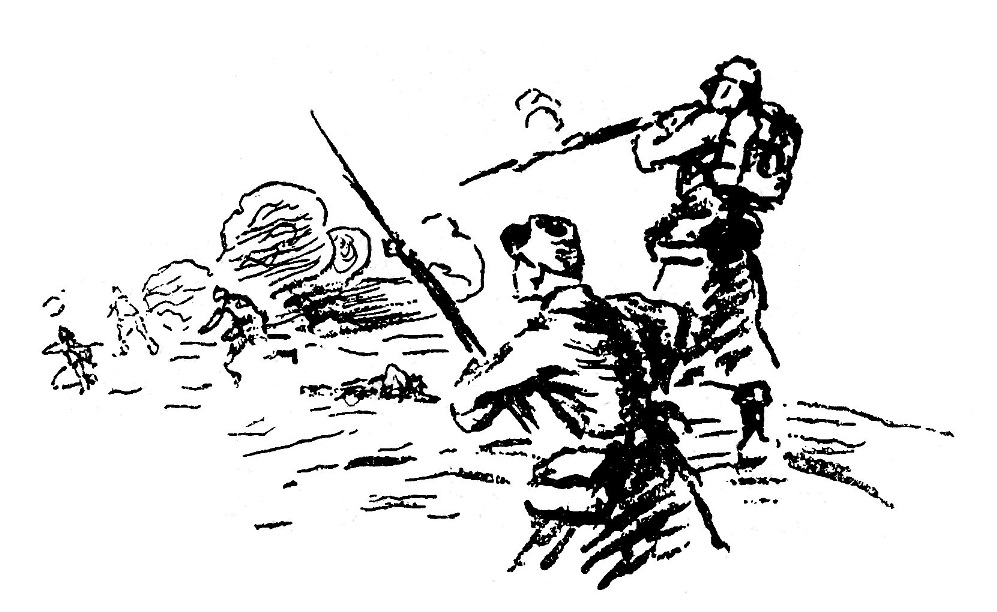
As Laffargue advanced he held his rifle raised at the ready and, each time a German ‘flat cap’ appeared, he threw it to his shoulder and fired. This was enough to prevent the Germans from firing for a few seconds, during which he could dash forward twenty metres or so, watching all the time for another ‘flat cap’. He says that those with cover will always keep their heads down if fired on and attackers should take advantage of this tendency. By the time he reached the German trench he had emptied the magazine of his rifle. How he had got there, he did not know, for his eyes had been fixed only on the enemy.
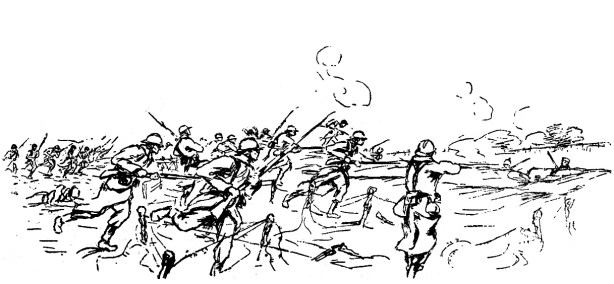
Laffargue’s illustration from Conseils of the final charge through the German wire.
At the German front line
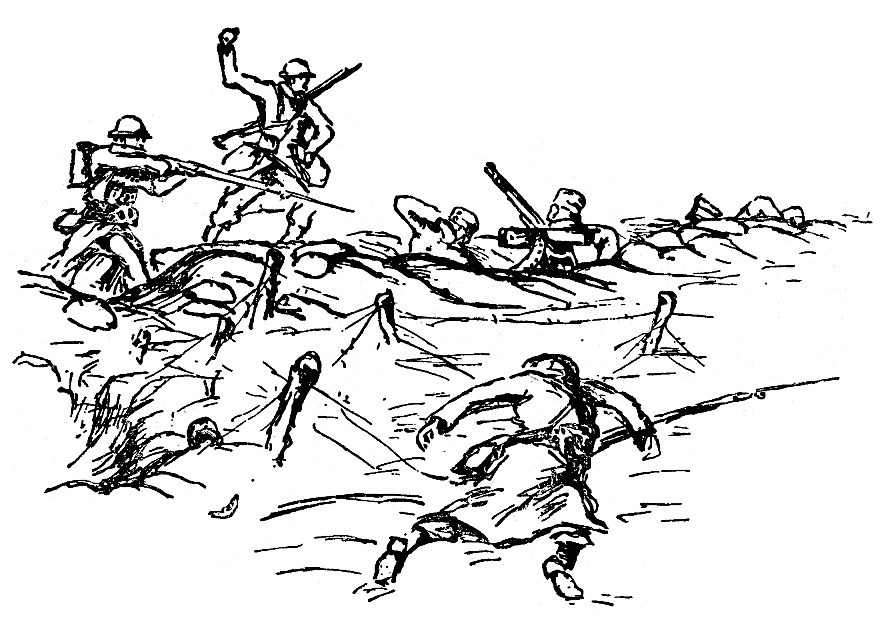
He found himself on the chalk parapet of the German trench, below the enemy was ‘a greenish mass animated by hurried movements, from which sprang short jets of fire’. So began the duel to the death in which one or the other must die. Below him, almost at the tip of his bayonet, was a German: both stood with their rifles at the hip, ‘two pallid faces on two stooped bodies’. Who would die was the question of a tenth, of a hundredth of a second. Both were transfixed but Laffargue knew that his rifle magazine was empty. Suddenly the German also began to reload, fired first and a bullet passed through Laffargue’s arm. Almost simultaneously, Laffargue shot into the German’s face but, to his astonishment, missed. He cocked and fired again but the German had disappeared. Instead, an officer and two men were emerging from a dug-out. Laffargue threw up his rifle and fired, his bullet grazing the officer and planting itself in the trench wall. The officer looked up at him, eyes agape. To Laffargue’s left a shadow loomed at his feet; he jumped round to face a rifle pointing towards him. Suddenly, he lost his balance; as he fell, his fear was that this would mean a halt to his Company’s advance. He lay on the parapet, feeling utterly isolated and waiting to be killed. More of his regiment came forward, including the survivors of the 1st and 2nd Sections who were lying in clusters in the wire, enfiladed by the machine gun which was 15 metres behind where Laffargue now lay. After what seemed a century, the handful of survivors and their young NCO, their bodies bent, rushed through the same gap used by Laffargue. Then he recognised Lieutenant Henry, leading the 8th Company in the second wave, who seeing Laffargue from some way away, ran to him, knelt and began to speak. Suddenly his face tensed and he began to take aim only to fall back, clutching his knee into which a bullet had deeply ploughed.[18]
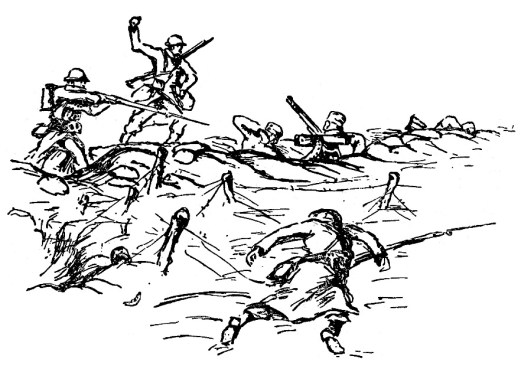
Laffargue’s illustration from Conseils of the fight at the German trench.
Soon all around them was a fierce melee. Rifles were fired at point blank range and grenades detonated. The attackers halted and fired on one knee or standing. Two men piled sandbags to make a fragile defence as around the German parapet there grew a ‘crown of corpses’. The attack hung in the balance, would Laffargue’s men advance or retreat? Who would be left standing after the slaughter? Would a wave of panic sweep over them? Some were infected and there were cries of ‘gas!’ and ‘the Bosches are coming!’ Laffargue, lying useless on the ground in unbearable helplessness, could only will them forward: ‘Advance! Advance!’ Finally the machine gun was silenced and the attackers charged towards the second German trench. Laffargue turned his head to the right and saw, above the parapet, a wide scatter of infantry moving forward. He recognised his 4th Section with the remnants of the 3rd, reinforced by the second wave. They had crossed the German trench, cleared it of Germans which, for the depleted 3rd Section, had been a very hard fight, reformed on the far side and, kneeling, opened fire on the next trench. Rallied for a second time by Lieutenants Legendre of the 7th Company and Vernajot of the 8th, they hurled themselves into the attack over the second trench.
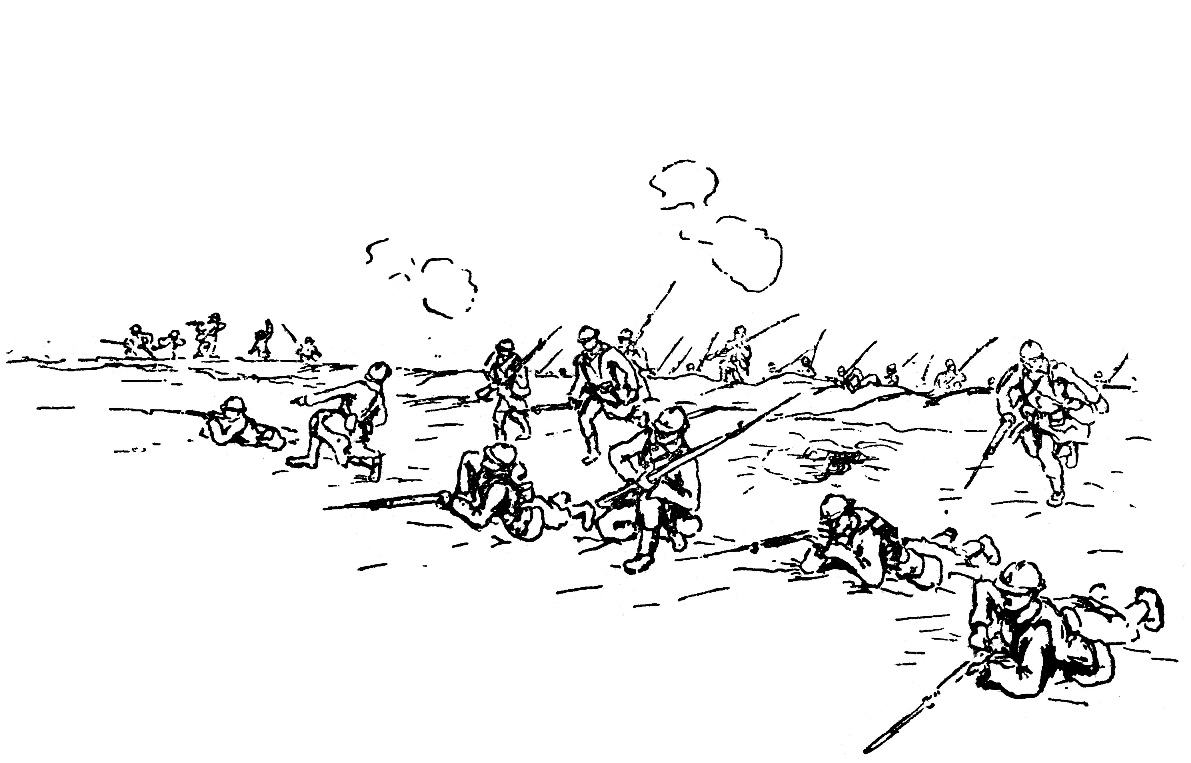
In his post-war tactics manual, Laffargue states that the line should re-form lying down, ten metres from the first trench, before resuming the attack.
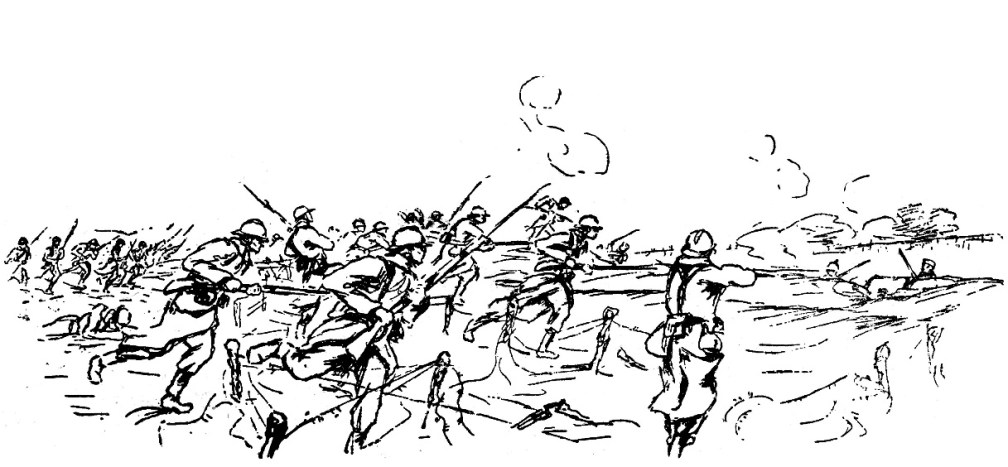
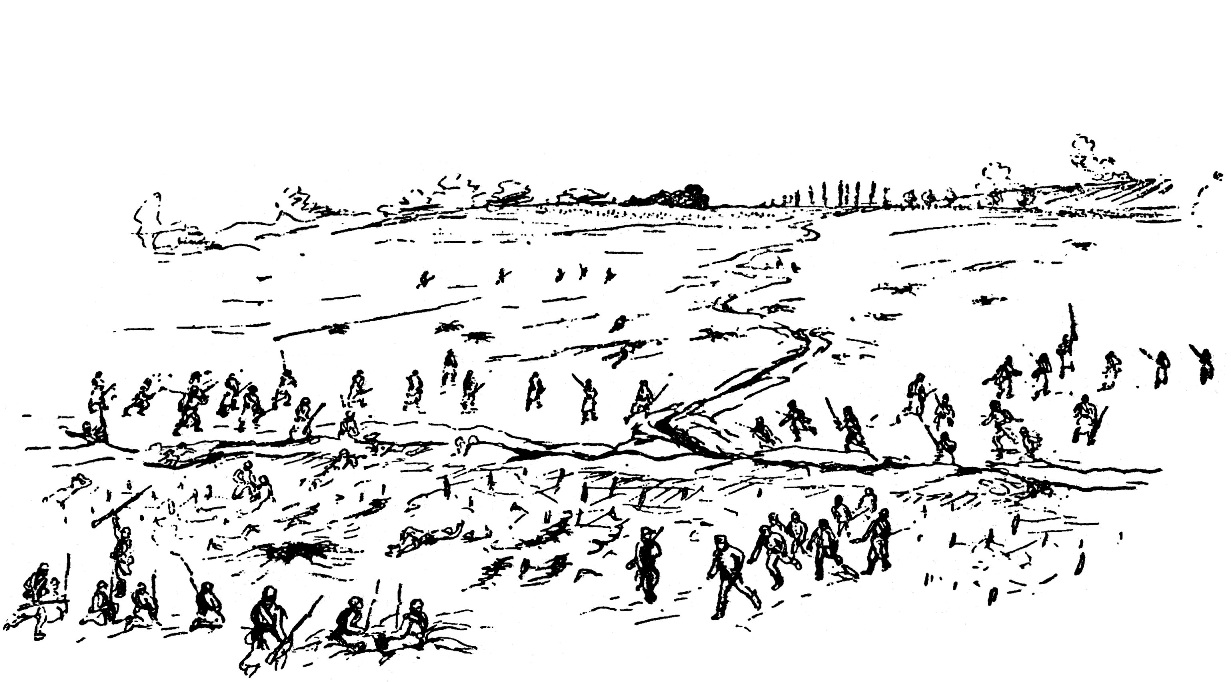
I can still see the troops running, weapons inclined, forming a confused, widely scattered swarm, rolling towards the enemy, one fires, while others run, then stop for a second to shoot, at random, without any regularity. Bayonets rise and fall alternately with a flash.[19]
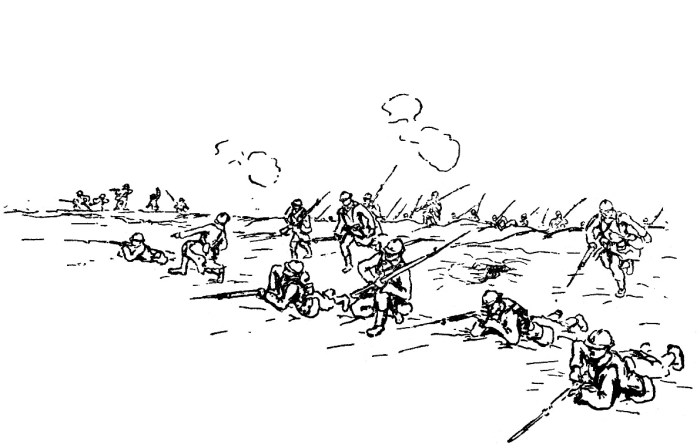
Laffargue’s illustration from Conseils showing attackers re-forming after taking the first trench, ready to assault the second.
Laffargue says it was probably during the charge on the second trench that one of his men, ‘a talented painter, a soldier of great heart’ was mortally wounded in the chest. Private Cartier-Bresson lived long enough to describe how he had clearly seen a German raise his rifle to take aim at him and, by the time he had brought his own weapon to his shoulder, the German had already fired. Laffargue relates the story to demonstrate the need for split-second reactions and for holding the rifle raised, ready to fire.[20] Lying on the German trench parapet, the scene in front of Laffargue fast faded into feverish disorder, a near madness, but amidst the luminous mist he saw one incident very clearly. With a sudden movement of the shoulders, a French soldier half pivoted backwards with an expression of intense anger, then collapsed forwards, shot in the back, ‘I shall never forget this vision of tragic and supreme fury.’ Germans were only now emerging from dug-outs in the first trench and firing on the backs of the attackers. Forced to return, the French ‘massacre them all’. If Laffargue’s attack had followed Note 5779, trench cleaners would have been allocated to ensure that this did not hold up the attack. Laffargue cites this as an important lesson but, contrary to Note 5779 and later doctrine, recommends that the first attacking wave should carry out this work and that it should not be left to bombers following behind.[21]
The German second trench
The second trench, 100 – 150m beyond the first, was engulfed in turn by the attackers but the Germans did not wait for the clash. Appalled at the massacre which had occurred in the front line, they jumped from the trench at the approach of the ‘irresistible tide, and flee wildly across the plain, chased by our own galloping at their heels’. The attack disappeared from Laffargue’s view beyond the main road (the Route de Béthune D937).[22] The attackers surged forward, finding a gap between the heavily fortified centres of resistance of Neuville-Saint-Vaast on their left and the Labyrinth on their right, expanding ‘like a wave which had broken through a dike’. The attackers were hardly disturbed by the German artillery, due Laffargue presumes, to French counter-battery fire. Had they the means to continue advancing, Laffargue imagines that they could have reached the German second line of defences and, in effect, broken through the whole of their positions.[23]
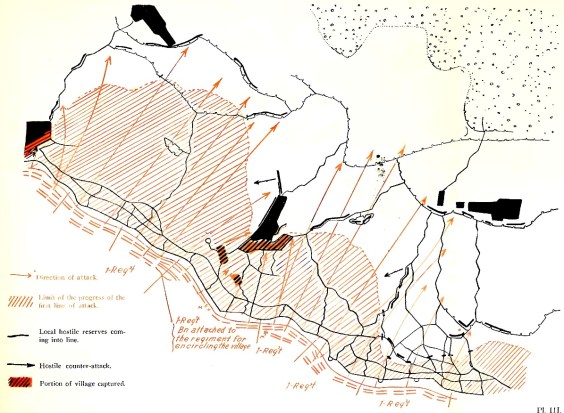
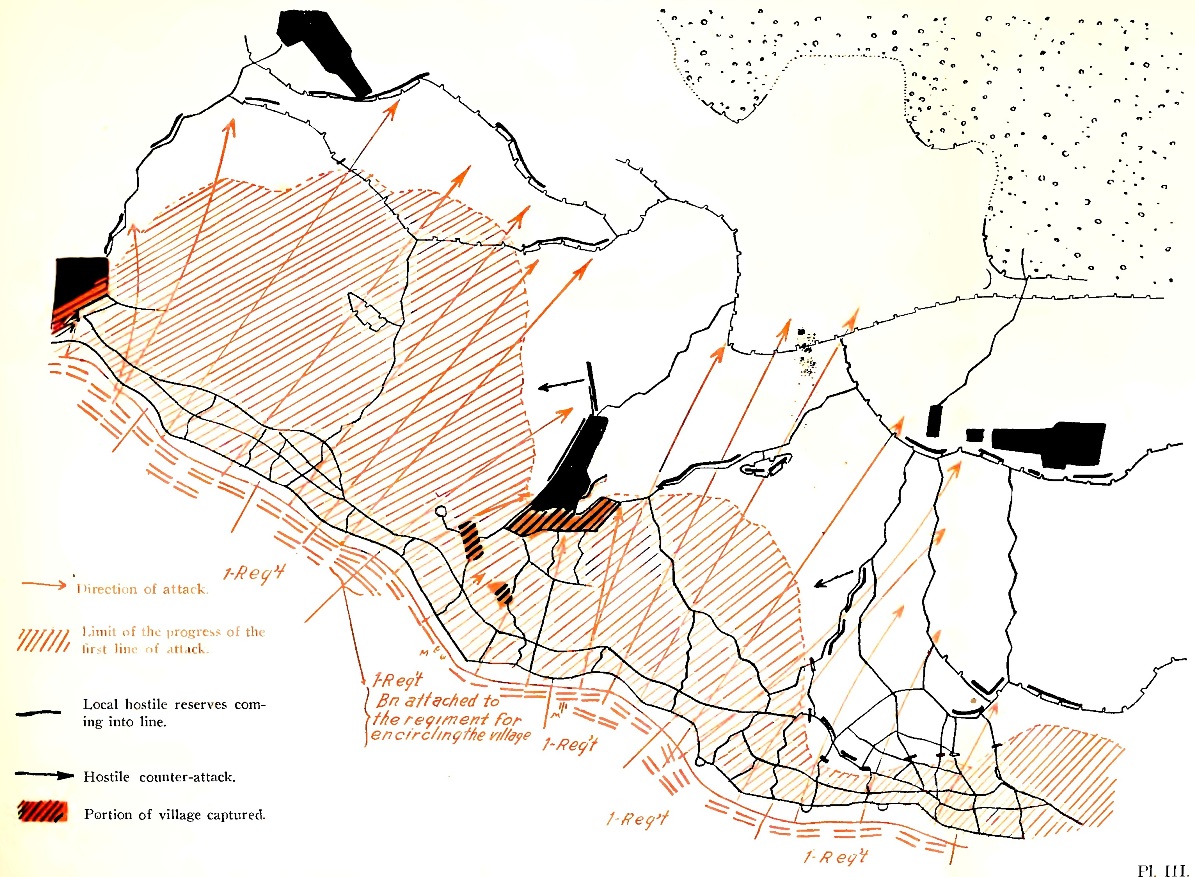
Plate III from Étude sur l’attaque ‘Action of the First Line of Attack’ showing how the first wave might reach the German second line of defences.
The Cemetery
The survivors of Laffargue’s Regiment continued unopposed from the German second line for 1.5 kilometres. Finally, at 1100, one hour after the launch of the attack, they were halted by machine gun fire about 200m in front of the civilian cemetery of Neuville-Saint-Vaast, east of the village. The cemetery was unoccupied by the enemy but fire came from two machine guns in a mill 400m to the left. The attackers attempted to summon artillery fire but it came only after a long delay and landed on the wrong location, by which time the Germans had reoccupied the cemetery. Four hours later the 146th Regiment arrived but was mown down by machine gun fire; the next day the 229th Regiment made only a slight and costly advance. Laffargue says that if they had had artillery moving forward, he suggests 37mm guns, they could have dealt with the machine guns at the mill before the Germans could bring up reserves and his regiment could have continued on to the ridge. It is noteworthy that he does not refer to or advocate the use of attack behind a moving barrage, rather he wants his own men to have the means of dealing with opposition.[24]
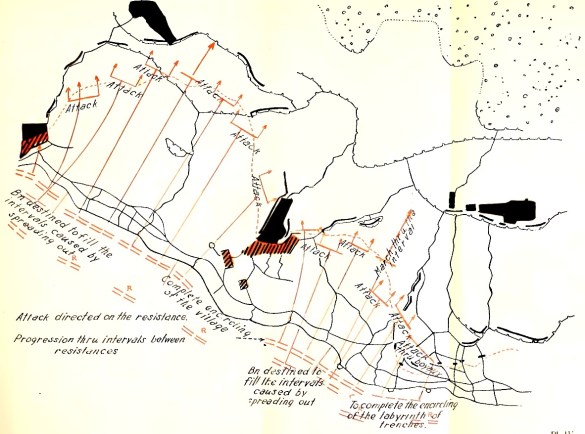
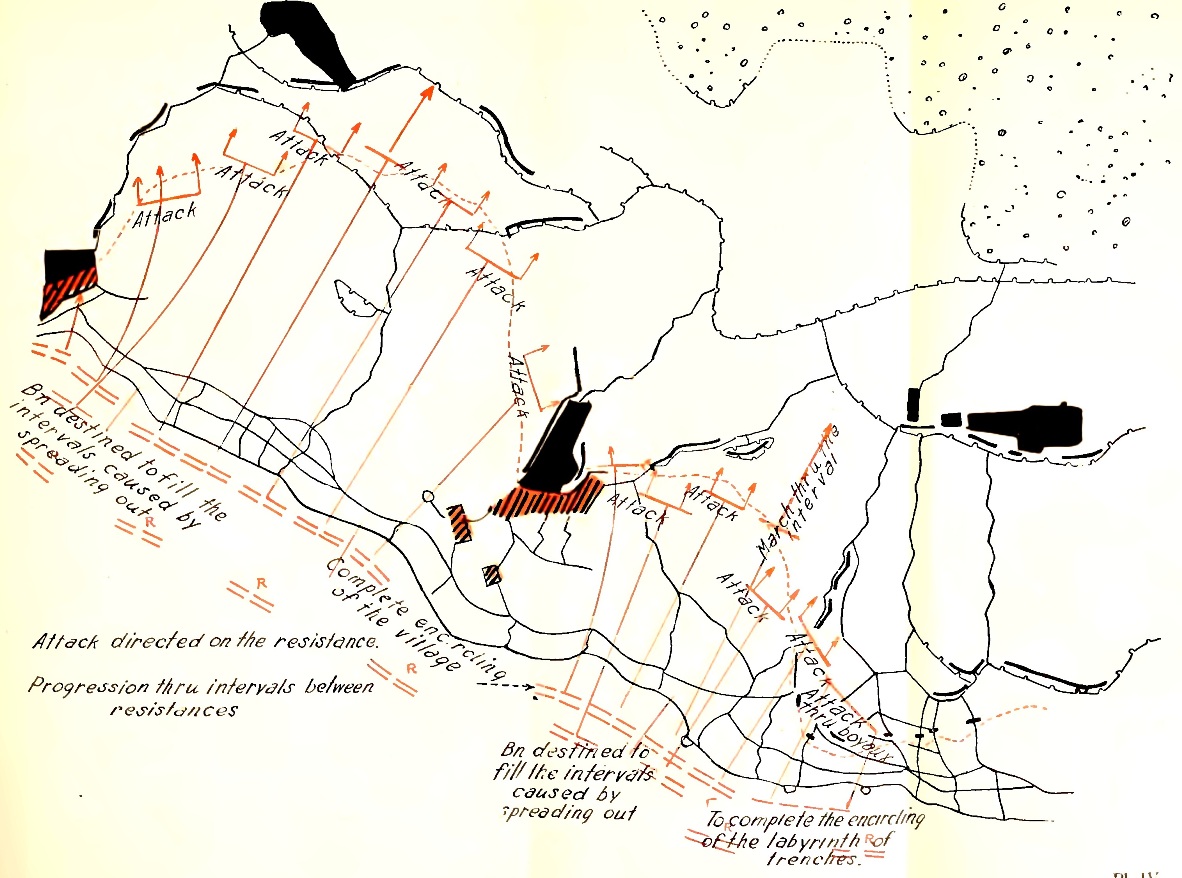
Plate IV from Étude sur l’attaque ‘Action of the Second Line of Attack,’ shows the attack developing through the interval between centres of resistance and the second line of attack dealing with the resistance.
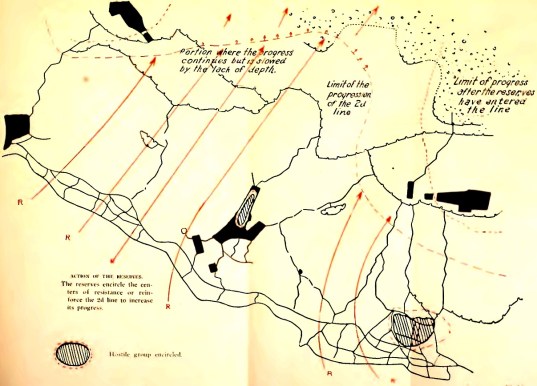
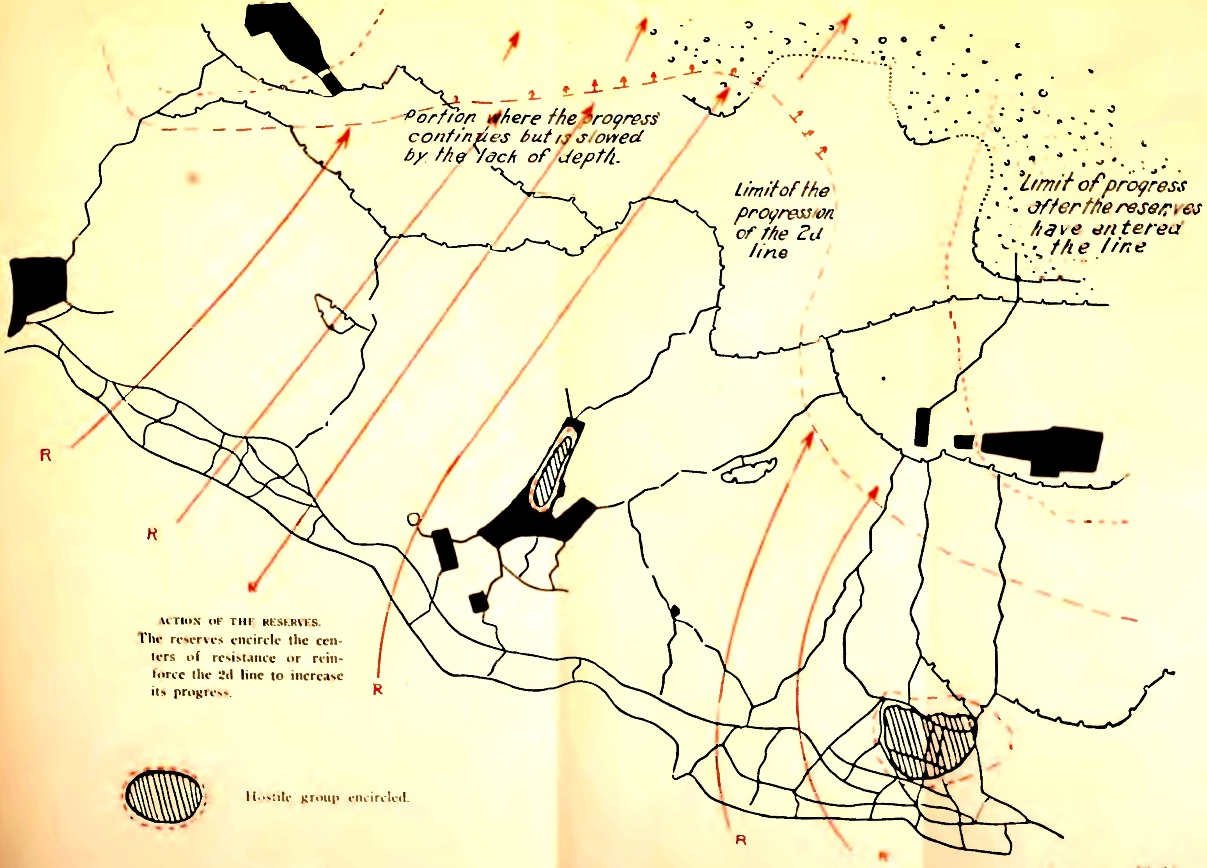
Plate V from Étude sur l’attaque Action of the Reserve Battalions Zone Definitely Cleared shows how the follow-up troops could completely break through and take Vimy Ridge.
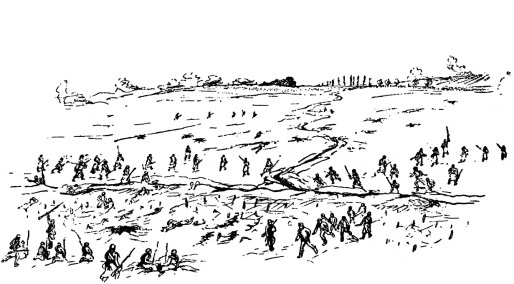
Laffargue’s illustration from Conseils of the pursuit after taking the German second position, a notional view that resembles the advance of the Moroccan Division at Vimy Ridge.
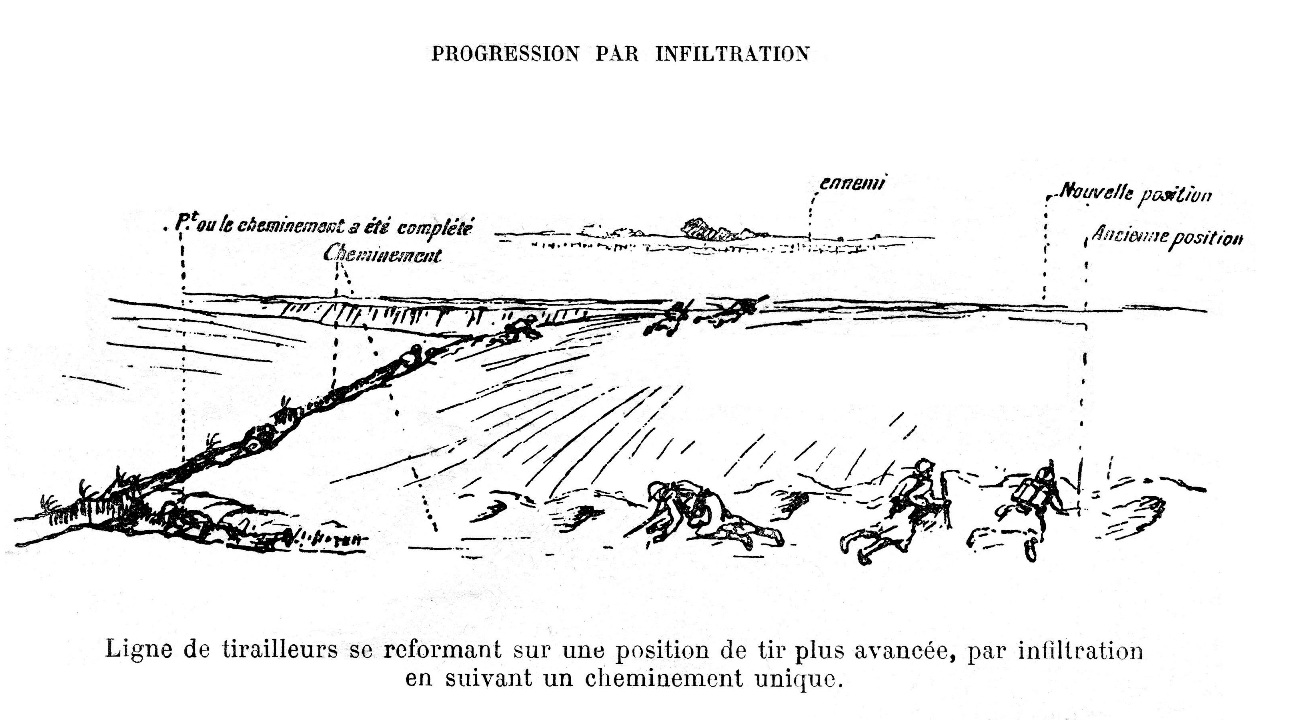
This for Laffargue was the key lesson of the battle. Had there been a means of dealing with the machine guns, his regiment could have reached the German second position (in a manner shown on his Plate III). Because Laffargue advocates attacking between the centres of resistance in a rapid, rather than a step-by-step attack, his pamphlet has been heralded as the origin of ‘infiltration’ tactics. These centres of resistance he advocated, did not need to be destroyed, just neutralised at the edges, ideally with heavy smoke. In 1915 such use of smoke was technologically not yet possible as the clouds produced were neither sufficiently thick or of long enough duration. Laffargue recommends that the second wave of attackers should deal with the centres of resistance, and in this respect he is reflecting the use of trench cleaners as advocated by Note 5779. He makes no use of the actual term ‘infiltration’ in his first pamphlet and only in his second does he use it when describing not his tactics of by-passing centres of resistance but of using natural cover to gain a more beneficial position from which to bring fire on the enemy and launch a new attack in line.[25]
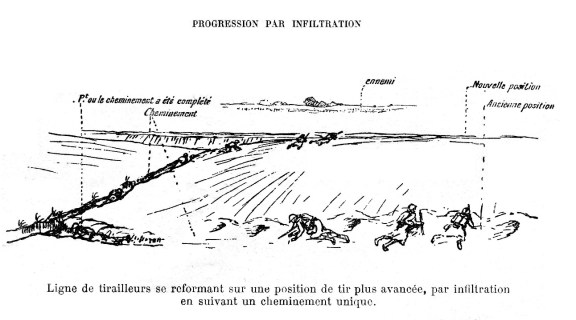
Laffargue’s drawing to illustrate his only reference to ‘infiltration’ shows how a sunken road might be used to approach a German position rather than by-passing a centre of resistance. From Conseils aux Fantassins pour la Bataille.
Laffargue’s pamphlet probably did not have much impact on French headquarters which was already gathering large quantities of information in the form of after-action reports and disseminating its lessons in a more comprehensive manner, as evidenced by Note 5779. According to Laffargue’s own account, Joffre had him attached to his headquarters but he was sidelined by his chef de cabinet who did not wish such a junior officer to influence tactical doctrine.[26] In 1940 the myth was planted that, while the British had not even translated Laffargue’s Étude, the Germans had used a captured copy as the inspiration for their own infiltration tactics.[27] In fact the British had translated and distributed the pamphlet in December 1915.[28] Similarly there is little evidence that Laffargue’s work led to the development of German tactics, the key elements of which had already been developed before its publication.[29] His pamphlets were probably most valuable in disseminating fairly up-to-date information about methods in use at the front and a realistic picture of the psychological impact of combat on soldiers in a popular and accessible manner, which also prepared them for combat in a manner designed to increase fighting spirit. It would have been astonishing if Laffargue had been the only person to have thought of new ways of dealing with the tactical problems of trench warfare but by the 1930s the idea had taken hold that, during 1914-1918, lone radical voices of sanity had been ignored by the forces of reaction in command of the armies.
See below for references.
Join me on a battlefield tour with The Cultural Experience:
The War Poets: Words, Music and Landscapes, 10th-13th July 2023
First & Last Shots 1914 & 1918
Medics & Padres in the Great War
Walking Ypres 1914-1918
Walking the Somme, Summer 2023
Myths of Messines
Understanding Chemical Warfare in the First World War
Yellow Cross: the advent of mustard gas in 1917
References
[1] [André Charles Victor Laffargue], Étude sur l’attaque dans la période actuelle de la guerre Impressions et réflexions d’un Commandant de Compagnie (Paris, Impr. du Service geographique de l’armee, 1915), Laffargue’s introduction is dated 25 August 1915. On 9 May 1915, Laffargue commanded 7th Company, 2nd Battalion, 153rd Infantry Regiment (77th Brigade, 39th Division, 20th Army Corps). The pamphlet was first published anonymously in 1915 by the French Army. In 1916 it was published commercially under his own name. For this article the US translation will be used, The Attack in Trench Warfare Impressions and Reflections of a Company Commander, Translated for the Infantry Journal by an Officer of Infantry, (Washington: The United States Infantry Association 1916).
[2] G. C. Wynne, If Germany Attacks The Battle in Depth in the West, (London, Faber & Faber, 1940), pp. 53-58 is the origin of the idea that the British did not translate Laffargue’s pamphlet, and cites Ludwig Renn’s Warfare (London, Faber & Faber, 1939) stating that the pamphlet was the inspiration for German infiltration tactics. Something similar is repeated in a footnote to the 1917 British Official History which had been largely drafted by Wynne but who asked for his name to be removed from the title page, J. E. Edmonds, Military Operations France and Belgium 1917, Vol. II (London, HMSO, 1948), p. 62. Gudmundsson includes an appendix to disprove the story that German tactics were inspired by a captured copy of Étude which is also borne out by his account of their development, Bruce I. Gudmundsson, Stormtroop Tactics Innovation in the German Army, 1914-1918, (Westport, Praeger, 1989), pp. 193-196. Samuels also discusses the ‘Laffargue Myth’ but his description of Laffargue as regarding his men as ‘dumb animals is not borne out by Étude or his other writings, Martin Samuels, Doctrine and dogma: German and British infantry tactics in the First World War, (Westport, Greenwood Press, 1992), pp. 53-57. Griffiths points out that Laffargue is advocating infiltration but doing so with waves, Paddy Griffith, Battle Tactics of the Western Front The British Army’s Art of Attack 1916-18, (New Haven, Yale University Press, 1994), pp. 54-57.
[3] André Laffargue, Conseils aux Fantassins pour la Bataille (Paris, Librarie Plon 1916).
[4] Commandant breveté Laffarge, Les Leçons de l’instructeur d’infanterie, 5th Ed., (Paris, Charles-Lavauzelle & Cie., 1934).
[5] Laffargue, The Attack in Trench Warfare, p. 6.
[6] Jonathan Krause, Early trench tactics in the French Army: the Second battle of Artois May-June 1915, (Farnham, Ashgate, 2013), p. 5.
[7] Note 5779 was dated 16 April 1915. This account of Note 5779 is based on Krause, op. cit., pp. 23-32.
[8] Laffarge, Leçons, p. 209.
[9] ‘Mécanisme de la préparation de l’attaque dans l’infanterie’, Journal des Marches et Operations, 60e régiment d’artillerie de campagne, 3e batterie, Service historique de la défense, 26 N 1012/6 http://www.memoiredeshommes.sga.defense.gouv.fr.
[10] Gudmundsson, op. cit., p. 22.
[11] The Attack in Trench Warfare, p. 18.
[12] The Attack in Trench Warfare, p. 21.
[13] The Attack in Trench Warfare, p. 39.
[14] Leçons p. 285; The Attack in Trench Warfare, p. 8. 7139 Sergent Henry Louis Ferry has no known grave. ‘Brave Ferry, qui dormez aujourd’hui, à jamais inconnu sans doute, dans ce champ de blé si calme nourri de notre sang, comme voudrai : vous ressusciter dans vos jeune bleuets !’ Leçons p. 24.
[15] The Attack in Trench Warfare, pp. 8, 18.
[16] Leçons, p. 285.
[17] Leçons, p. 285.
[18] Leçons, p. 286.
[19] Leçons, pp. 287-288.
[20] Leçons, p. 288. 1116 Soldat Louis Jules Cartier-Bresson died of his wounds on 11 May 1915. Shortly before the war, Cartier-Bresson had begun teaching his nephew to paint. Henri continued to study art but he turned to photography becoming the father of photojournalism.
[21] The Attack in Trench Warfare, p. 19.
[22] Leçons p. 288.
[23] The Attack in Trench Warfare, pp. 11, 40.
[24] The Attack in Trench Warfare, p. 15.
[25] Conseils pp. 30-31.
[26] Williamson Murray, ‘Armored warfare: The British, French, and German experiences,’ in Williamson Murray and Allan R. Millett (Eds.), Military Innovation in the Interwar Period, (Cambridge University Press, Cambridge, 1996, p. 31 acknowledging James Hogue for notes of his meeting with Laffargue in 1987.
[27] Wynne, op. cit., p. 58.
[28] CDS 333, A Study of the Attack in the Present Phase of War: Impressions and Reflections of a Company Commander (December 1915).
[29] Gudmundsson, op. cit., pp. 193-196.
[30] http://www.generals.dk/general/Laffargue/Charles-Victor-Andr%C3%A9/France.html.
























![[Gen Charsley] EeAHyX_XgAUZi8x-ROT2-cr](https://simonjoneshistorian.com/wp-content/uploads/2014/02/gen-charsley-eeahyx_xgauzi8x-rot2-cr.jpg?w=469&h=467)


 Simon Jones Historian