Edward Harrison, who gave his life developing protection against poison gas

I was very pleased to be asked by the Oxford Dictionary of National Biography to write the entry for one of the lesser-known heroes of the First World War who died one week before the Armistice as a result of poisoning and overwork while developing protection against poison gas.

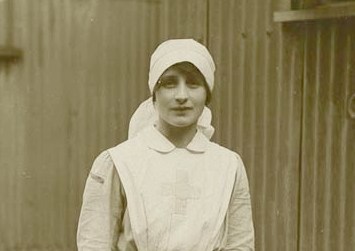
Edward Harrison

Edward Frank Harrison (Wikimedia Commons)

Harrison, Edward Frank (1869-1918), analytical chemist and soldier, was born on 18 July 1869 in Camberwell, London, the third child of William Harrison, a Home Office clerk and his wife Susannah, a school teacher.   His father died when he was aged nine and his mother opened a small school which enabled the education of her sons at the United Westminster Schools.  At the age of 14 Harrison was apprenticed to a pharmaceutical chemist in north London, following which he was an assistant pharmacist in Croydon.  In 1890 he gained a Pharmaceutical Society Bell Scholarship and entered the School of Pharmacy in 1891.  He spent long hours in the research laboratories of the Society and made ends meet by working at a pharmacy each evening and as an assistant lecturer at the School.  Hard work, seriousness and a strong moral purpose were features from an early age.  His parents were Particular Baptists but his scientific education and a rigorous critical discernment meant that he found such religious conviction wanting to be replaced by a belief in research for its own sake.  He retained however a strong sense that life must have a moral purpose.

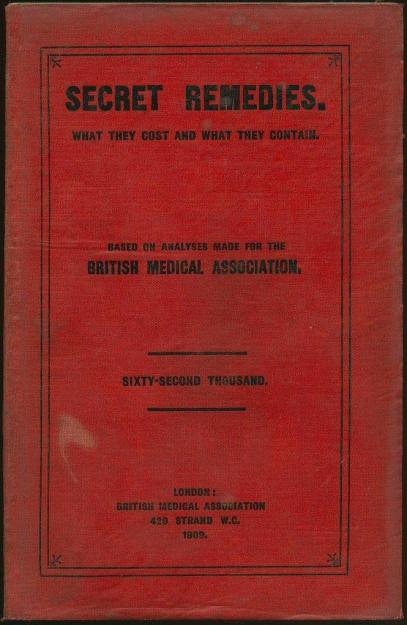
In 1894 he was made a Fellow of the Royal Chemical Society but the desire to earn enough to marry caused him to take a position with Brady and Martin pharmaceutical chemists of Newcastle upon Tyne which lasted five years.  In 1895 he married Edith Helen Wilson, a school teacher and sons Noel Stuart and Douglas Frank were born in 1897 and 1900.  In about 1899 he was appointed head of the analytical department of Burroughs, Wellcome and Company at Dartford.  During this time he also prepared for his B.Sc. at the University of London and graduated in 1905.  In that year he formed a partnership with Charles Edward Sage as an analytical and consulting chemist and to teach at Sage’s Central School of Pharmacy.  The partnership was dissolved in 1906 and Harrison took up independent practice in Chancery Lane, London.  He was assisted by Percy Arthur William Self and by 1914 traded as Harrison and Self.  A reputation for careful and thorough research led the British Medical Association to commission Harrison to analyse a variety of proprietary medicines to prevent deception of the public, and the results were published in 1909 as Secret remedies: what they cost and what they contain, followed in 1912 by More secret remedies.  That year he gave highly effective evidence to the Select Committee of the House of Commons on Patent Medicines as chief witness for the BMA.

Secret Remedies

Secret Remedies, written by Edward Harrison for the British Medical Association in 1909 to expose fake medicines.

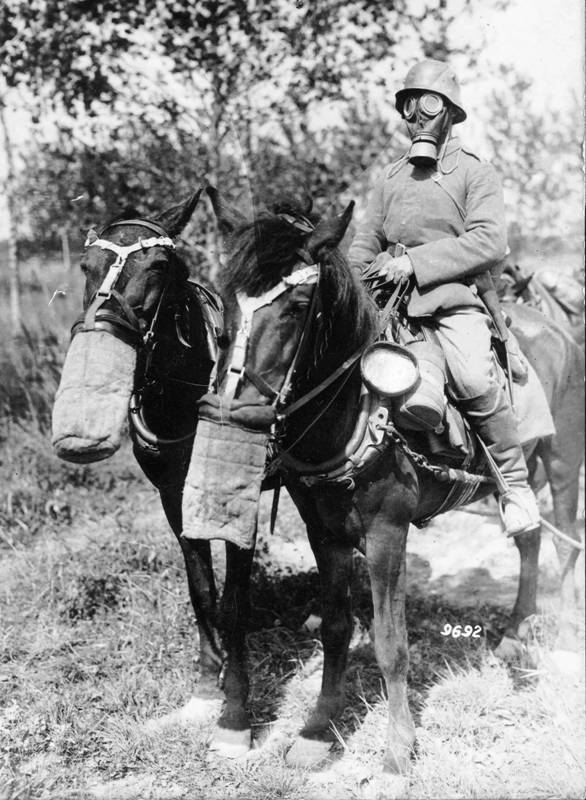
Following the outbreak of the First World War, Harrison made repeated attempts to enlist in the forces.  He succeeded in May 1915 in joining the 23rd (1st Sportsman’s) Battalion, Royal Fusiliers, reducing his stated age by two years to meet the limit of 45.  The Germans in April having carried out an attack in Belgium using chlorine gas, in July he transferred to the Royal Engineers following the formation of a Chemists’ Corps and was immediately commissioned temporary Second Lieutenant in order to work on anti-gas research.  Like most of his profession, he was motivated in particular by detestation for what was seen as the prostitution of chemical science by the Germans in the use of poison gas but he also had no doubt that the Allies should reply in kind.

Harrison joined the staff of the Anti-Gas Department, initially at the Royal Army Medical College at Millbank, London, which had the task of devising protection.  The situation was one of the utmost urgency, the Allies having been caught with no form of respirator.  The design and production of masks to protect against chlorine was comparatively simple but by July 1915 the problem was to devise a single mask which could keep out a potentially very large number of gases which at one point exceeded 70.  Hydrogen cyanide and phosgene emerged as the most likely to be used.  Harrison’s experience and intuition enabled him to make rapid decisions when scientists with a purely academic background tended to be overly cautious and deliberate in their investigations.  There was a high degree of self-experimentation and all the scientist during this most critical phase were at times incapacitated, often to the point of unconsciousness.

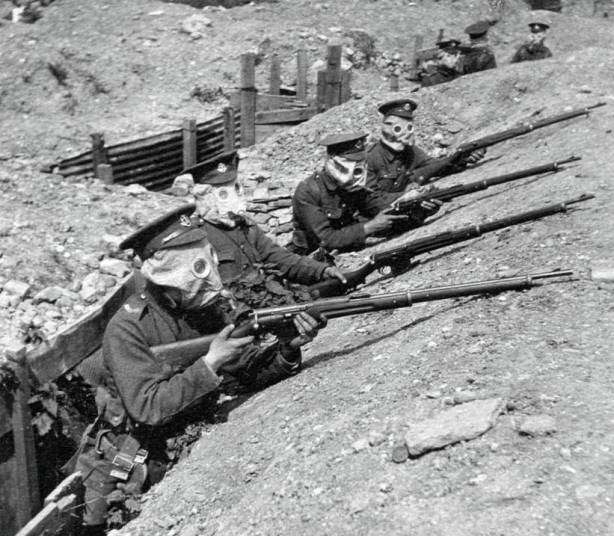
GasDrill Purfleet1915

British troops train in gas helmets, 1915. (c) Simon Jones.

The War Office wished improved protection to be through modification of the existing chemically impregnated flannelette hood.  Although these hoods had some success against phosgene, they were penetrated by high concentrations and were not suitable for adaptation to meet new threats.  Almost immediately in July 1915, Harrison and a small team began developing a respirator in which the protective chemicals were layered in a filter box, initially an adapted army water bottle.  Soda lime permanganate granules, developed by Bertram Lambert at Oxford University, were capable of providing protection against a very wide range of substances but broke down into a dust which choked the wearer.  Hardening the granules rendered them ineffective until, after forty-nine attempts, Harrison discovered a successful formula.  Initially known as ‘Harrison’s Tower’, the respirator developed by the end of 1915 comprised a filter box connected to a facepiece with inlet and exhalation valves.  Adopted by the Army as the Large Box Respirator, 200,000 were issued to artillerymen and machine gunners between February and June 1916.  A compact version, the Small Box Respirator, was made a universal issue from August 1916.  The design meant that the filter box could be modified to protect against new agents; regarded as the most effective gas mask of the war it was adopted by the USA in modified form.  Harrison emerged as the most able in solving the complex problems of both design and production and made frequent visits to France to meet with chemists working at the front.  In January 1917 Harrison became Head of the Anti-Gas Department and in June was appointed a Companion of the Order of St. Michael and St. George.  On 1 November 1917, the Anti-Gas Department became part of the Chemical Warfare Department (CWD) of the Ministry of Munitions and Harrison was appointed an Assistant Controller of the CWD responsible for anti-gas apparatus.   In July 1918 he was appointed Deputy Controller and, in October, Controller of the CWD; in the same month he was appointed Officer of the French Légion d’Honneur.

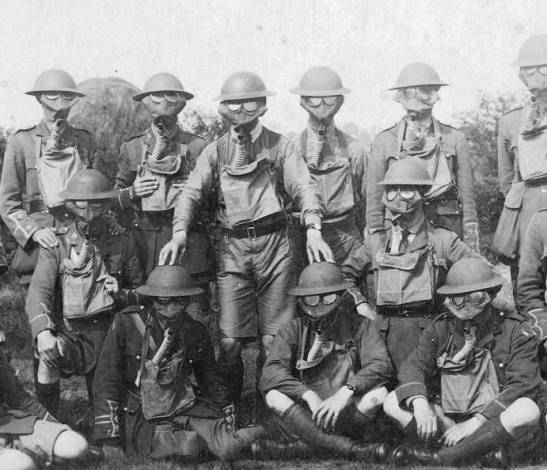
Officers in Small Box Respirators

British officers in Small Box Respirators, 1917-1918. (c) Simon Jones.

His eldest son was killed in action age 19 on 30 July 1916 during the Battle of the Somme.  By October 1918, Harrison was weakened by two and a half years of constant work and the gas inhaled during the early stages.  He succumbed to influenza and died at the premises of Harrison and Self at 57 Charing Cross Road on 4 November 1918.  He was buried with full military honours at Brompton Cemetery.  Lengthy tributes emphasised his abilities, personality and organisational genius.  Memorials to Harrison were unveiled by the Pharmaceutical Society, Bloomsbury Square, and the Chemical Society, Burlington House, and both organisations continue to award prize medals in his memory.

Harrison Medal

The Harrison Medal awarded by the Royal Society of Chemistry. A large version of the medal forms the Society’s war memorial in Burlington House, London.


Contact me for details of sources. Find the article in the Oxford Dictionary of National Biography online.

I have also written about the Edward Harrison for The Guardian.


Join me on a battlefield tour with The Cultural Experience:

Simon Jones Battlefield Tour Somme Poets 2019

The Tank War 17th-20th May 2025

The Battles of the Marne and Aisne 6th-11th September 2025

Mons and Le Cateau 31st August – 3rd September 2025

More Information about Battlefield Tours


Sawyer Spence (1)

Understanding Chemical Warfare in the First World War


IWM Q3999

The Lochnagar Mine: how and why it was blown and who were the men who dug it

The Lochnagar Mine

IWM Q3999

(c) IWM Q3999

One of the most famous and dramatic landmarks on the Somme battlefield is the Lochnagar mine crater near the village of La Boisselle. The yawning chasm is the result of a massive explosion at the opening of the battle at 7.28 a.m. on 1st July 1916.  This article tells you how and why it was blown, who dug it, what effect it had on the Germans, and whether it helped the attack.

Version française ici

The Glory Hole

Underground warfare began in the La Boisselle sector on Christmas Day 1914. The purpose of blowing a mine beneath an enemy position was to destroy a section of the defences but mostly the tunnels were stopped beneath no man’s land by counter mines. By the time the British took over the sector from French troops, no man’s land was riddled with mine galleries below ground and the surface was a mass of large craters, as both sides fought to destroy their opponents galleries by detonating ever larger explosive charges.[1]

RIR111 (c) R. Whitehead

The front line of the German 111th Reserve Infantry Regiment at the ‘Glory Hole’, called by the Germans the Granathof Stellung, 1915-16. ‘Tr’ represents mine craters in no man’s land. (c) Ralph Whitehead.

The specialist British 179th Tunnelling Company of the Royal Engineers arrived in the sector in August 1915 and found the Germans dominant, with deeper and more extensive tunnel networks. There followed a desperate struggle for control of the ground beneath no man’s land and the sector became so riven by mine craters that the British troops named it the ‘Glory Hole’. By October, when 185th Tunnelling Company was brought in to work alongside 179th, they had dug down to the water level at around 100 feet but the Germans were even deeper.[2]

British and German mine systems at La Boisselle. (c) GoogleEarth and Simon Jones

British and German mine systems at La Boisselle. (c) GoogleEarth and Simon Jones

Neither the French nor the British had managed to place a tunnel beneath the enemy front line, but the Germans had achieved it several times, destroying trenches and dugouts and burying alive infantry and engineers.  The Germans had established ascendancy beneath no man’s land on the Western Front and the British response was to form specialist Tunnelling Companies of experienced miners. The officers were mostly mining engineers and 185th was commanded by Captain Thomas Richardson who, a few months previously, had been in charge of sewerage construction in Rio de Janeiro.

Thomas Richardson

Thomas Richardson, first commander of 185th Tunnelling Company.

The Genesis of the Lochnagar Mine

On 11th November 1915, in a new attempt to reach the German trenches, Richardson began a new tunnel away from any known German mining. To conceal the entrance from German view, he began it 400 feet behind his own front line, at a communication trench called Lochnagar Street, but to reach the German lines it would need to be driven almost a thousand feet.

To further conceal the workings and protect them from shell and mortar fire, Richardson first sank a vertical shaft 30 feet and excavated a chamber; from here he began what was described as a ‘main attack gallery’ at a steep 45 degree incline. To remove the spoil, he drove another gallery sloping gently back from the chamber to a point over 100 feet behind. By the end of the month they had driven the attack gallery 115 feet which, if it maintained a 45 degree incline, will have reached 110 feet depth. They had also begun a second gallery at 45 feet depth, running towards the German line on a horizontally plane which had reached 54 feet in length. The miners advanced the tunnels by up to 17 feet a day but the speed of work caused problems for the infantry having to remove the spoil. For every foot dug about 48 sandbags of spoil had to be removed and in early December they lay a trolley way to facilitate their removal.[3] Richardson also began a third gallery towards the Germans by branching from the main attack gallery at 90 feet depth; like the 45 feet gallery, this was horizontal rather than inclined.
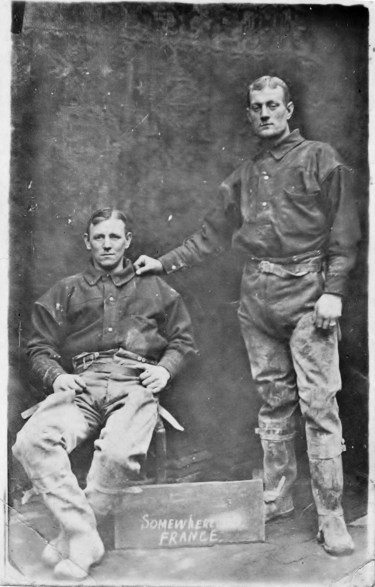
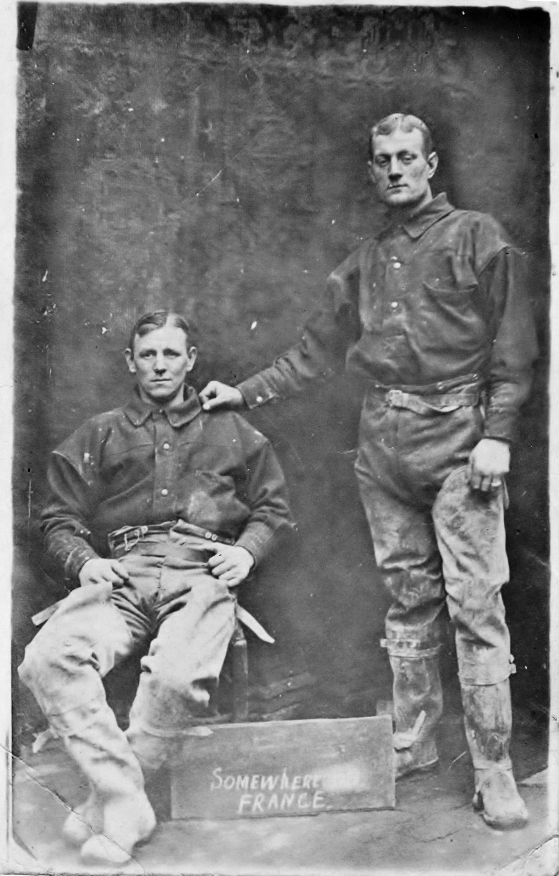
Joe Cox and Tom Hodgetts (c) Duncan Hunting

Joe Cox and Tom Hodgetts, miners from Shirebrook, Derbyshire, serving with 185th Tunnelling Company photographed on the Somme in Albert. Friends from before the war, only Tom survived. (c) Duncan Hunting

At the deeper levels, the chalk was extremely hard and the engineering contractor who had recruited the Tunnelling Companies, John Norton-Griffiths, advocated using pneumatic picks to drive tunnels through it at the water level, between 80 and 120 feet deep, to attack the Germans.[4] Richardson, however, did not to use a compressor to drill the Lochnagar tunnels mechanically, although one was installed at the far more extensive Inch Street system in the Glory Hole. Compressed air driven rotary drills were not a success and stuck in small pockets of soft chalk,[5] while hammer drills could be heard for long distances underground, alerting the enemy to the activity. The alternative however was also noisy, as it involved shot blasting with explosives from 1½-inch diameter holes hand-drilled into the face. The reverberation of the denotations were clearly heard and felt for long distances underground, but Richardson and his German opponents adopted shot blasting as the only means of making progress. Captain Henry Hance, who commanded 179th Tunnelling Company, disliked this method because he believed it would provoke the enemy and alert them to the British work, but he also had no choice but to adopt it.

Sometime in January 1916 Richardson ceased driving the main attack gallery, possibly because it was well below the water level and will have needed constant pumping. He continued the 45 feet and 90 feet deep horizontal galleries and, because the ground rose towards the German lines, their depths slowly increased to 50 and 100 feet. Richardson’s reasons for driving galleries at different levels are not fully clear but they enabled him to listen more effectively for German counter mines and also enabled him to mask the noise from his deeper gallery with deliberately noisy work at the upper level.[6]
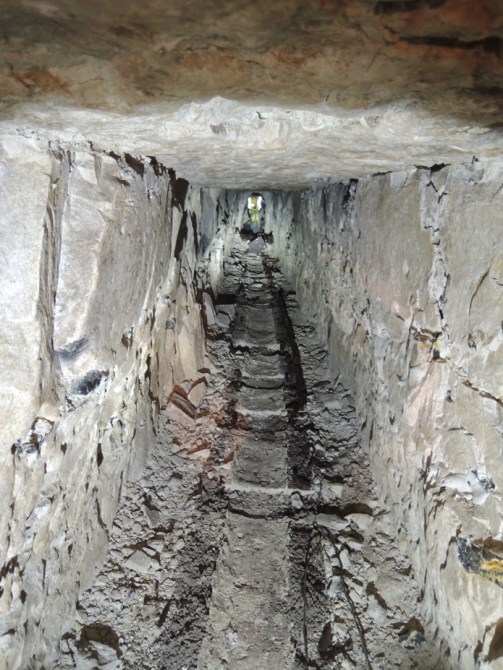
LaBoisselleWTransversal

A British tunnel at 80 feet depth in the hard chalk at La Boisselle explored in 2013. (Iain McHenry/La Boisselle Study Group)

German Suspicions: Silent Working

The spoil heap from the Lochnagar workings quickly grew to ‘a colossal mountain of white chalk burrowed from the bowels of the earth.’[7]  The Germans could see it from aerial photographs and probably also from their own lines and began to shell it regularly. Early on the 30th January, the Germans launched a raid on the British front line south of the Lochnagar mine, capturing a dozen men of the Essex Regiment but failed to reach the mine entrance. [8] It was a lucky escape but shortly afterwards, a disaster was to befall 185th. On 4th February, while Richardson was experimenting with a listening apparatus in the Inch Street system, the Germans blew a mine charge close to a British gallery. Methane from the explosion was forced into the British system and detonated, badly injuring Richardson and another officer; the resulting vacuum drew in carbon monoxide, also a by-product of the original explosion, which killed the two officers and sixteen miners.

Three weeks later, 185th Tunnelling Company was ordered to a new sector to the north and Hance’s 179th took over its underground workings. By this time, the upper Lochnagar gallery was advanced almost 800 feet, the lower 535 feet. Hance halted work on the deeper gallery and just continued the upper, which was now less than 200 feet from the German front line. The danger of detection was now extremely real. They halted work frequently to listen for sounds of German countermining, often for long periods, and on 8th March no sounds were audible to the naked ear for 24 hours. By the end that month, the face of the Lochnagar tunnel was about 140 feet from the Germans and 179th had to try to work in complete silence if the Germans were not to detect them. The hand-pushed spoil trucks were too noisy, even though they were fitted with rubber tyres and ran on wooden rails and, as one of the officers, James Young, recalled, ‘at the end everything was man-handled.’[9]  Lieutenant Stanley Bullock described the ground as ‘broken chalk’, which meant that it was possible to get a bayonet point into cracks in the face, and Hance described the methods used to avoid being heard:

It was done in silence. A large number of bayonets were fitted with handles. The operator inserted the point in a crack in the “face”, or alongside a flint, of which there were any number in the chalk, gave it a twist which wrenched loose a piece of stone of varying size which he caught with his other hand and laid on the floor.  If, for any reason, he had to use greater force, another man from behind would catch the stone as it fell.  The men worked bare-footed, the floor of the gallery was carpeted with sandbags, and an officer was always present to preserve silence.  As sand bags were filled with chalk they were passed out along a line of men seated on the floor, and stacked against the wall ready for use later as tamping.[10]
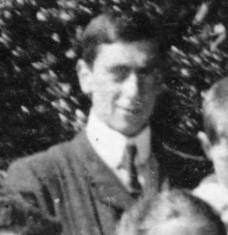
H M Hance

Henry M. Hance, commander of 179th Tunnelling Company, photographed before the war. (c) Mr. J. Bennett and Simon Jones.

To ventilate the long drive they used large blacksmiths bellows connected to hose which ran up to the working face but the air was still so poor that candles would only burn at the face directly where the air came out of the hose.[11] They reduced the size of the gallery to about four and a half feet high and two and a half feet wide, leaving less to excavate, but conditions were even more uncomfortable.  Hance recalled:

The work was extremely laborious, and if we advanced 18” in 24 hours we thought we did well.[12]

In fact, average progress during March fell to less than one foot a day.[13]

In the Inch Street system, the galleries of both sides were so close beneath no man’s land that a break-in, described by Bullock as ‘one of the things we dreaded,’ was daily expected and finally occurred on 10th April 1916.[14] Captain Wilfred Creswick, in charge of the Inch Street and Lochnagar workings, entered an enemy gallery but the Germans blew a charge laid in readiness and he, with two miners working nearby, were killed and their bodies lost beyond recovery. Creswick was replaced as Section Commander by James Young, a colliery manager from Kilmarnock; he was to be responsible for the completion, charging and firing of the Lochnagar mine. The next day, the Germans raided the front line above the Lochnagar mine for a second time, capturing 29 British infantry but, again, they did not penetrate as far as the tunnel entrance. On the day of the raid, Hance was sent for extended leave to a rest centre in Marseille for reasons not recorded but probably exhaustion and he didn’t return until 7th June. Until then, 179th was under the second in command, Captain Gilbert Rowan, a colliery manager from Fife. This was to be a crucial period of preparation for the Somme offensive.

Gilbert Rowan (c) Fiona Middlemiss

Gilbert Rowan, who commanded 179th Tunnelling Company during much of the preparation for the Battle of the Somme. (c) Fiona Middlemiss

The Lochnagar tunnel was directed at a German position known as the Schwabenhöhe from which the Germans had a wide field of fire against British attackers crossing an area known as Sausage Valley. Hance described the objective as being threefold:

(1) to destroy the enemy trench and to knock out his machine guns at this point, where his trench formed a pronounced salient (2) to destroy his underground system whatever it might be (3) to kill any troops he might have sheltering underground from our bombardment.[15]

In mid-April, 179th branched the tunnel to aim at two points on the German front line with the intention of placing two mines, 250 feet apart but, as the branches were slowly advanced, they began to hear the sounds of Germans overhead, digging down from their front line. The German mining operations were carried out by Württemberg troops of the 1st Reserve Company of the 13th Pioneers, commanded by Lieutenant Sihler. Sihler must have suspected British activity because in April he started two underground listening galleries from the Schwabenhöhe; on 22nd reported that noises had been heard in front of the southern part and began three more tunnels to try to locate the source. By the end of the month, the two closest to the British tunnel were about 130 feet away but, although the southernmost was kinked slightly towards the British tunnel, they continued otherwise straight suggesting that Sihler had not pinpointed its location. By mid-June Sihler’s two galleries closest to the Lochnagar tunnel were both down over 80 feet (27m and 26m), almost twice as deep as the British.[16] ‘Jerry was very close and under us,’ Young recalled and, as they worked silently in the Lochnagar tunnel, the British miners could hear the Germans plainly with the naked ear, in a gallery descending from their front line, ‘stumping down their incline’ and also clearly above in dugouts.[17] But the sounds didn’t get any closer: Sihler knew they were somewhere but didn’t know exactly where.

The Coming Somme Attack

During April and May Rowan had to deal with increasing demands on his men for the coming Somme offensive. The 179th was engaged in a second major mine gallery on the left side of La Boisselle village, aimed at a German position known as Y Sap, which was to be even longer than the Lochnagar tunnel. Rowan was also ordered to dig a series of shallow tunnels across no man’s land, known as ‘Russian Saps’, not only at La Boisselle but opposite Ovillers and Thiepval to the north, intended as mortar or machine gun positions and to enable re-supply once the German front line had been captured. One, known as Kerriemuir, was started in April about 400 feet to the left of the Lochnagar mine. Rowan had to withdraw a quarter of his personnel from the tunnel system at the Glory Hole to work on the Russian Saps and the blowing of mines in the Glory Hole was stopped unless absolutely necessary.[18] Hugh Kerr, in charge of the Y Sap tunnel, paid tribute to the men of 179th:

The men worked like hell – you never saw such workmen in your life.  They went all out. We had over 900 strong at one time; had about 600 or 700 infantry attached humping sandbags out of the place.[19]

Daily Mirror May 25, 1917-Small

Hugh Kerr, responsible for the Y Sap mine which he fired on 1 July 1916. (Daily Mirror 25 May 1917)

On 15th May Rowan attended a meeting at III Corps headquarters at which the coming attack was explained: ten days later he suffered a reoccurrence of a gastric ulcer. It was only in mid-June, when the commander of Fourth Army, General Rawlinson, issued orders for the attack, that the rest of the 179th were definitely informed of it. The strain of the work also told on the men and during late May and June some miners were demoted from six shilling a day ‘Tunnellers’ to two shillings and two pence ‘Tunneller’s Mates’ for ‘inefficiency’ or ‘laziness’, a major blow to the pride of a miner who could earn far more at home. On 19th June, a Sergeant deserted but was later allowed to continue serving in the ranks.

The Y Sap mine reached its target beneath the German position, at the cost of sacrificing quiet working, but progress at Lochnagar was so slow that time was running out. When the 4th Army Operation Order was issued on 14th June, neither of the two Lochnagar branches tunnels had reached beneath the German line, both were well over a hundred feet short. Hance stopped driving the two tunnels forward and began cutting out chambers to contain explosives. To compensate, he would have to ‘overcharge’ the mines with far more explosive than was needed simply to form a crater, in order to throw the maximum amount of debris over the German trenches: rather than blow the defenders skywards, they would bury them alive.  The overcharging would also to throw up high lips of debris which might form a barrier to prevent the Germans firing from the flanks, especially from the village of La Boisselle across no man’s land, and also create high ground from which the attackers could gain observation and fire over the Germans. But this depended on the attackers reaching the high lips before the Germans and previous experience showed that the Germans were faster than the British at capturing crater lips, even when taken by surprise.

The plan by the 34th Division to capture the heavily fortified La Boisselle relied on a converging attack which would envelop the village. Rather than helping this attack, the mines risked disrupting it, for the attacking infantry would have to pass either side of the Lochnagar  and Y Sap mines, leaving gaps in the advance. The battalion on whose left front the Lochnagar mine was to be detonated, the 10th Lincolns (Grimsby Chums), had to delay their advance because of the need to withdraw from their front line owing to the danger of their trenches collapsing and the perceived danger of falling debris. No man’s land was wider to the right of the mine and this meant that they had to cross an even wider expanse. When the commander of the brigade which was to make the attack at this point (Brigadier-General R. C. Gore, 101st Infantry Brigade) briefed his battalion commanders on the coming operation, one, Lt. Col. Urmiston, 15th Royal Scots, objected that the mine would delay the advance and leave his men vulnerable to machine gun fire coming from his left when the German machine gunners would be able to focus entirely on his battalion. He offered to change places  with the Lincolns, closest to the mine, and take the risk from the debris, if it meant that all the units could advance simultaneously. According to Urmiston, his offer was declined by his brigade commander who felt unable to alter decisions already taken by the higher command.[20]

The timing of the mines blown on 1st July 1916 became controversial when that at Beaumont Hamel was detonated ten minutes before Zero.[21] This fatal error not only gave the Germans the perfect warning that the attack had finally come but also disrupted the timings of the crucial barrage lifts in the whole sector, denying the attacking infantry the protection of their own guns so that troops could try to seize the crater in advance of the main attack. This was not proposed at La Boisselle where initially the Lochnagar mine was ordered to be fired at one minute before Zero and the Y Sap Mine at Zero. Within a few days orders were amended so that Lochnagar was to be blown two minutes before Zero, then both mines were to be blown at this time.[22] This was probably prompted by caution over the attackers being injured by falling debris and the danger of a slight delay in the mines firing. Two minutes were in fact more than adequate for the debris to fall but it required precise coordination of the firing of the mine and the advance by the infantry. The infantry were eager to get across no man’s land as soon as their barrage moved on to the next line of defences, before the Germans could open fire, but the mining officer in the trenches had to fire the mine exactly to synchronise with the artillery barrage and the infantry attack. The decision as to the timing will not have been Hance’s although he may have been consulted and will have had a view. He had been awarded the Military Cross for charging and firing a mine on 15th June 1915 at Givenchy, which had killed a Canadian officer and buried other attackers. As with Lochnagar, it was overcharged because it had not reached as far as the German line and was also blown two minutes before zero.[23]

Aerial PhotographRes

Aerial photograph with British and German mining south of the Glory Hole prior to Zero on 1st July 1916. (c) Landesarchiv Baden Württemberg/ Annotations (C) Simon Jones.

Charging the Mine

As Hance calculated the quantity of explosives needed at Lochnagar and Y Sap he will have known of no one else in history who had created such large explosions.  He would place 40,000 pounds (18.1 tonnes) at Y Sap and two charges of 30,000 pounds (13.6 tonnes) at Lochnagar.  The left branch at Lochnagar was roughly at ninety degrees to the German trench while the longer right branch approached it at about forty-five. Therefore he divided the charges unevenly, placing 24,000 pounds in the left branch and 36,000 in the longer right branch. The two chambers were not large enough for the charges which would overflow into the branch galleries back to the junction and the charges would form one massive crater. The combined 60,000 pounds (27.2 tonnes) would therefore give 179th Tunnelling Company the record for the largest mine yet blown by the British.[24]  At the same time 179th would fire two 8,000 pound ‘camouflet’ charges in the Inch Street system to destroy the German galleries, this meant that a total of 116,000 pounds (52.6 tonnes) had to be carried into the front line and down the long tunnels.

Since 5th June, 179th had known that the attack would be preceded by five days of preparatory bombardment and gas attacks, during which time the trenches were to be kept as empty as possible. As well as the danger of some of the British shells falling short, the Germans were very likely to respond with counter shelling and they needed to complete charging before this began, although the date was yet to be announced. Bullock described how the explosive for the Lochnagar mine and the two camouflets was brought up by night in horse drawn wagons to a chateau just behind the lines at Bécourt, which also housed a medical unit and Brigade headquarters:

much to the anxiety of the Brigade Major, who certainly had reason for his fears since, should this have been exploded, which was quite likely considering that the Germans were frequently bombarding this place, he and his staff and the dressing station would all have gone sky high.[25]

Every night for about a week, infantry parties carried over one and a half thousand boxes, each containing 50 pounds of the ammonal explosive, up to the mine entrances:

I or one of the other Tunnelling Officers had always to meet these parties in order to see that the work was duly carried out and at the same time guide them through the trenches. As may be imagined, this was not a task particularly enjoyed by those concerned, as, not only was it very heavy work, as the trenches at that time were wet and greasy, but the job of carrying explosive about with the likelihood of shells dropping amongst you was not a particularly desirable one. By the time the Infantry had been on this work for two or three nights the general impression amongst them was that we were getting up enough explosive to blow Fritz back to Berlin.[26]

The boxes were about a foot square and, according to one of the Grimsby Chums, each infantrymen had to take up two:

… we carried ammonal up to the mouth of a mine-shaft, in square wooden boxes, each containing 50 lb., two being nailed together with narrow strips of wood which served as handles. On the first night we were in a trench behind the château, awaiting the order to move off, when we were startled by a shower of 5.9’s, and a near-stampede followed. Fortunately, those in front moved off briskly, and those behind lost no time in following. The boxes were delivered in record time![27]

During the day they decanted the ammonal explosive into rubberized canvas bags to keep it dry during the two weeks that it would lie in the chamber. Each bag contained about thirty pounds and for the Lochnagar charges they filled 2,000 bags. One tunneller described decanting as:

a dangerous and unpleasant job, the ammonal dust staining everything it came in contact with, including arms and faces, a violent and lasting yellow.[28]

The charging of Lochnagar was begun by Captain James Young and Lieutenant Ralph Fox and they expected to get the job about half complete before they were relieved after 48 hours.  They did not use the wheeled trolleys for fear of alerting the Germans and the quantity of men needed soon ate up all the available oxygen in the cramped, 900 foot tunnel.  When Bullock and Second Lieutenant Alexander McKay took over, they found only about twenty bags loaded. Rather than trying to carry the bags down the tunnel, they organised the men as a human chain along the entire length, while the officers took it in turn to stack the bags in the chambers and branch galleries:

We determined to get along with the thing as quickly as possible and took eight hour spells in the face each with periodical trips up and down the gallery in order to keep the Infantry passing bags from one to another at full speed. This could only be done by having the men spaced every two yards, thus curtailing the distance each man had to carry.[29]

Q115 IWM Collections

In this staged photograph, a Tunnelling officer demonstrates a geophone listening device while the miners appear to be putting in tamping for a mine charge. In reality, the geophone was too sensitive to be used when men were working in the vicinity. (C) IWM Q115

All the time they were conscious of the Germans above and below but, so long as they could hear them, they knew that they were not going to blow.  The German routine was to stop work between midnight and 7am: it was during this silent period that there was the greatest risk of being blown but 179th could not stop work. By 7am they had loaded about 400 bags and anxiously waited for the Germans to resume: instead there was a further silence that Bullock found ominous and terrifying:

we all thought that the Boche must have tumbled to what we were doing, and we half expected to have the whole thing blown up any minute, the only consolation being that we should not know what had happened.[30]

Finally, after an hour, the Germans started work as normal; Bullock never understood the reason for the delay. Later that morning they had half the charge loaded and the detonators and leads prepared for embedding in the charges.  Both charges at Lochnagar required twelve detonators, connected in series, each inserted into a guncotton primer, which were placed inside charge bags and buried evenly throughout the explosives, plus a complete back-up system of another twelve detonators in case the first failed.  It was the most dangerous part of the work, carried out by the officers in the chambers, surrounded by hundred of stacked bags of explosives. Bullock and McKay had all the detonators in, the leads connected and the two chambers about three-quarters charged when Young came up that afternoon to take over.  He expected to check that the detonators were in correctly and the leads properly connected, but Bullock and McKay had worked much faster than he anticipated – one senses rivalry between the shifts and the officers – and Young had no choice but to report to Hance that everything was in order.  By the following morning they had completed the charging and begun backfilling, or tamping, the tunnel.  They had stored hundreds of sandbags of chalk along the gallery in readiness and used them to block the tunnel solidly for 350 feet from the branch.

 Zero

On 23rd June Fourth Army ordered that the bombardment should begin the following day, this would make Zero day the 29th. On the afternoon of 28th June, six officers detailed by Hance to fire the four mines went to the headquarters of 34th Division for their final instructions for the attack the following day.  The firing of Lochnagar was the task of James Young and Second Lieutenant Ralph Fox, Stanley Bullock and Alexander McKay would blow the two mines in Inch Street, and Y Sap was blown by Captain Hugh Kerr and Lieutenant Ralph Hawtrey. They learned that Zero Hour was to be at 7.30 a.m. and that they were to detonate the four mines two minutes before. They set their watches by one at headquarters which in turn had been synchronised with others sent to each headquarters all along the attack front. No sooner had they reached the front line, after a long journey through trenches packed with troops preparing for the attack, than they were ordered to return: Zero had been postponed for two days to 1st July. Bad weather had prevented accurate bombardment of the German positions and more shelling was needed.

Hawtrey, Young, Bullock 28 June 1916res

Ralph Hawtrey, James Young and Stanley Bullock, 179th Tunnelling Company, in Albert on 28th June 1916, prior to leaving for the front line for the opening of the Battle of the Somme. Ralph Hawtrey was killed at High Wood in September. (c) Mrs. A. Russell and Simon Jones

When the firing party went up for the second time the German retaliation had begun: the shrapnel shells bursting in the air was ‘one of the most brilliant displays of fireworks’ that Bullock had ever seen.[31]

The firing leads were run back to dugouts close to the front line, where in the early morning, the six tunnelling officers were checking and re-checking the firing circuits by passing through a low current from a battery to flick the needle of a galvanometer. Even though they had used twin sets of leads for each mine, sudden shelling could cause a breakage that might be impossible to find and repair. All the effort would have been wasted and the attackers would lose the advantage that the mines promised. At 6.25 a.m., the British bombardment resumed with a fierce new intensity.

The infantrymen who were to attack near to the two mines had been warned to stay out of any unsupported dugouts, to beware of falling debris and to expect craters 150 yards across. A whole section of the British front line which jutted out immediately to the right of where Lochnagar was to explode was evacuated by the 10th Lincolns (Grimsby Chums) owing to the danger. To the left, in the Tyneside Scottish someone in the first wave shouted to his men five minutes before Zero, ‘NOW! Get hold of the parapet boys, she’s going up’.[32]

Opposite, mostly deep in their dugouts and the cellars of La Boisselle, men from Baden of the 110th Reserve Infantry Regiment had endured a week of torment from explosions, thirst and hunger. But in most places, although their trenches were in ruins, the dugouts held up against the British shells and only to the south of the Schwabenhöhe had heavy mortars caused some to collapse.

At 7.28 a.m. Stanley Bullock rammed down the handle of his exploder to fire the first of the Inch Street mines. After the merest pause, he felt the ground beneath him shudder, a few seconds later another shake of the ground told him that Young had successfully fired Lochnagar:

In the suspense which ensued before I felt the next mine explode, there was no thought for the destruction of life and waste of material when thousands of tons of explosives disappeared into space, only that orders should be faithfully obeyed.[33]

McKay then pressed his plunger home; they did not notice the Y Sap mine go up but Kerr fired it successfully. On the ground, the shockwaves of the mines were felt far more than heard, there was no bang, either on the Somme or in England as was claimed much later;[34] but 8,000 feet above the battlefield the sound waves reached a pilot who had been warned to keep clear of La Boisselle but turned his machine to observe the detonations of Lochnagar and Y Sap:

… the earth heaved and flashed, a tremendous and magnificent column rose up into the sky. There was an ear-splitting roar, drowning all the guns, flinging the machine sideways in the repercussing air. The earthy column rose, higher and higher to almost four thousand feet. There it hung, or seemed to hang, for a moment in the air, like the silhouette of some great cypress tree, then fell away in a widening cone of dust and debris. A moment later came the second mine. Again the roar, the upflung machine, the strange gaunt silhouette invading the sky. Then the dust cleared and we saw the two white eyes of the craters.[35]
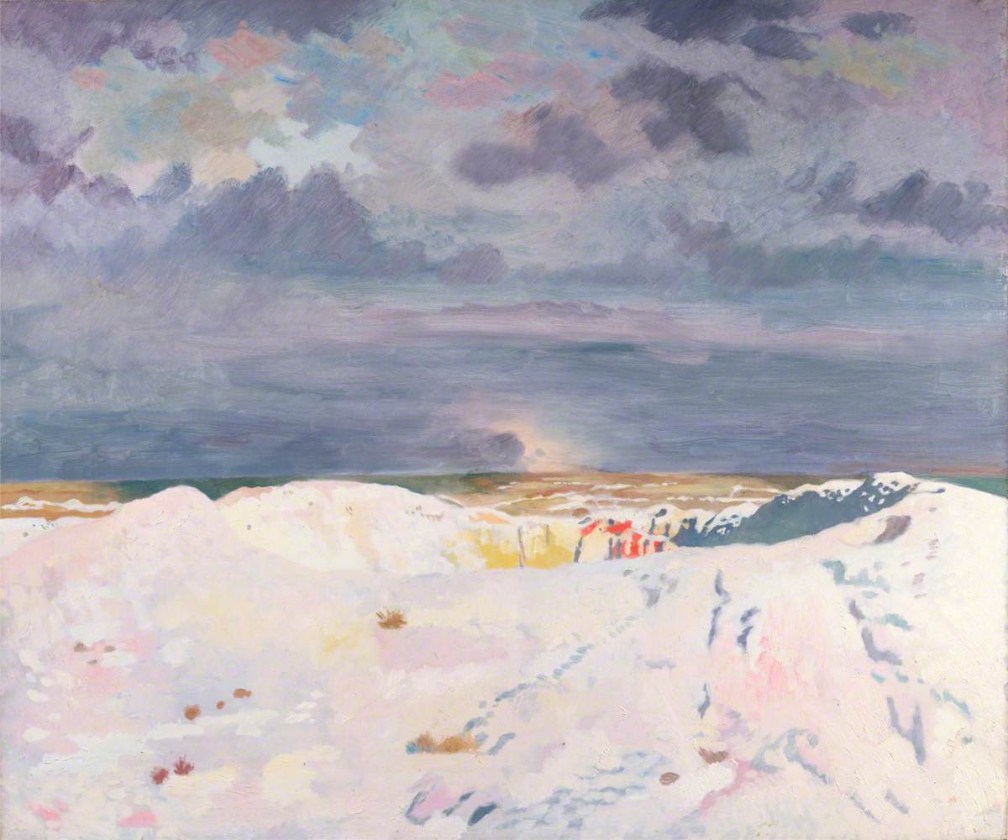
© IWM (Art.IWM ART 2379)

‘The Great Mine, La Boisselle’, the Lochnagar Mine depicted by the artist William Orpen in 1917. © IWM (Art.IWM ART 2379)

An officer of the 3rd Tyneside Scottish, in the second wave to the left of the Lochnagar mine, was exalted:

…we witnessed a most wonderful spectacle. A huge column of chalk was thrown up several hundred feet into the air and came down in a beautiful white cascade. [36]

One of the Grimsby Chums described ‘the whole ground around swaying and rocking as with an earthquake’ and another, who braced his leg against the trench, had it broken by the shock wave.[37] They felt the ground sway three times and saw a crust of earth rise and bursting from it a core of amber:

great pieces of earth as big as coal wagons were blasted skywards to hurtle and roll and then start to scream back all around us. A great geyser of mud, chalk and flame had risen and subsided before our gaze.[38]

Another likened the swaying of the ground to the plate of a weighing machine:

Looking over the parapet, one saw a huge wall rise to some three hundred feet, composed of chalk, mud, dust, timber, etc., with here and there a German. [39]

LEAD Technologies Inc. V1.01

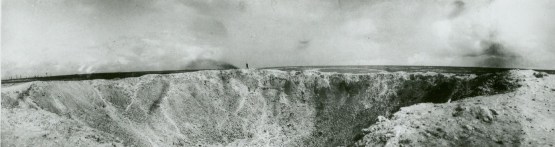
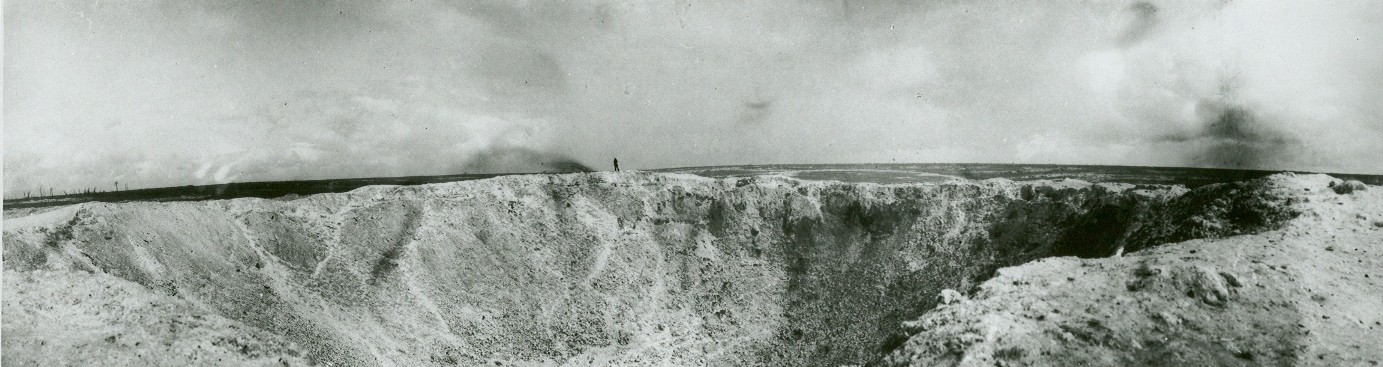
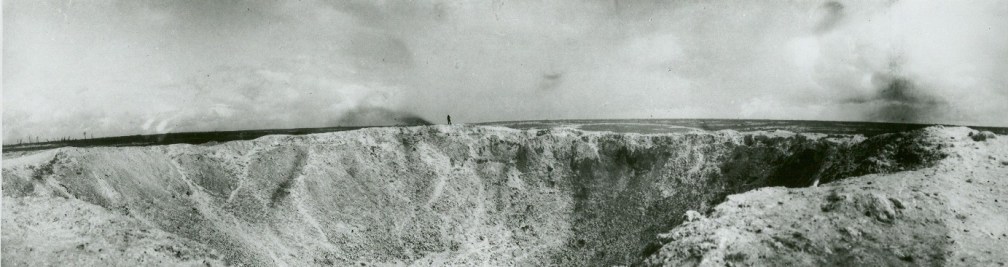
The Lochnagar crater, shortly after it was blown, showing the location of the two charges. From The Work of the Royal Engineers in the European War, 1914-19. Military Mining (Chatham, 1922).

The Lochnagar mine hurled up 84,000 tonnes of earth and chalk and left a crater 220 feet across and 55 feet deep.[40]  The debris buried 600 feet of the German front line and the Baden infantry in the dugouts had no chance: some were instantly fragmented, some hurled into the air, crushed, or would die slowly trapped 30 feet underground.  At Y Sap the mine completely destroyed the German advanced position, leaving a high-lipped crater 130 feet wide but, having detected the British digging beneath them, the Germans had withdrawn back to their front line and suffered no casualties.

Two minutes after the mines detonated came Zero. As the British guns lifted their fire from the German front line to the positions behind, 4,000 heavily burdened British soldiers climbed out of their trenches and began walking across the overgrown fields of no man’s land while, behind them, another 4,000 surged forward. Soon more would advance, for the commander of the 34th Division had deployed all his 12,000 infantry at once against La Boisselle.

Apart from around the Lochnagar mine and in places south of the Schwabenhöhe, the deep German dugouts had withstood the British bombardment. The mine explosions and the lifting of the British barrage alerted the Baden infantrymen that the long-expected attack had arrived.  The survivors emerged from dugouts with machine guns and rifles to open fire on the rows of soldiers advancing in orderly lines through the long grass and sweeping down the slopes behind in columns.  Within two minutes of setting out, the leading attackers were struck by the German machine gun and rifle fire.  Many of the Grimsby Chums and 11th Suffolks were hit before they had even passed their own front line, having been pulled back to avoid the Lochnagar mine debris. The pace of the advance was carefully regulated to keep behind the protective British barrage but as the men at the front faltered, those following caught up and the bunched men formed perfect targets. Within ten minutes eighty percent of the leading battalions were hit. The losses suffered by the 34th Division attacking at La Boisselle were the worst of any on the 1st July 1916.[41] Urmiston was correct in his prediction about heavy German fire, except that it was experienced by all the attacking battalions. However, the Lochnagar mine successfully destroyed a section of the German front line. The destruction enabled the attackers to penetrate the German front line and advance beyond it until, counterattacked, they were forced back to the area of the crater.[42] In his report on the mine, Hance claimed that the mine had benefited the attackers by causing ‘considerable loss’ to the Germans and that:

by the violence of the shock to his garrison, and the shelter afforded by the lips of the crater itself, enabled our attacking infantry to reach his trenches here, and to pass over them in the first assault, with comparatively light loss. Such loss as was incurred must have been caused by fire from his flank. The infantry were also on Z night to establish themselves inside this crater, forming an advance position in front of our original trenches.[43]

Attack of 34th Division (Official History)

The attack of the 34th Division on 1st July 1916 (British Official History).

The Kerriemuir Russian Sap was intended to allow the re-supply of the captured front line in just such an eventuality. By the night before Zero, the 179th was supposed to have prepared the tunnel with just two feet of cover left before it broke the surface, three-quarters of the way across no man’s land. The final work of opening it immediately the mines were blown was the task of a platoon of the 18th Northumberland Fusiliers Pioneers under Lieutenant John Nixon.  On the evening of 30th June, however, Nixon was shocked to learn that his men would have to dig through twelve feet of chalk to open the tunnel, a full day’s work. They therefore began the task at midnight and managed to open the Kerriemuir tunnel an hour after Zero, and it was used later in the afternoon to feed men through to reinforce the captured German line in the Schwabenhöhe (it was not, as was claimed later, connected to the Lochnagar mine crater).[44]

Q 49394

A burial mound in the bottom of the Lochnagar Crater, September 1917. (c) IWM Q49394.

Although the Lochnagar mine gave some assistance to the British attack, Germans losses caused by the explosion were subject to a confused and exaggerated claim from the British side. The GHQ Inspector of Mines, Brigadier-General R. N. Harvey, visited a week after the attack and spoke to the 179th officers who had been on duty. He later described the effect that the Lochnagar mine was believed to have had on the Germans:

We reckoned we closed in 9 deep dug-outs, each with an officer and 35 men – for prisoners were taken from the next dug-out, they were all marched out and the officer said there were 9 other dug-outs with the same numbers of inhabitants as his, i.e. 9 x 1 officer and 35 men – 9 officers and 315 men.  As a result, our troops went over with few casualties.[45]

The British Official Historian erroneously ascribed Harvey’s claim to the Y Sap mine rather than Lochnagar but neither Harvey’s estimate of the German losses nor his claim of light casualties to the attackers are supported by the evidence and there is no record of any British attempt to excavate German dugouts collapsed or destroyed by the mine.[46] German records show that nothing like the number of men referred to by Harvey was holding the affected front line which was part of the sector of the 5th Company of 110th Reserve Infantry Regiment. An analysis of casualty reports shows that this company suffered 109 casualties between 27th June and 3rd July, of which 35 were reported as killed or missing (killed) on 1st July.[47] It is possible therefore that the garrison of no more than one German dugout was lost as a result of the explosion of the Lochnagar mine.

La Boisselle fell to the British on 4th July, but James Young did not see the crater of the Lochnagar mine before he was wounded on 8th July. He survived the war, and died in 1949.

After the Y Sap crater was filled in during the 1970s, the Englishman Richard Dunning purchased the crater to ensure its preservation to which aim the Friends of Lochnagar work today.

OLYMPUS DIGITAL CAMERA

The Lochnagar Crater today (Wikimedia Commons).


See below for the references to this article.


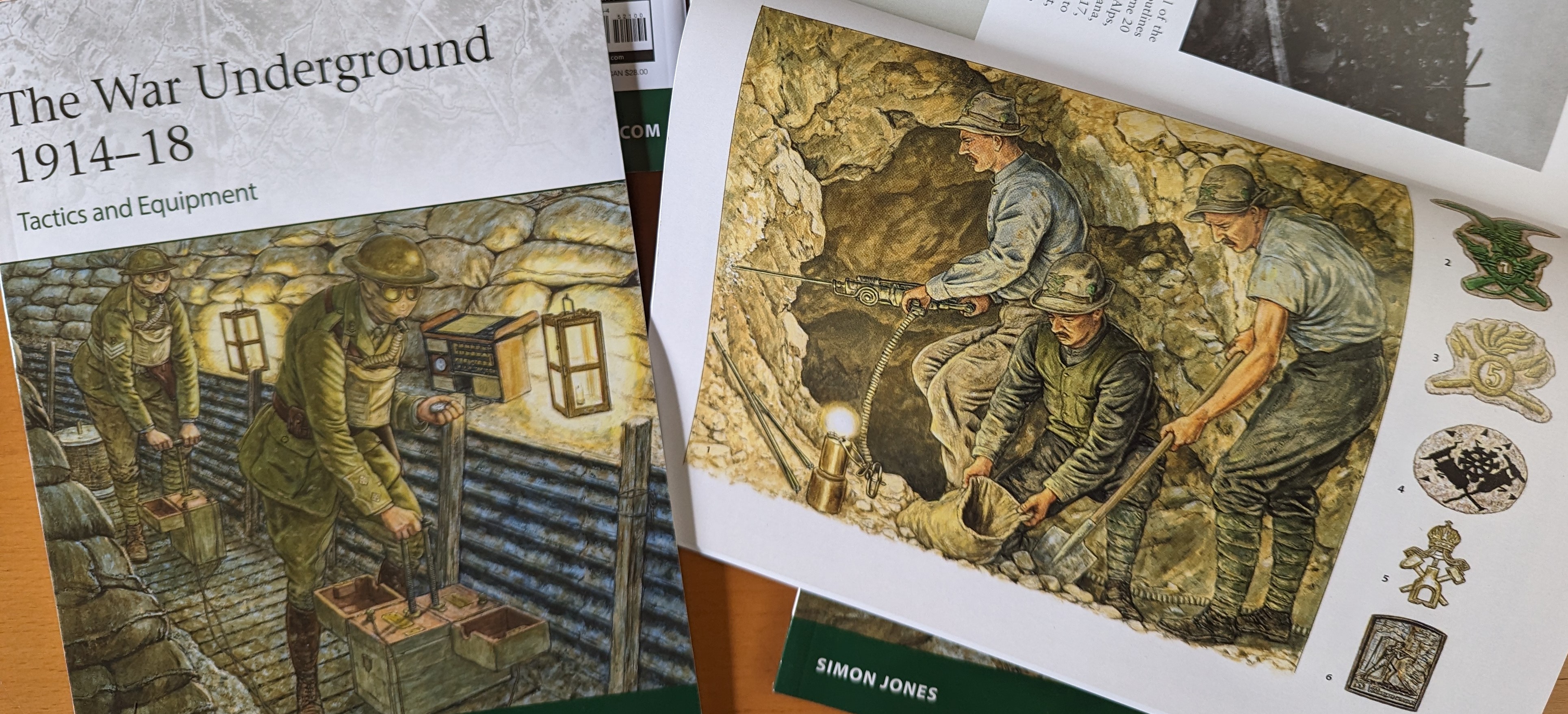
Buy signed copies of The War Underground 1914-18 and World War I Gas Warfare (Osprey Elite Series)PXL_20240524_113844426-cr


Peckham-enh

Myths of Messines: Four Misconceptions about the 1917 Battle Re-examined


joe-cox-and-tom-hodgettsres

Shirebrook Miners in the Tunnelling Companies 


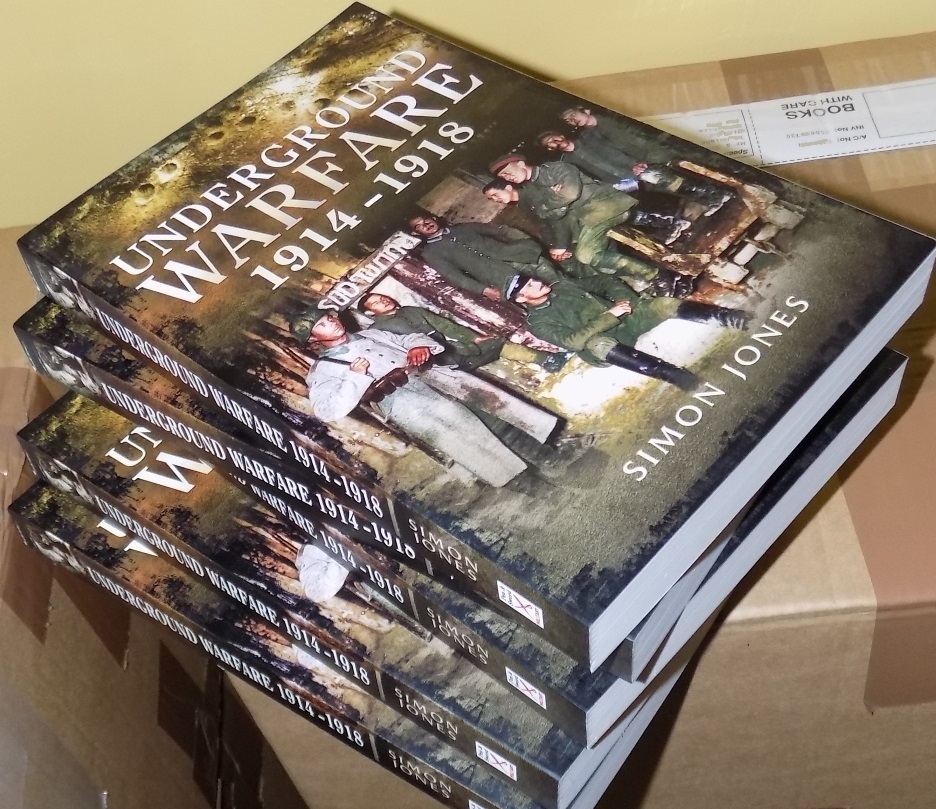
Underground Warfare 1914-1914 in paperback

Buy Underground Warfare 1914-1918 at a reduced price


H15258

Myths of Messines: The Lost Mines


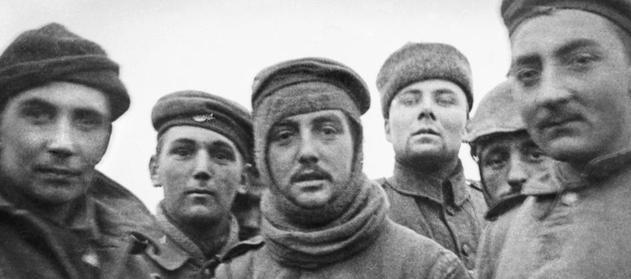
A Memory of Christmas 1914

Understanding the 1914 Christmas Truce


More pages:

Men of 179th and 185th Tunnelling Companies

Contact Simon Jones

Video lecture Born Fighters: Who were the Tunnellers?

Virtual Tour of Tunnels and Trenches excavated at La Boisselle.


Contact me

Facebook

LinkedIn


The Lochnagar Mine: References

[1] Information about underground warfare at the Glory Hole can be found at http://www.laboisselleproject.com/.

[2] Details about the progress of the Lochnagar mine are from War Diaries of 185th and 179th Tunnelling Companies, and reports in brigade and divisional War Diaries in the UK National Archives.

[3] [War Office], Military Engineering Vol. IV Demolitions and Mining, (London, 1923), p. 143.

[4] 21/10/1915 Reports by John Norton-Griffiths, National Archives WO158/129.

[5] J. Young, ‘Notes on 179 Company R.E.’, Tunnellers’ Old Comrades Association Bulletin, No. 13, (1938), pp. 70-72.

[6] Possibly Richardson intended a ‘fougasse’, whereby the effect of burying the German trenches with a mass of debris was increased by first blowing a shallow mine then immediately afterwards a deeper charge.

[7] J. W. Burrows, The Essex Regiment 9th, 10th, 11th, 13th & 15th Battalions, (Southend-on-Sea, n.d.), p. 149.

[8] 53 Brigade WD, Intelligence Report 23-24/1/16; Brigade Operations Report 30/1-5/2/16; R. Whitehead, The Other Side of the Wire, Vol. 1, (Solihull, 2010), pp. 354-357.

[9] Young, ‘Notes on 179 Company R.E.’, op. cit.

[10] H.M. Hance, letter to J. E. Edmonds, June 1930, CAB45/134.

[11] Young, ‘Notes on 179 Company R.E.’, op. cit.

[12] Hance to Edmonds, op. cit.

[13] Mining plans, 179th and 185th Tunnelling Companies, National Archives, WO153/904.

[14] Bullock, ‘Exploits in the First World War’, op. cit.

[15] H.M. Hance, Weekly Mine Report, 5/7/16, 34 Division GS War Diary.

[16] Kriegstagebücher, Pionierbataillon Nr. 13, 1. Reserve-Kompanie M414 Bd. 251-260, Landesarchiv Baden-Württemberg Hauptstaatsarchiv Stuttgart.

[17] Young, ‘Notes on 179 Company R.E.’, op. cit.

[18] R.U.H. Buckland, ‘Experiences At Fourth Army Headquarters’, Royal Engineers Journal, 1927, p. 386.

[19] T.S. transcript of interview with H. R. Kerr by A. Barrie, c. 1959, Barrie Papers, Royal Engineers Museum.

[20] A.G.B. Urmston, letter to J. E. Edmonds, 11/6/1930, National Archives, CAB45/191.

[21] S. Jones, Underground Warfare 1914-1918, (Barnsley, 2010), pp. 118-120.

[22] III Corps Operation Order No. 70, 20/6/1916 III Corps GS War Diary; 103 Infantry Brigade Operation Order No. 24, 21/6/16 103 Brigade GS War Diary; 101 Brigade Operation Order No. 34 23/6/16, 101 Brigade GS War Diary.

[23] 1st Brigade, Canadian Field Artillery War Diary; 1st Canadian Infantry Battalion War Diary; A. Fortescue Duguid, Official History of the Canadian Forces in the Great War 1914-1919, General Series Vol. I, (Ottawa, 1938), pp. 487-489.

[24] The largest mine on the Western Front was 50 tonnes, blown by the Germans at Vauquois on 14 May 1916; the largest British mine of the war was 43.2 tonne mine blown at St. Eloi on 7 June 1917. See S. Jones, Underground Warfare 1914-1918, op. cit., pp. 63-64.

[25] Bullock, ‘Exploits in the First World War’, op. cit.

[26] Bullock, op. cit.

[27] Unidentified soldier of the 10th Lincolns quoted E. Swinton (ed.), Twenty Years After, Vol. 2, (London, n.d.), p.928.

[28] J.C. Neill (ed.), The New Zealand Tunnelling Company 1915-1919, (Auckland, 1922), p. 47.

[29] Bullock, op. cit.

[30] ibid.

[31] ibid.

[32] Pte Elliott, 20/Northumberland Fusiliers (Tyneside Scottish), quoted G. Stewart & J. Sheen, Tyneside Scottish, (Barnsley, 1999), p. 97.

[33] S. C. Bullock, Address to Rotarians, (n.d.), unpublished T.S., courtesy Mrs. A. Russell.

[34] There is no evidence of anyone claiming to have heard mine explosions in England on 1st July 1916. This is apparently confused with the claim of the Prime Minister Lloyd George to have heard the detonation of the Messines mines on 7th June 1917, which itself is implausible: it is more likely that he heard the opening artillery salvo.

[35] Lewis appears to have greatly over-estimated the height to which the debris was thrown by the explosion. Cecil Lewis, Sagittarius Rising, (London, 1977), p. 89.

[36] Capt. Herries, 22/Northumberland Fusiliers (Tyneside Scottish), quoted G. Stewart & J. Sheen, Tyneside Scottish, (Barnsley, 1999), p. 98.

[37] Lt Col E K Cordeaux, quoted in P. Bryant, Grimsby Chums: the Story of the 10th Lincolnshires in the Great War, (Hull 1990), p. 58; M. Middlebrook, The First Day on the Somme 1 July 1916, (London, 1971), p. 120.

[38] Pte. H. Baumber quoted in P. Bryant, Grimsby Chums: the Story of the 10th Lincolnshires in the Great War, (Hull 1990), p. 56-57.

[39] Unidentified soldier of the 10th Lincolns quoted in E. D. Swinton (ed.), Twenty Years After, Vol. 2, (London, n.d.), p.928.

[40] Information from M. and T. Beech, Multi-Limn Survey, pers. comm. via P. Barton, 2013.

[41] J. E. Edmonds, Military Operations France and Belgium, 1916, Vol. 1 (London, 1932), pp. 375-384.

[42] R. Whitehead, The Other Side of the Wire, Vol. 1, (Solihull, 2013), Vol. 2, pp. 296-7.

[43] H.M. Hance, Weekly Mine Report, 5/7/16, 34 Division GS War Diary.

[44] A map in the British official history erroneously shows the tunnel running into the Lochnagar crater, J. E. Edmonds, Military Operations France and Belgium, 1916, Vol. 1, op. cit., Map Volume, map 8.

[45] R.N. Harvey, letter to J. E. Edmonds, n.d. (c. 1930) CAB45/189.

[46] J. E. Edmonds, Military Operations France and Belgium, 1916, Vol. 1, op. cit. p. 382, fn.

[47] My grateful thanks go to Ralph Whitehead for collating and providing this data. The number killed or missing but not taken prisoner on 1st July was 35, and another eight missing but not prisoners during the period, i.e. a total of 43 men. See also R. Whitehead, The Other Side of the Wire, Vol. 2, (Solihull, 2013).

(c) Simon Jones


Crucible of Innovation: Salisbury Plain during the Great War

SalisburyPlainPCe

On May 7th 2016 I will be one of the speakers at the AGM of The Western Front Association, along with Professor Andrew Lambert and Richard van Emden. My subject will be ‘Crucible of Innovation: Salisbury Plain during the Great War’ which I researched while Guest Curator for English Heritage producing a special exhibition for the Stonehenge Visitor Centre in 2014. The exhibition examined the history of the monument and the surroundings during 1914-1918, especially the Salisbury Plain Training Area. The vast complex of military camps, firing ranges, airfields, army and air force schools and the Porton Down chemical warfare experimental ground made Salisbury Plain a centre for innovation and especially the development of the all-arms battle, which is now recognised as the revolutionary contribution made by British and Commonwealth forces to Allied victory.

The exhibition ran during 2014-2015, see the photographs on the website of the designer Northover & Brown.

The WFA AGM is on Saturday 7th May 2016 at the Fleet Air Arm Museum, Yeovilton.


Home

Contact

Famous Verdun photographs which are not what they seem

57

A dramatic photograph was prominent in media reports of the centenary of the opening of the Battle of Verdun on 21 February 1916, apparently showing a French soldier caught in the moment of death. It is usually licensed from Getty images who have now altered their caption to acknowledge that it is in fact a film still from 1928.

Embed from Getty Images

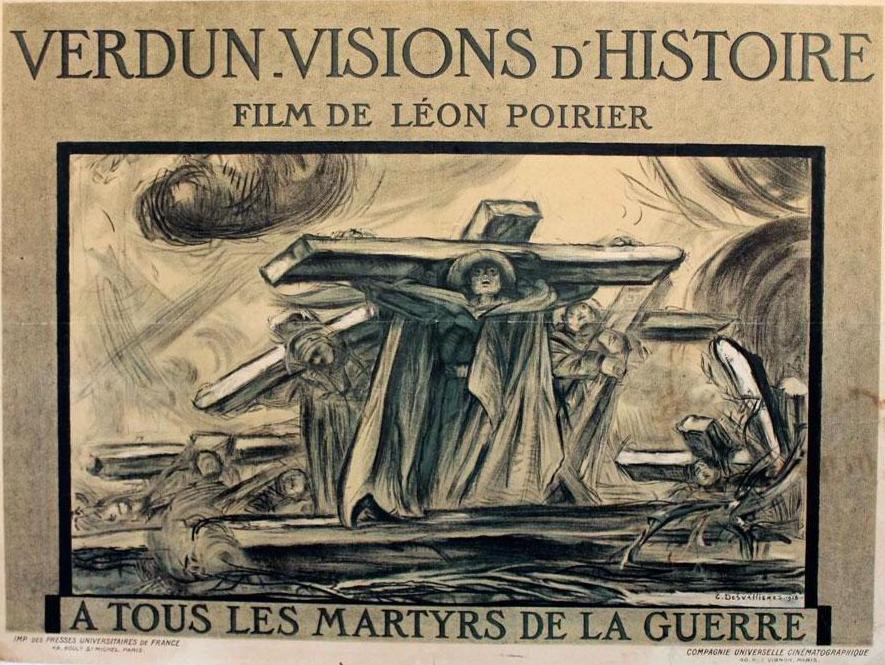
The French film maker Léon Poirier produced a remarkable feature Verdun, visions d’histoire, shot on the old battlefields and inside the forts, using veterans wearing original uniforms and equipment.

Leon Poirier Verdun_visions_d_histoire

(Poster source)

Another famous photograph of stretcher bearers under shell fire is also from the film but Getty have yet to alter the caption.Embed from Getty Images

Watch Verdun, visions d’histoire on YouTube:


Buy signed copies of The War Underground 1914-18 and World War I Gas Warfare (Osprey Elite Series)pxl_20240522_141416108-cr


Q 11718


albert-wyatt-letter-thetford-watton-times-13021915a

Understanding the 1914 Christmas Truce


© IWM (Art.IWM ART 2379)

The Lochnagar Mine


German grenades in Rossignol Wood

The Secrets of Rossignol Wood


Sawyer Spence (1)

More Posts

Rossignol Wood

Rossignol Wood

Rossignol Wood, shell craters and trenches.

It is more than thirty years since I first stumbled across this wood on the northern part of the Somme battlefield. Rossignol, or Nightingale, Wood seldom features in the usual histories or battlefield itineraries but it clearly showed evidence of fierce fighting: deep trenches running along the edges, smashed concrete bunkers and collapsed dugouts, shell holes and heaps of German grenades, while in the adjacent ploughed field lay British shell fuses.  Two small British cemeteries are close by and one, uniquely for a Commonwealth War Graves Commission cemetery, holds more German burials than British. Subsequent visits and research over the years have revealed the story of the fighting at the wood and also its association with some of the most remarkable personalities of the war.

Rossignol Wood view from German trench

Rossignol Wood, the view from German trench.

Fighting came to the wood in February and March 1917 when the Germans withdrew from the old Somme battlefield to the Hindenburg Line. Strong German rearguards caused heavy casualties to the North and South Staffords and the Bradford Pals.  Immediately to the west, the 18th Durham Light Infantry captured the German line. For his part a young Second Lieutenant, James Barker Bradford, received the Military Cross but died of his wounds. He was the third in age of the four famous Bradford brothers, two of whom went on to receive the Victoria Cross but both were also to lose their lives.

German grenades in Rossignol Wood

German grenades in Rossignol Wood.

The Germans withdrew later in March only to retake the ground a year later during the 1918 spring offensive when they were halted a short distance away at Hébuterne. In April 1918 the Lincolns and the Somersets attempted to capture the wood but were forced out. Their chaplain, Theodore Hardy DSO MC, went into the wood and, with the help of a sergeant, managed to bring a man back. For his actions, including tending a wounded man near a German bunker which still survives in Rossignol Wood, Hardy was awarded the Victoria Cross. He died of wounds in October 1918, the most highly decorated non-combatant of the First World War.

Rossignol Wood German bunker

Rossignol Wood, German bunker.

In July 1918 the German infantry officer Ernst Jünger came to Rossignol Wood. The author of The Storm of Steel,  the most famous German memoir of the First World War, Jünger also wrote an account of the period that he spent at the wood, entitled Copse 125 after its German name. The book culminates in a grenade attack immediately to the south of the wood against New Zealand troops among whom was Sergeant Dick Travis DCM MM of the Otago Regiment. Travis helped beat off the attack and captured two machine guns but was killed the following day; he received a posthumous Victoria Cross and is regarded as New Zealand’s greatest soldier.

Rossignol Wood Cemetery

New Zealand graves in front of German burials in Rossignol Wood Cemetery. The cemetery contains 41 Commonwealth and 70 German burials.


Join me on a battlefield tour with The Cultural Experience:

Simon Jones Battlefield Tour Somme Poets 2019
The War Poets: Words, Music and Landscapes, 10th-13th July 2023

First & Last Shots 1914 & 1918

Medics & Padres in the Great War

Walking Ypres 1914-1918

Walking the Somme, Summer 2023

More Information about Battlefield Tours


Home and more posts

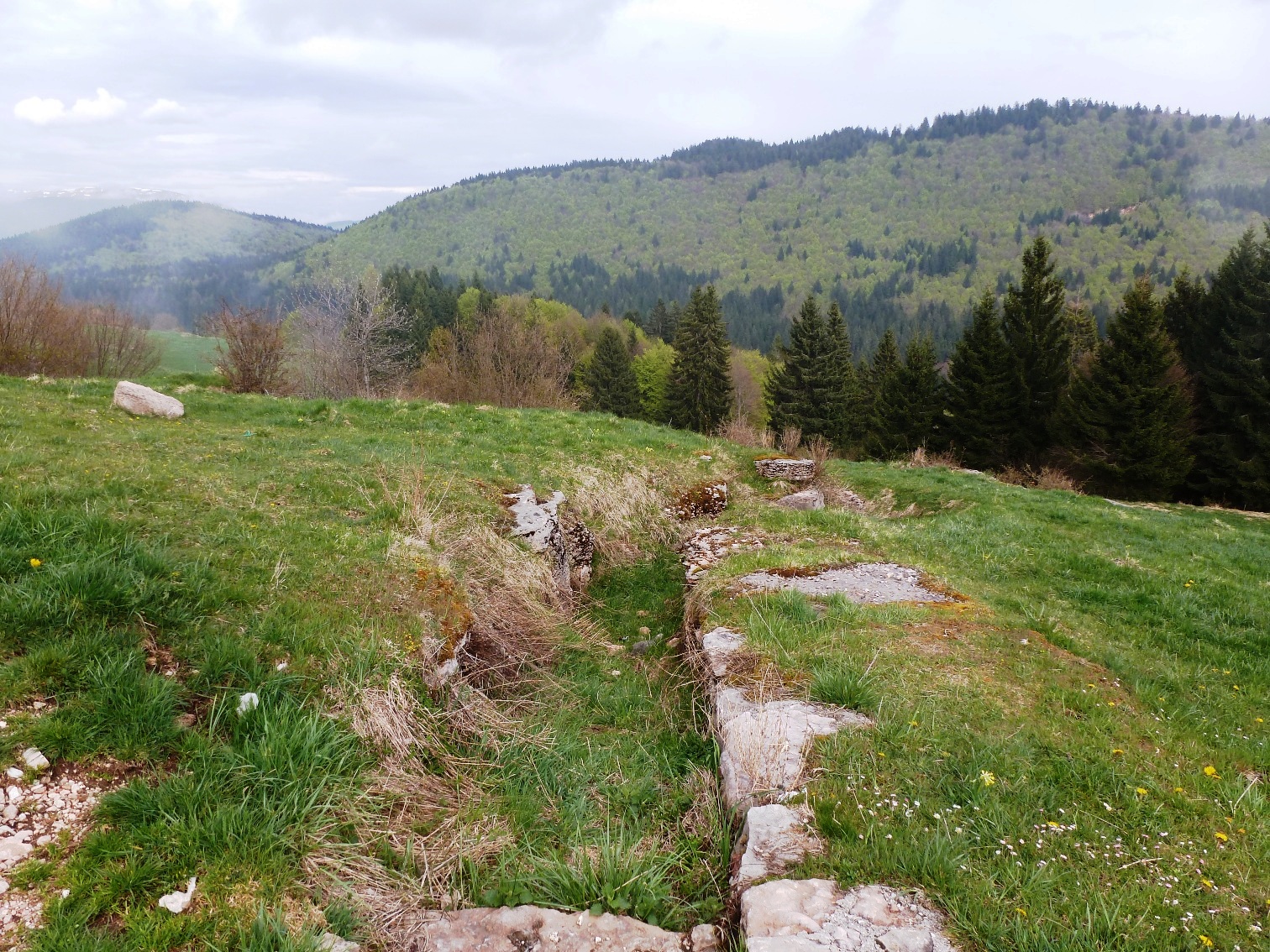
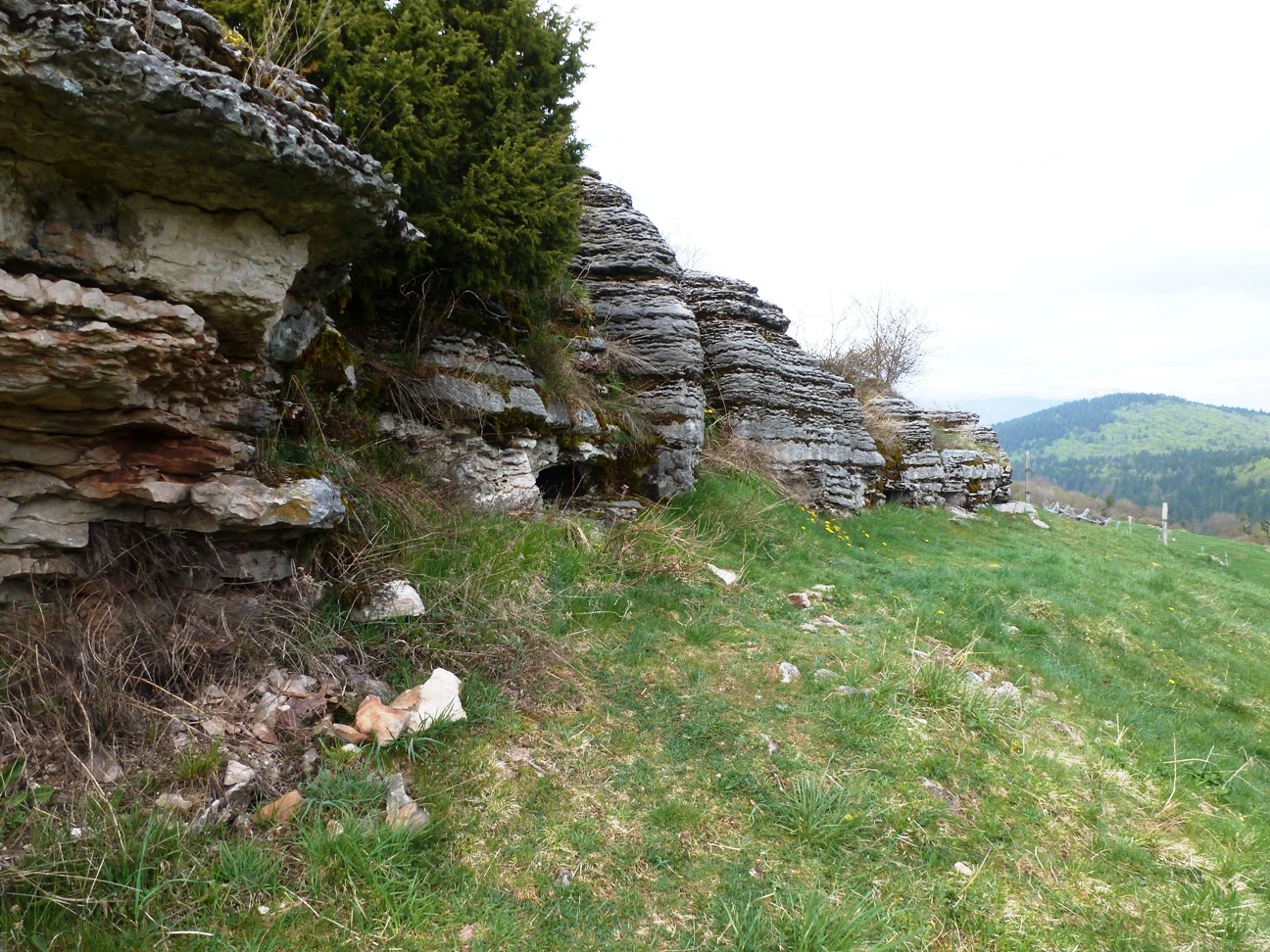
The Italian Front in the First World War at Asiago: Monte Zovetto and Magnaboschi

Monte Zovetto OP 2

Monte Zovetto Italian and British observation posts and shelters.

Monte Zovetto trench 2

Monte Zovetto trench

Monte Zovetto OP 3

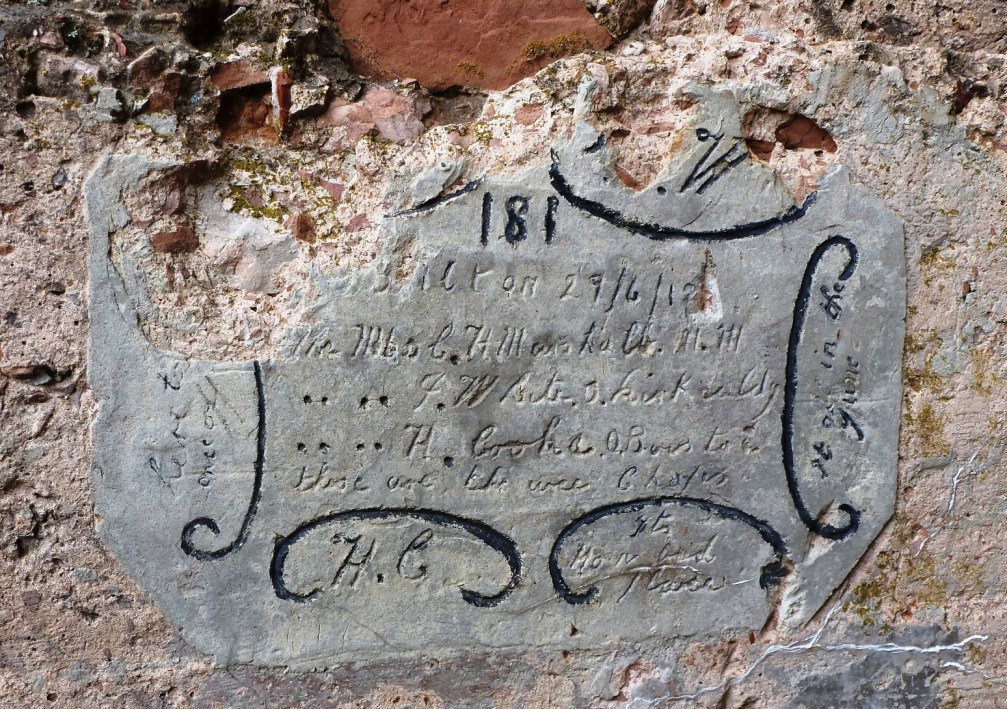
Monte Zovetto inscription OP 4

Monte Zovetto OP 1

Monte Zovetto inscription 1

Monte Zovetto  inscription left by British artillerymen in June 1918.

Monte Zovetto inscription left by British artillerymen in June 1918.

Magnaboschi British Cemetery

Magnaboschi British Cemetery

Magnaboschi British Cemetery

© Simon Jones


Join me on a battlefield tour with The Cultural Experience

Simon Jones Battlefield Tour Somme Poets 2019
The Battles of the Marne & the Aisne 1914 – 1918

First & Last Shots 1914 & 1918

Medics & Padres in the Great War

Walking Ypres 1914-1918

Walking the Somme

More Information about Battlefield Tours


Setsas from Monte Sief

Col di Lana: the First World War in the Dolomite mountains


Where and how did Edward Brittain die?

The Italian Front in the First World War at Monte San Michele.

The Italian Front in the First world War at Redipuglia and Monte Sei Busi.

Contact.

Where and how did Edward Brittain die?

p1110007cropenh

The death in action of her brother Edward, in Italy in June 1918, forms the final tragedy of Vera Brittain‘s memoir Testament of Youth.

Edward Brittain applied for a temporary commission in September 1914, when he was not yet nineteen years of age.

His parents gave their consent to Edward's application, signing this statement written by him. (National Archives WO339/27827)

His parents gave their consent to Edward’s application, signing this statement written by him. (National Archives WO339/27827)

He was posted to the 11th Sherwood Foresters in February 1916 and badly wounded during the Battle of the Somme on 1st July when was also awarded the Military Cross for bravery.

Edward Brittain's wounds recorded in his service record. (National Archives WO339/27827)

Edward Brittain’s wounds recorded in his service record. (National Archives WO339/27827)

Edward Brittain after the award of the Military Cross (Literary Executors for the Vera Brittain Estate, 1970 and The Vera Brittain Fonds, McMaster University Library)

Edward Brittain after the award of the Military Cross (Literary Executors for the Vera Brittain Estate, 1970 and The Vera Brittain Fonds, McMaster University Library)

He was eventually found fit for further overseas duty in March 1917 and returned to his battalion in France. In November his battalion was sent to Italy.

On 15th June 1918, the Austro-Hungarian army launched a major offensive in Italy, part of which fell against British forces on the Asiago plateau. The 11th Sherwood Foresters held San Sisto Ridge, a small, steep, wooded hill, rising 60 metres above the plain. Two companies of the Sherwood Foresters held the front line forward of the ridge, which ran just within the tree line. Captain Brittain commanded ‘A’ Company which held the right hand section of the front line.

Part of the British front line held by Edward Brittain's company in June 1918, known as Alhambra Trench, in 2015 military barbed wire now keeps cattle out of the woods.

Part of the British front line held by Edward Brittain’s company in June 1918, known as Alhambra Trench, in 2015 military barbed wire now keeps cattle out of the woods.

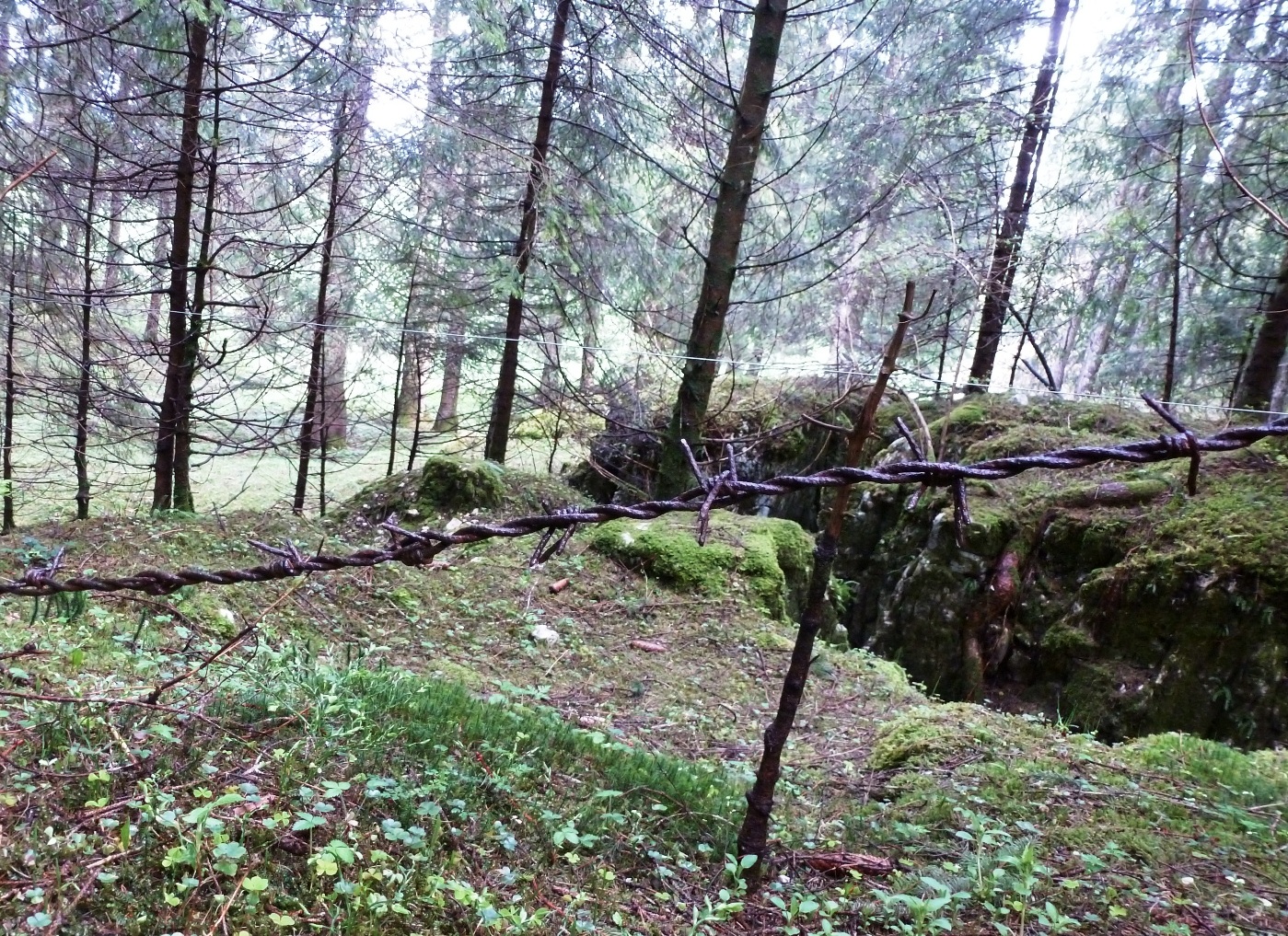
Alhambra Trench with wartime barbed wire. The positions were blasted and drilled from the rock.

Alhambra Trench with wartime barbed wire. The positions were blasted and drilled from the rock.

In front were picquets of about ten men from each company with four machine guns.  At 3am the Austrians began a bombardment of the British positions which lasted for four hours and included gas shells on the front lines. The volume of gas was so great that it rolled down the rear slope of San Sisto Ridge into the valley behind.  At 6.45am the picquets saw troops led by small groups of stormtroops with flame throwers emerging through gaps in the Austrian wire.

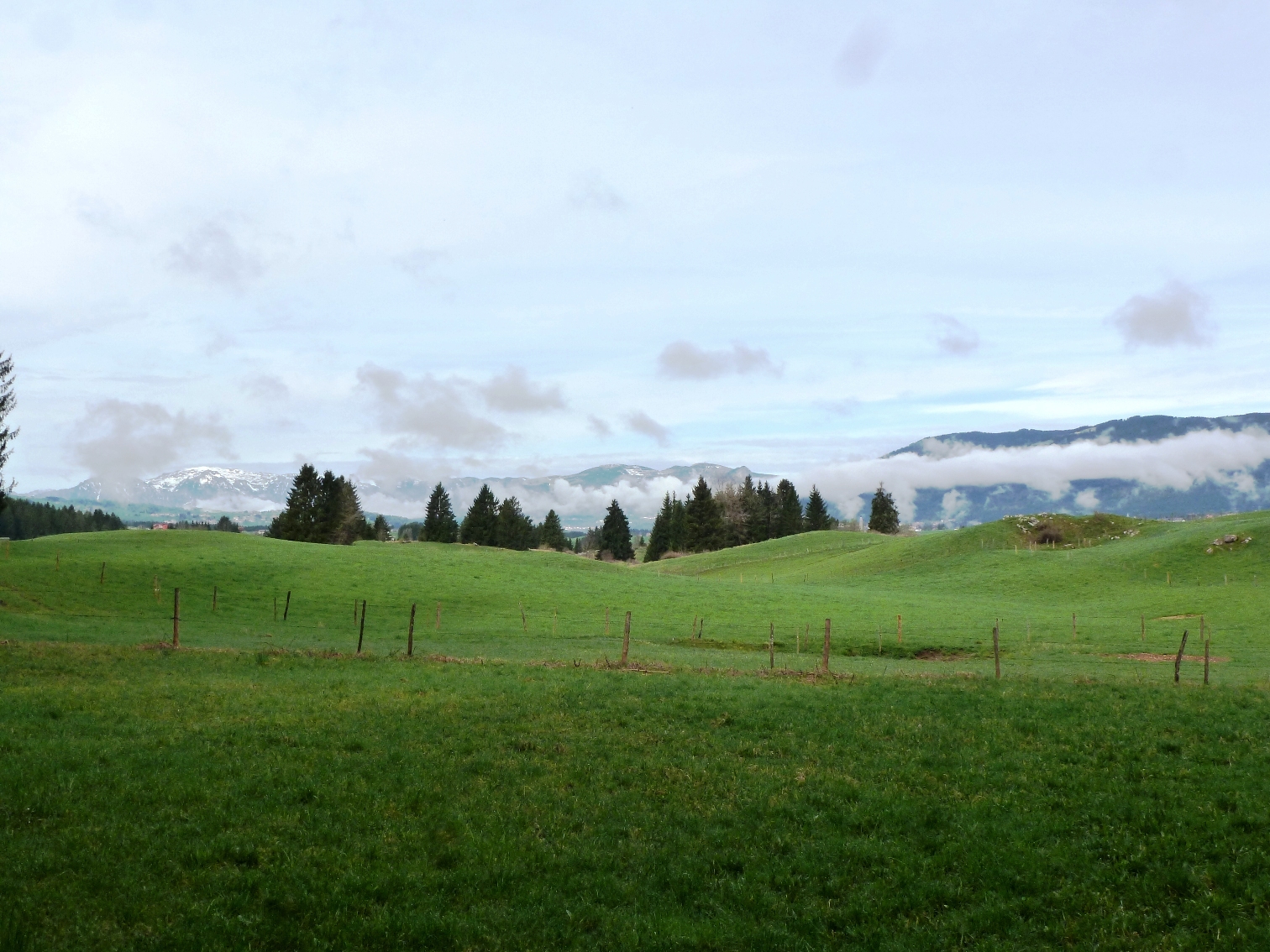
The direction from which the Austrian attack came. The rocky outcrop to the right was the location of two British machine guns; the ten-man picquet from Brittain's A Company was just beyond. The town of Asiago is in the valley behind.

The direction from which the Austrian attack came. The rocky outcrop to the right was the location of two British machine guns; the ten-man picquet from Brittain’s A Company was just beyond. The town of Asiago is in the valley behind.

At the time of the attack, Brittain was liaising with French troops immediately to the right. His Company had about 50 men after the bombardment, to hold about 800m of front line and he was probably the only unwounded officer in the company.  One of the machine guns in front of Brittain’s company was destroyed but the picquet opened fire as did the remaining machine gun which fired 1,000 rounds and inflicted heavy losses on the attackers.  However the attackers managed to outflank the picquet and machine gun forcing them to withdraw, which in turn caused the left hand machine guns to pull back. The Austrian attackers began to crawl towards the British wire and found a route through at the junction of the two companies of the Sherwoods. Entering the British trenches, the Stormtroopers were followed by trench clearing parties which worked left and right with grenades and flamethrowers, capturing 200m of the front line.

The deployment of British at the start of the battle. The 11th Sherwoods were holding the front line with D Company on the left and Brittain's A Company on the right; C Company was on the ridge summit behind. Machine guns R1 and R2 were deployed in front of the British wire, as was a picquet of ten men.  The Austrian break-in is shown by the red arrow and the area in which Edward Brittain lost his life is shown by the cross. (23rd Division GS War Diary National Archives WO95/4229)

The deployment of British at the start of the battle. The 11th Sherwoods were holding the front line with D Company on the left and Brittain’s A Company on the right; C Company was on the ridge summit behind. Machine guns R1 and R2 were deployed in front of the British wire, as was a picquet of ten men. The Austrian break-in is shown by the red arrow and the area in which Edward Brittain lost his life is shown by the cross. (23rd Division GS War Diary National Archives WO95/4229)

Soon between 100 and 200 attackers were in the British trench, as the Sherwoods attempted to block the trench at either end of the break-in. Brittain immediately led a counterattack, forcing some of the Austrians back through the wire, and reorganised the defence. It was as he looked out for signs of the Austrians that he was killed, reportedly shot through the head by a sniper.

The area  of Alhambra Trench retaken by Brittain's counterattack and where he was killed shortly afterwards.

The area of Alhambra Trench retaken by Brittain’s counterattack where he was killed shortly afterwards.

Brittain’s Company was now officerless and the Austrians had at least ten machine guns inside the British wire. They resumed pouring through the gap into the British front line and about thirty pushed up a communication trench to the summit of the ridge into an undefended length of trench.

Communication trench where the Austrians broke in and pushed up to the summit of San Sisto Ridge.

Communication trench where the Austrians broke in and pushed up to the summit of San Sisto Ridge.

A dugout near the summit of San Sisto ridge.

A dugout near the summit of San Sisto Ridge.

A counterattack organised by the commanding officer of the 11th Sherwood Foresters, a 26-year-old Lieutenant Colonel, Charles Hudson, forced the Austrians back and retook the ridge but soon afterwards Hudson was seriously wounded by a grenade. A second British counterattack consolidated the hold on the front line.

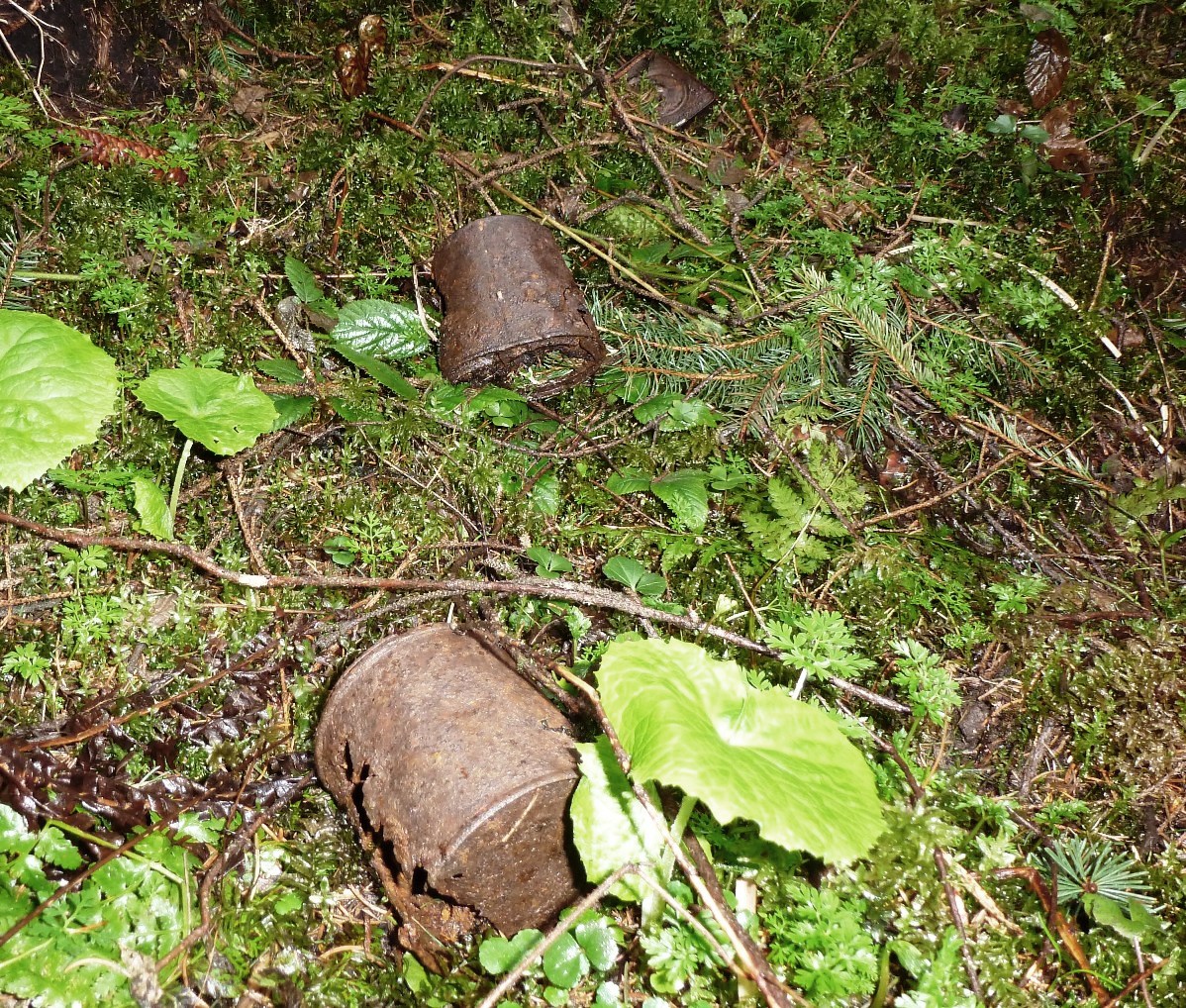
Ration tins on San Sisto Ridge, 2015.

Ration tins on San Sisto Ridge, 2015.

The top of a British petrol tin, used for transporting water to the front line, San Sisto Ridge, 2015.

The top of a British petrol tin, used for transporting water to the front line, San Sisto Ridge, 2015.

The War Office telegram sent to Edward's father on 22nd June 1918. (National Archives WO339/27827)

The War Office telegram sent to Edward’s father on 22nd June 1918. (National Archives WO339/27827)

Notification of the location of Edward's Grave sent to his father. (National Archives WO339/27827)

Notification of the location of Edward’s Grave sent to his father. (National Archives WO339/27827)

Vera Brittain visited Hudson in 1918 and in Testament of Youth describes how he told her that her brother was “sniped” by an Austrian officer and shot through the head, just after the counterattack which he had led.  She also quotes from a letter received from a Private in her brother’s company: ‘Shortly after the trench was regained Capt. Brittain who was keeping a sharp look out for the enemy was shot through the Head by an enemy sniper, he only lived a few minutes.’

Granezza British Cemetery.

Granezza British Cemetery.

Edward's grave at the end of the row buried with men from his Company.  In September 1921 Vera visited the cemetery and planted rosebuds and a small asparagus fern beside her brother's grave.

Edward’s grave at the end of the row buried with men from his Company. In September 1921 Vera visited the cemetery and planted rosebuds and a small asparagus fern beside her brother’s grave.

After the publication of Testament of Youth Hudson wrote to Vera stating that shortly before the attack a letter from her brother had been opened by the censor and found to contain references to homosexual activity with men under his command. Hudson said that he warned Brittain obliquely that his letters were read the day before and believed that as a result Brittain had deliberately sacrificed himself during the attack. Edward Brittain’s army service record contains no reference to this.  Edward’s death is thought to have contributed to their father’s suicide in the Thames in 1935.


The account of the action on San Sisto Ridge is based on Francis MacKay, Asiago (2001) with reference to War Diaries of 11th Battalion Sherwood  Foresters (WO95/4240) and General Staff 23rd Division (WO95/4229), and Percy Fryer, The Men from the Greenwood (1920).  Reference to the revelations by Charles Hudson is made by Mark Bostridge, Vera Brittain and the First World War (2014).


Join me on a battlefield tour with The Cultural Experience:

Simon Jones Battlefield Tour Somme Poets 2019

The War Poets: Words, Music and Landscapes, 6th-9th July 2023

First & Last Shots 1914 & 1918

Medics & Padres in the Great War

Walking Ypres 1914-1918

Walking the Somme, Summer 2023

More Information about Battlefield Tours


sawyer-spence


VB

Where did Vera Brittain serve in France during the First World War?


P1000901crop

The most effective chemical attack ever staged: the gas attack at Caporetto, 24th October 1917


Austrian positions Monte Sief view to Setas

Col di Lana: the First World War in the Dolomite mountains


Joe Cox and Tom Hodgetts (c) Duncan Hunting

Who dug the Lochnagar Mine?


Home and more posts

Contact me

Facebook

LinkedIn


Understanding chemical warfare in the First World War

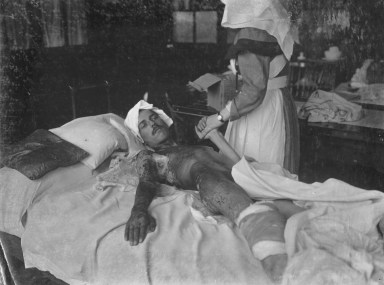
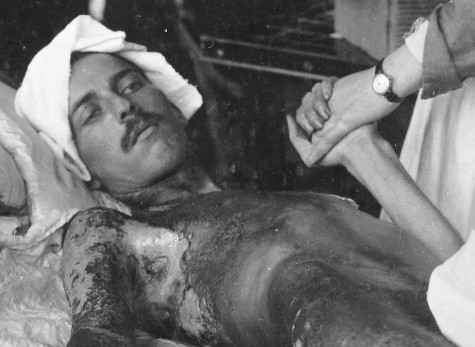
In August 1918, while waiting to advance east of Amiens, Sergeant Sawyer Spence unwittingly lay in a shell hole contaminated with mustard gas. Feeling no ill effects he only reluctantly agreed to be evacuated; only after 24 hours did medics realise that his uniform had been saturated by the oily liquid. By the time he reached a hospital twelve days later, in the converted pavilion of Nottingham’s Trent Bridge Cricket Ground, the whole of one side of his back and legs was septic and discharging pus, the result of massive blistering. He was the worst mustard gas case that the hospital had ever seen.

Sawyer Spence suffering extensive mustard gas blisters, Trent Bridge Hospital, Nottingham, 1918. © Jon Spence, used with permission.

Sawyer Spence suffering extensive mustard gas blisters, Trent Bridge Hospital, Nottingham, 1918. © Jon Spence, used with permission.

Sawyer Spence was one of an estimated half a million chemical warfare victims of the First World War. The first were on 22nd April 1915 when the Germans released 150 tonnes of chlorine gas from their front line trenches north of Ypres in Belgium and allowed it to drift towards the French positions. It inspired some of the most powerful works of art and literature to come out of the First World War yet, since its shocking debut, our understanding of chemical warfare remains surrounded by a miasma of fear, emotion and propaganda.

Chemical weapons were outlawed at arms control conferences at the Hague in 1899 and 1907; despite being signatories, Germany, France and Britain all carried out research before the outbreak of war. When trench warfare atrophied into a vast linear siege, chemicals were high on the list of solutions to break the deadlock; substances that would not cause permanent injury, such as tear gas, were favourites. Germany was first, adding an irritant to shrapnel shells, and thus technically not breaking the Hague Agreement, but the British-Indian troops they were used against in October 1914 failed even to notice. In a second attempt, Germany fired tear gas in shells against the Russians near Bolimow in Poland in January 1915, was equally ineffective when in the cold the liquid failed to vaporise. France followed by issuing instructions in February 1915 for the use of an anti-riot tear gas cartridge at the front, again without particular success. Britain adopted a tear gas, ethyl iodoacetate, in January 1915 after it was identified by Jocelyn Thorpe, professor of organic chemistry at Imperial College, University of London, which was codenamed ‘SK’ after the South Kensington location. Thorpe claimed that the War Office was only convinced of SK’s effectiveness after a small boy was given a shilling to stand in a trench into which it had been released; in April 1915 the British government was still pondering its legality.

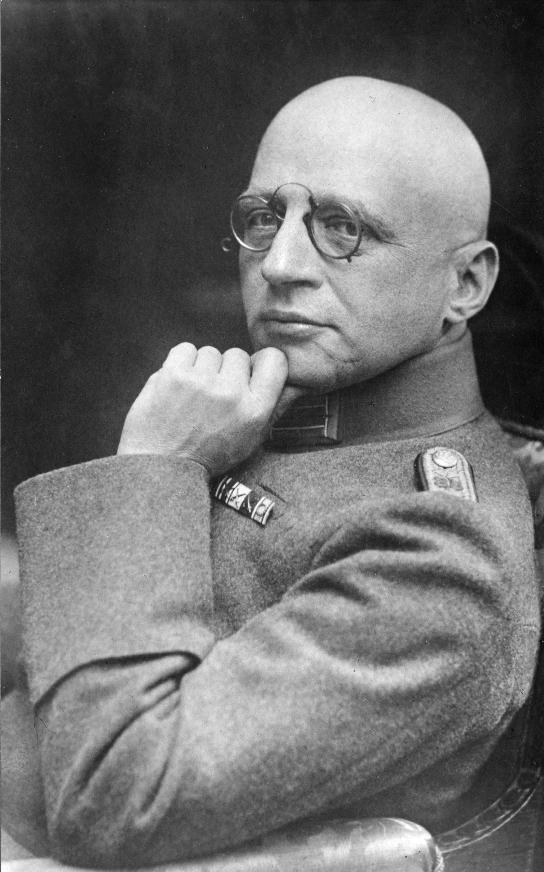
Fritz Haber, in the uniform of the 35th Pioneer Regiment.

Fritz Haber, in the uniform of the 35th Pioneer Regiment.

Germany took the lead in chemical weapons thanks to her developed chemical industry and universities, but also because of the remarkable genius of Fritz Haber. The son of a dyestuff manufacturer, six years before the outbreak of war Haber made perhaps the single greatest chemical discovery of the twentieth century, for which he was to receive the Nobel prize for chemistry: the means of converting atmospheric nitrogen to ammonia. Fertiliser made using the Haber-Bosch process has produced food to increase the world’s population by an estimated one billion people; it has also facilitated the bulk production of explosives. Haber was the first Director of the Kaiser Wilhelm Institute for Physical Chemistry and in 1914 threw his immense energy and talent into his nation’s war effort. Vigorous and persuasive, he was responsible more than any other individual for the development of chemical weapons during the First World War. After the failure of the earlier attempts, Haber made a simple and direct proposal: readily available chlorine gas should be released from cylinders to be carried by a breeze over the enemy positions. If it was successful, the Germans believed that the Allies could not respond owing to their limited capacity for chemical production. Despite moral and military objections by two senior German commanders, the chief of the general staff, von Falkenhayn, decided that it should be tried at Ypres. A simple idea, in practice it was anything but. Carrying the heavy cylinders of chlorine into the trenches and concealing them was dangerous and difficult; when some were hit by shell fire the gas killed three of their own men and injured 50. The prevailing westerly wind placed the Germans at a disadvantage; it refused to blow in the right direction, or changed just as the attack was about to be launched. After a fruitless two week wait, the Germans had to reinstall 6,000 cylinders from the south of Ypres to the north but again twice more postponed when the wind was wrong.

German troops carry poison gas cylinders to be installed in trenches.  © Simon Jones

German troops carry poison gas cylinders to be installed in trenches. © Simon Jones

Finally, the order was given to release when it was ‘half-way favourable’; the troops assembled packed in the trenches throughout the 22nd April until, late in the afternoon, a southerly wind arose and orders were hurriedly issued to attack. The gas hissed from hundreds of pipes placed over the trench parapets and greenish-yellow clouds drifted across no man’s land towards the French positions; in most places, the gas quickly engulfed the trenches and the field guns close behind them. Reservist and North African troops had no means of protection; a powerful odour of bleach and fumes which stung the eyes were quickly followed by choking as they inhaled the gas. Most fled for their lives but the unlucky ones fell to the ground where the gas pooled. As the gas entered their lungs the mucous membranes produced fluid to flush away the irritation, oxygen transference was severely hindered and the victims began to drowned.

A French victim of the first chlorine gas attack. © Simon Jones
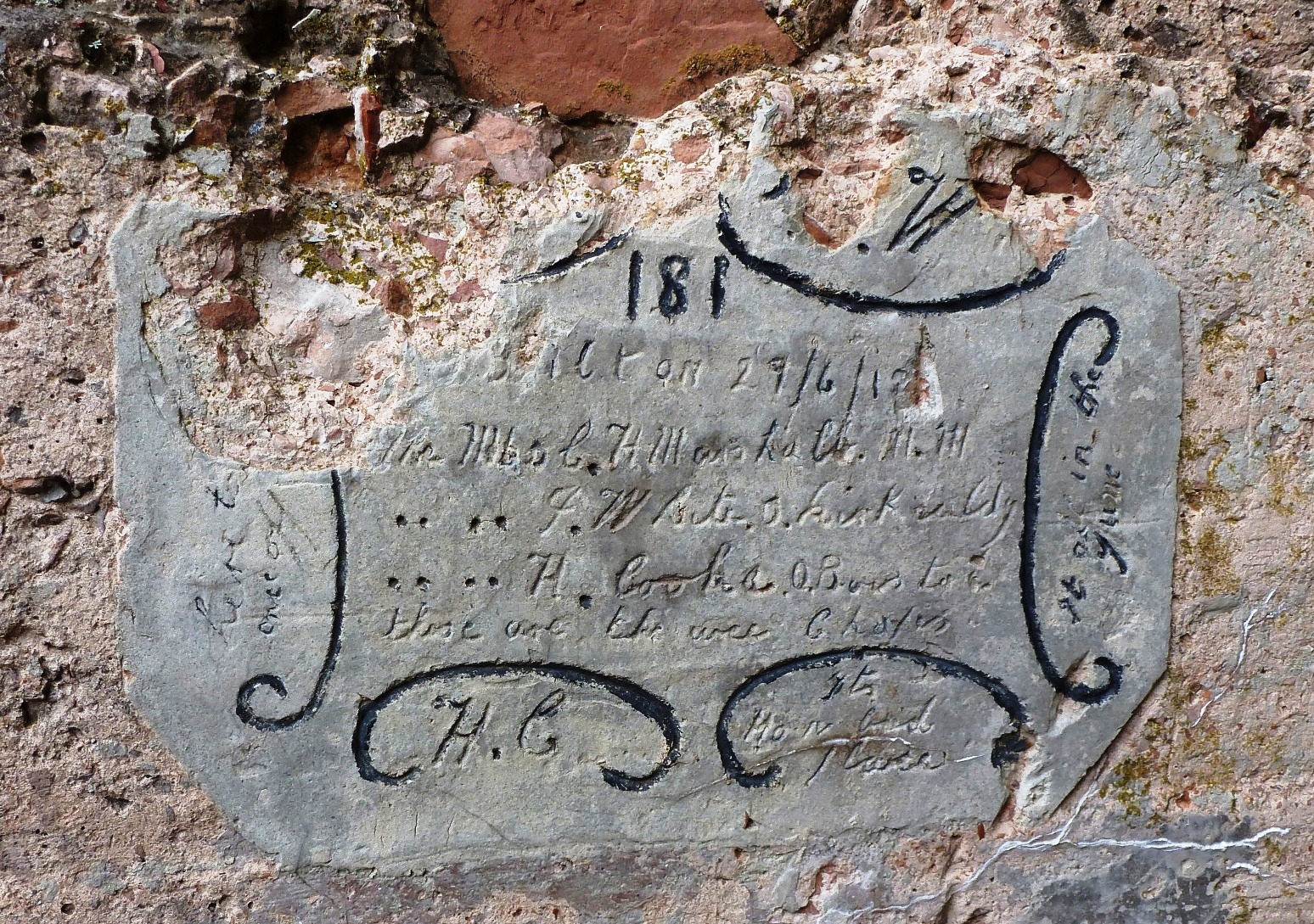
A French victim of the first chlorine gas attack. © Simon Jones
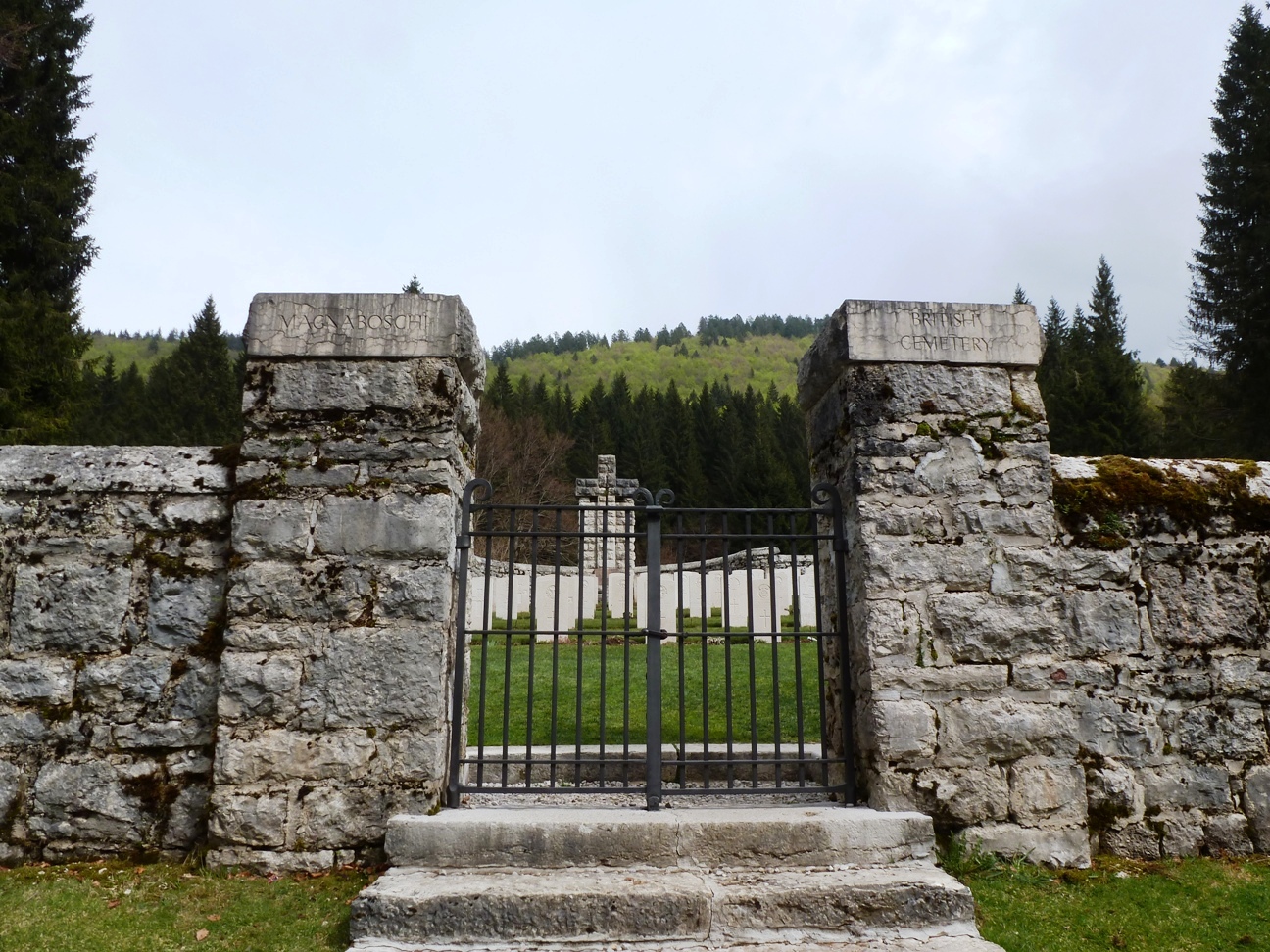
It should not have been a surprise to the Allies. At least two German soldiers deserted to the French before the gas attack, revealing detailed information and even producing rudimentary gas masks. Chemical weapons had achieved such negligible results that it was assumed the effects would be equally insignificant but it is cited as one of the great intelligence failures of history; when the name of one of the deserters was published in 1933, he was imprisoned by the Nazis and ultimately sent to Dachau concentration camp.

The Germans, moving cautiously for risk of succumbing to their own gas, gained two and a half miles by nightfall. It was the largest advance since the onset of trench warfare; but lack of troops and resistance on the flanks by Canadians and Belgians prevented them from exploiting the attack. In the captured French positions the Germans took thousands of prisoners, and found gas victims lying on their backs with fists clenched; but their own reports state that they found few dead. A doctor was told by a German officer, himself injured by chlorine, that he saw few French dead and most ‘had run away like a flock of sheep’. The number killed by the first attack, impossible to calculate, may still be somewhere between 800 and 1,400; a figure of 5,000 dead, grossly exaggerated by the Allies for propaganda purposes, is still reported as fact.

The response of the Allies was a mixture of real and artificial outrage; there was genuine anger that a barbarous and unchivalrous method should be used against their troops, and breaking the spirit if not the letter of the Hague Agreement. Chemical weapons nullified the romantic chivalric contest of equals that war was supposed to be but never has been. In this confused notion, to have an agreement and then break it almost seemed worse than if there had been no agreement at all. Paradoxically, an unrealistic notion of the degree to which warfare could be governed by humanitarian considerations may even have made matters worse by bringing about a swifter abandonment of restraint once the system collapsed. The Hague Agreement failed to prevent the use of chemical weapons because it did not anticipate what the war was becoming: a war of nationalism and ideologies, a war of hatred, a war to the death. There was also much inflated indignation to influence neutral American opinion; in this respect the chlorine attack was a propaganda gift to the Allies, as was the sinking of the liner Lusitania just 16 days later.

Many would subsequently express a more detached view on the relative distinction between chemical and so-called conventional weapons. The wartime officer, C. R. M. F. Cruttwell, later principal of Hertford College, concluded that ‘there is little to choose in horror and pain between the injuries inflicted by modern war. The extent to which the human body can be mangled by the splinters of a bomb or shell, without being deprived of consciousness, must be seen to be believed.’ J. B. S. Haldane, future Professor of Genetics at University College London, went further: injured by chlorine developing the first protective masks and shortly afterwards wounded in action, he maintained that the pain and discomfort from gas were ‘utterly negligible compared to those produced by a good septic shell wound’. A weapon which temporarily incapacitated such as tear gas, Haldane said, was ‘the most humane weapon ever invented’. Yet such views ignore the fact that there was nothing irrational about the terror felt by soldiers at being gassed; even the Army pathologist who specialised in gas cases felt that there was something particularly terrible about dying of suffocation from gassing. Coupled uneasily with outrage was the belief that the Allies must adopt such an apparently effective method without hesitation and not be hindered by misguided notions of honour if the enemy was not abiding by them. Five days after the first chlorine attack the British cabinet gave its consent for the Minister for War, Lord Kitchener, to fall ‘to the level of the degraded Germans’ and instructed him to ‘use anything he could get invented’. 

The method used at Ypres turned out to be of limited military value. Nine subsequent German chlorine attacks during the month-long Second Battle of Ypres were thwarted by the desperate resistance of British soldiers protected by rudimentary mouth pads soaked with neutralising solutions, including urine, which limited German gains to a few short lengths of front line trench. The Germans themselves suffered heavy casualties when the wind changed, which worsened when they tried it on the Eastern Front, and on one occasion 1,450 of their own men were gassed with 138 killed. But the chlorine attacks had a profound impact on the British, seemingly unaware of the difficulty of coordinating the massed troops to exploit the gas with a favourable wind to blow it onto the enemy. Britain’s first attack with chlorine gas was to be made in the wrong place for the wrong reasons. Sir Douglas Haig, commanding the British 1st Army, was a sceptic about the value of gas. However, ordered by the government to carry out an attack around Loos over terrain which was utterly unsuitable and for which he had insufficient guns and shells, his view was altered by a demonstration of chlorine gas at Runcorn when it appeared to move so effectively to the Manchester ship canal that bargees had shouted abuse. The gas seemed the means to carry out this unwanted attack and even achieve a rapid advance like that of the Germans at Ypres. Confounding the German belief that the Allies lacked the capacity to do so, Britain managed to stage a chlorine gas attack on 25 September 1915, five months after the German attack; the Battle of Loos however was a failure. On the morning of the attack, Haig took the decision to release the gas on the advice of a meteorologist and the drift of the smoke from the cigarette of his ADC but when the wind appeared to change it was impossible to countermand the order. The British troops encountered exactly the same problems as the Germans but on a larger scale: the wind was wrong and panic that the gas induced in the attackers is recorded by Robert Graves in Good-Bye to All That. The Germans, in strong defensive positions, all had gas masks and the machine gunners had breathing apparatus. Over two and a half thousand British soldiers were hospitalised as gas cases, although two-thirds were more terrified than badly injured. Seven British soldiers, and no Germans, were reported killed by the gas. As a result, the British almost never again used gas directly to assist an attack. An attempt in late June 1916 by General Rawlinson to release 20,000 cylinders of combined phosgene-chlorine gas, during the preparatory bombardment which launched his Battle of the Somme, was again thwarted by the wind as well as by effective German gas masks. Instead British chemical weapons were used to kill, injure and demoralise enemy troops in sectors away from main attacks; in other words for attrition not break-through.

Personnel practicing for the first British gas attack.

Personnel practicing for the first British gas attack.

The escalation of chemical warfare was limited solely by the restraints of research, development and production rather than any questions of morality. The first attacks had shown that chlorine was not poisonous enough and too easily protected against; the Germans led in the introduction of new chemicals owing to their ability to produce chemicals in bulk. Both sides raced to deploy new and more poisonous chemicals and to issue masks to their own troops to protect against a range of potential substances. Phosgene, about one hundred times more toxic than chlorine, was the most prominent threat and a German phosgene attack against the British in December 1915 was thwarted by the rapid issue of an improved gas helmet. The Germans were soon able to penetrate these impregnated cloth helmets with higher concentrations and the British were forced to replace them with a complex but effective mask in which a box filter was connected by rubber hose to a face piece. These ‘Small Box Respirators’ began to be issued in autumn 1916 and within five months every man at the front possessed one. The unsung scientist responsible for coordinating this triumph of design and production, Edward Harrison, weakened by overwork and gas inhalation, died of influenza one week before the war’s end.

Edward Harrison, who gave his life in the development of protection from poison gas.

Edward Harrison, who gave his life in the development of protection from poison gas.

In 1916 the gas shell became the favoured means of overcoming the problem of the wind but a very large number of shells had to be fired to build up a concentration sufficient to penetrate a gas mask, especially after the British introduced Harrison’s Small Box Respirator. The tactic shifted to forcing men to wear their masks for long periods and thereby impede their ability to fight and chemical weapons became particularly important as a counter-battery weapon to silence the opponents’ guns. The aim was also to catch soldiers by surprise before they could adjust their masks and gas shells contained a charge just large enough to break open the shell with a distinctive dull plop. Wilfred Owen’s poem ‘Dulce et Decorum est’ describes his recurring nightmares of a man dying of gas poisoning after soldiers are surprised by phosgene shells which drop softly behind them. Troops easily recognised the sound and in 1918 the Germans increased the size of the charge, rendering them harder to distinguish from high explosive shells. The one major British innovation in chemical weapons, highly effective but also technologically the most crude, was a means of projecting a dense cloud of gas instantaneously onto enemy positions. Inspired by the desire of William Livens to avenge his wife whom he thought had perished on the liner Lusitania (it turned out she hadn’t sailed), each Livens Projector hurled a drum containing 11 litres of liquefied gas, when up to 800 were fired simultaneously, it either gassed the German soldiers before they could get their masks on or penetrated the filters owing to the high density. It was so effective that after its first use Livens boasted that he could kill Germans at 16 shillings per head. The Germans copied the Livens projector and, on the Italian front at Caporetto in October 1917, used it to drench low-lying Italian positions with phosgene; they followed it up with an advance far more substantial and dramatic than that at Ypres in 1915, and the resulting panic formed the central sequence of Hemingway’s A Farewell to Arms.

The first German lethal gas shell, containing 0.285 litres of diphosgene.

The first German lethal gas shell, containing 0.285 litres of diphosgene.

The quest to find toxic chemicals which did not disperse as quickly as a gas led the Germans to a liquid, dichlorodiethyl sulphide, commonly called ‘mustard gas‘ by the British owing to its odour of mustard or horseradish. The most effective chemical agent of the First World War, it would inflict on soldiers a new dimension of horror and suffering. Ironically, after testing on cats in 1916, the British rejected mustard on the grounds that it was not sufficiently lethal. German trials on monkeys demonstrated that it caused eye and respiratory injury but again there were doubts about its lack of toxicity. It was noted that the liquid took much longer to disperse than gas; a detonating shell spread droplets which slowly evaporated in daylight, prolonging its harmful effects. This quality prompted Haber to propose its use to the German High Command when he learnt of the requirement for a chemical weapon to forestall Allied attacks expected in the summer of 1917. However, Haber is said to have warned that it should only be used if Germany was certain of winning the war within a year; once the Allies had the ability to bulk produce their own, Germany would not be able to produce sufficient replacement uniforms needed for decontamination. On the night of 12 July 1917, the Germans fired 50,000 shells containing 125 tonnes of mustard into the ruins of Ypres; it was the first of a series of intense bombardments to target British attack preparations. Within 24 hours, over 2,000 British soldiers had been admitted to Casualty Clearing Stations, many suffering intensely painful inflammation of the eyes which effectively blinded them, they were led in files, each holding on to the man in front. After several hours many developed severe throat and lung irritation which in some turned into fatal broncho-pneumonia. A third prominent symptom, not anticipated by the Germans, was large skin blisters, especially on the buttocks, genitals and armpits. Mustard caused injury by skin contact, especially the sweaty parts of the body, either with the vapour as it evaporated in daylight or sitting where the liquid had been splashed by the bursting shell. The predictions that it would have a low mortality rate were correct: of the 2,143 cases admitted to Casualty Clearing Stations after the first bombardment, 95 died, a comparatively small number; put crudely it had taken 500 mustard gas shells to cause each death. But the Germans reported that the British guns were all but silent for two days afterwards. The effectiveness of mustard did not lie in the death rate, rather the large numbers injured, many of whom, by the standards of the time, recovered after several months in hospital. Many, however, such as those nursed by Vera Brittain on the French coast, suffered serious infection and pneumonia, ‘burnt and blistered all over with great mustard coloured suppurating blisters, with blind eyes… and always fighting for breath, their voices a mere whisper…’ A German mustard gas bombardment of the still partially inhabited town of Armentières later the same month, an operation called ‘Totentanz’ (‘Dance of Death’), caused 675 civilian casualties of which 86 died; a high proportion, many elderly, were unable or unwilling to leave the contaminated area. Yet, paradoxically, for some soldiers injury by mustard gas actually saved their lives by taking them out of the fighting for an extended period; in September 1917, a Canadian Chemical Advisor claimed that soldiers were deliberately exposing their eyes to mustard gas in order to escape the front line.

German troops demonstrate their gas mask at a gas alarm post. © Simon Jones
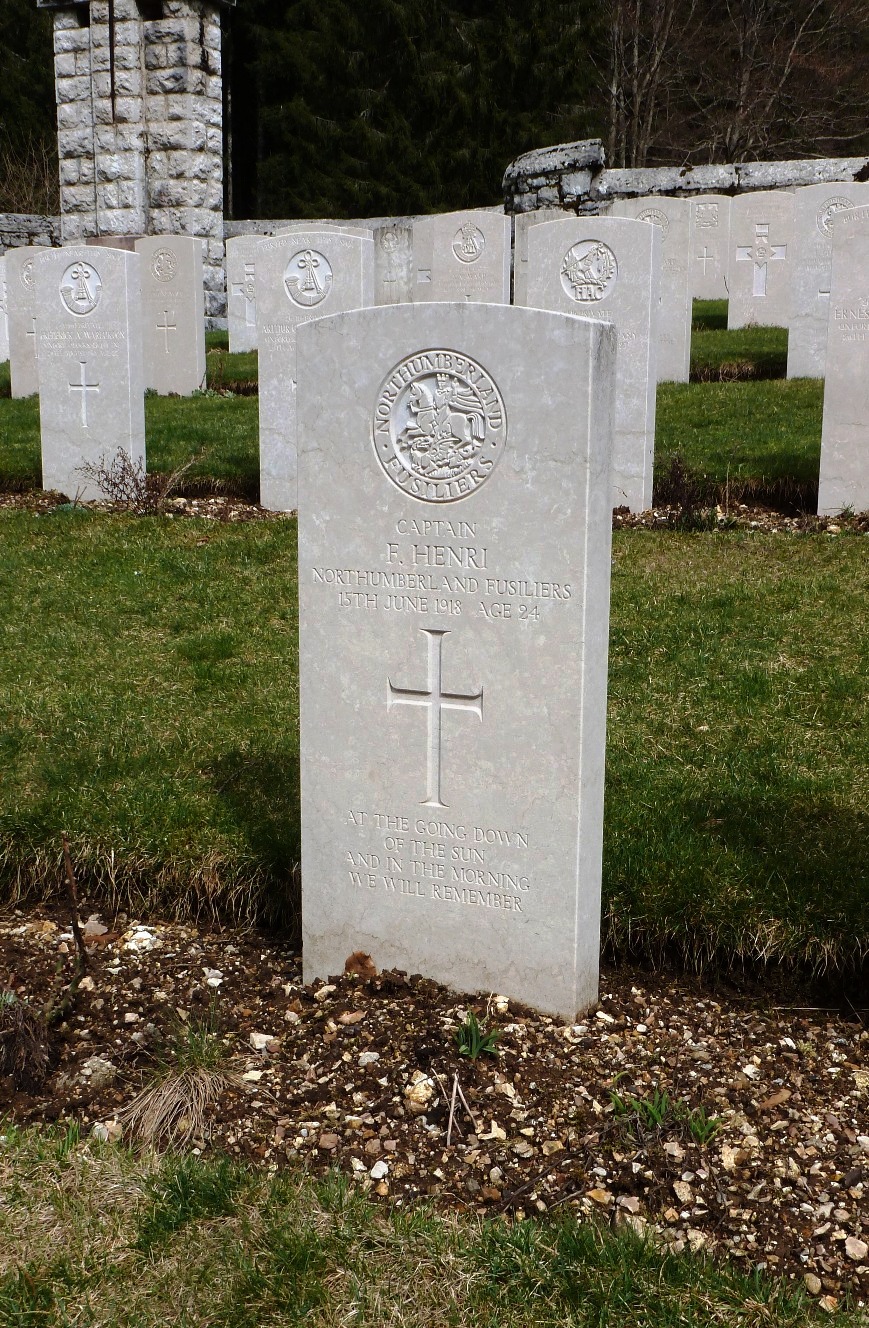
German troops at a gas alarm post. © Simon Jones
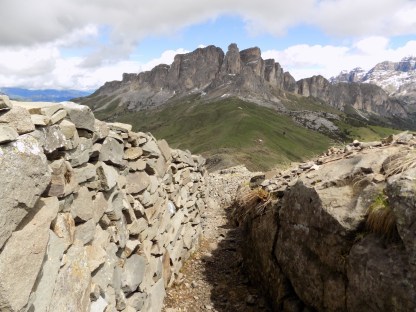
The International Red Cross appealed for an end to gas warfare in February 1918 but neither side was willing. The Allies were beginning to rival the Germans in production capacity and also did not trust the Germans to abide by such an agreement. The German use of chemical weapons during their offensives in the spring and summer of 1918 was lavish, comprising 50% of all shells fired, and sophisticated. Shells were colour coded according to their effect: non-persistent lung irritant gas phosgene shells were designated Green Cross and fired in combination with ‘Blue Cross’ shells designed to penetrate respirator filters and cause sneezing, forcing the soldier to remove his mask. Mustard gas, ‘Yellow Cross,’ was fired into the rear and flanks to block reinforcements from reaching the attack zone and to silence the artillery; as many as 80% of the shells fired into these areas were mustard. British mustard decontamination could not cope and at one point in 1918 the British had about 30,000 men in hospital suffering from the effects. In August 1918, the sight of lines of men blinded by mustard gas inspired society painter John Singer Sargent to produce his monumental canvas ‘Gassed‘ which remains for many the most powerful artistic representation of the First World War. Pushed back by Allied offensives, mustard was initially the ideal defensive weapon for the Germans and the British suffered up to 4,000 mustard casualties per week during September and October. But the effectiveness of German chemical weapons declined as their forces became disorganised and Allied troops learnt to avoid the worst effects of mustard. As Haber had warned, the Allies managed to produce their own mustard within a year of the German use; American production in particular threatened to overwhelm the German ability to decontaminate. By November 1918 the Americans could produce 1,600 tonnes of chemical warfare agent each month, enough for 2.7 million shells. If Germany hadn’t requested an Armistice she would have been overwhelmed by Allied chemical weapons in 1919.
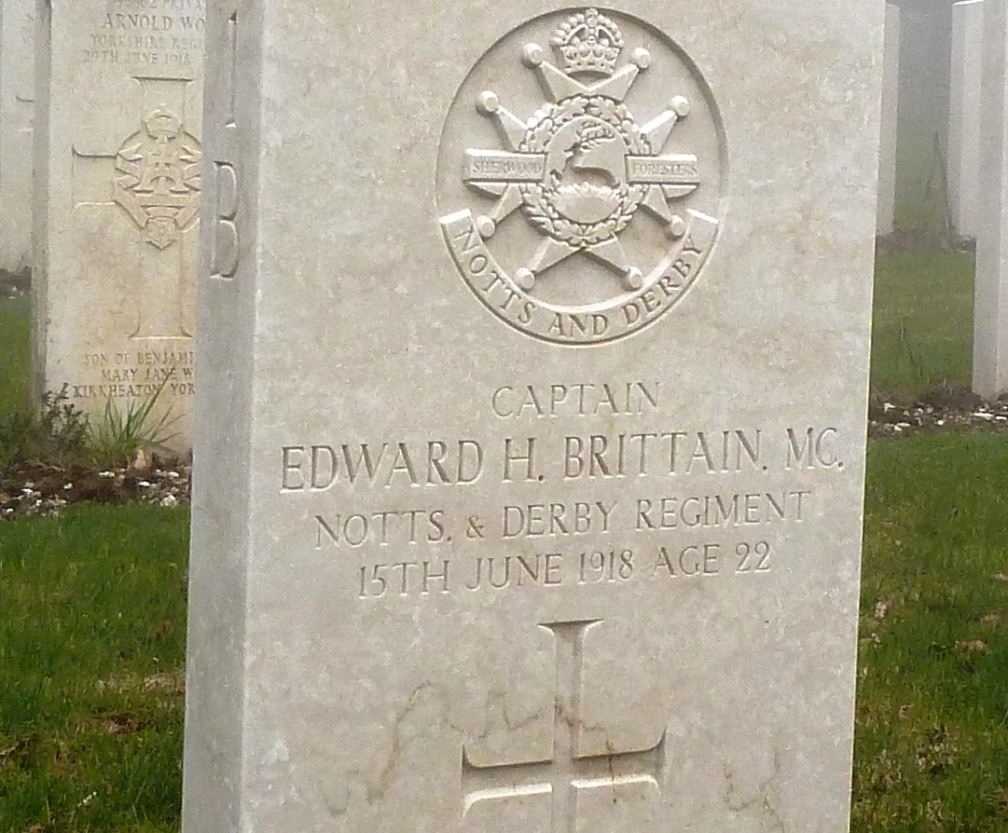
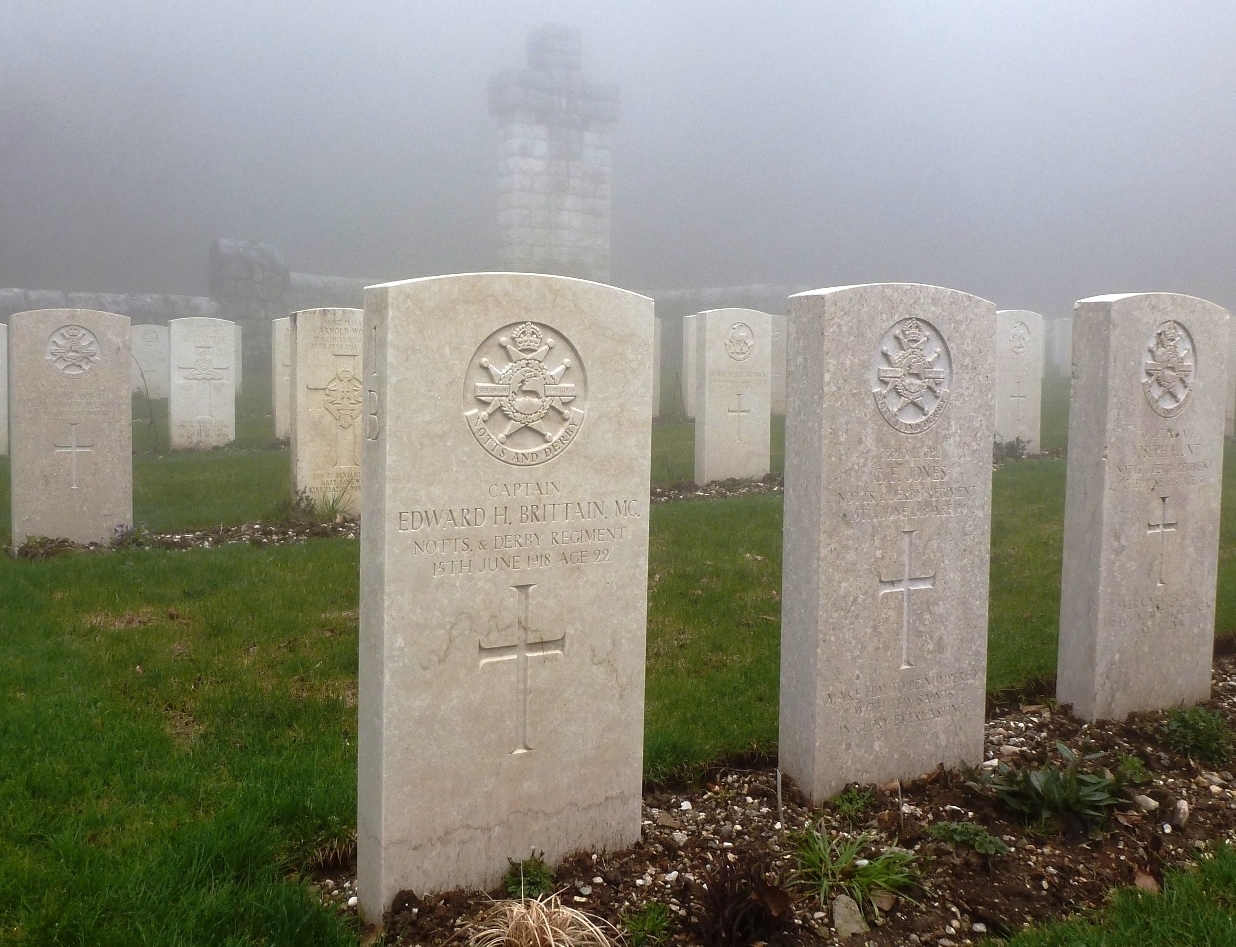
German respirators for man and horses.

German respirators for man and horses.

Was Germany ultimately defeated by chemical weapons? She was already beaten militarily in the field and starved at home by the blockade: chemical weapons did not have a decisive impact on the outcome. Deaths during the war from chemical weapons are estimated at about 18,000, or less than 0.2 per cent of battlefield deaths. Even allowing for the effectiveness of mustard in causing injury rather than death, this was a negligible contribution. Herein lies the reason why gas was not used on the battlefield during the Second World War: chemical warfare wasn’t as effective as other methods of warfare developed and refined during the First World War. With the end of the war, efforts were made to limit the use of chemical weapons. Under the Treaty of Versailles, Germany was forbidden chemical weapons, along with tanks, aircraft and submarines, and in 1925 the Geneva Protocol aimed at a global prohibition of chemical and bacteriological weapons. Between the wars the use of such weapons from the air on towns and cities dominated public anxieties and in the late 1930s most European nations embarked on the mass supply of gas masks to their civilian populations. Whilst the masks were not particularly good, informed opinion was aware that the concentration achievable with aircraft payloads would be low and thankfully the threat never materialised; however, since 1919 chemical weapons have been used almost exclusively against unprotected victims, usually non-combatants, and favoured by rogue states and terrorists. During the lead up to both Gulf wars the term ‘weapons of mass destruction’ encouraged an entirely false equivalence with nuclear weapons; ‘weapons of mass terror’ has been suggested as a more appropriate term.

In the hospital at Trent Bridge Cricket Ground, antiseptic dressings had little effect on Sawyer Spence’s septic mustard gas blisters and caused him such pain that they were abandoned; instead a treatment was begun with a new paraffin medication developed by Boots the Chemist. By early November 1918 he was at home recovering; he died, age 81, in 1973.

Sawyer Spence suffering extensive mustard gas blisters, Trent Bridge Hospital, Nottingham, 1918. © Jon Spence, used with permission.

Sawyer Spence suffering extensive mustard gas blisters, Trent Bridge Hospital, Nottingham, 1918. © Jon Spence, used with permission.

Fritz Haber, who used science to create life and to end it, is surrounded by myths. His wife, Clara, herself a doctor of chemistry, was opposed to his chemical warfare work but it remains unknown whether this was the reason, as has been claimed, for her suicide shortly after the first chlorine attack. The oft-quoted description of chemical warfare as ‘a higher form of killing’ attributed to him is almost certainly apocryphal. It is clear however that when the Nazis took power Haber, a Jew who had converted to Christianity, was unable to retain his post as head of the Kaiser Wilhelm Institute for Physical Chemistry. His friend Albert Einstein had concluded many years before that his own future did not lie with identifying himself with the German state. Haber realised this too late; leaving Germany in 1934 he died soon afterwards. A method of pest control using hydrogen cyanide gas invented in 1918 under Haber’s direction and marketed as ‘Zyklon B’ was used by the Nazis to kill over a million people.

Dr Clara Haber (née Immerwahr) committed suicide on 2 May 1915 while her husband was home on leave after the first gas attack.

Dr Clara Haber (née Immerwahr) committed suicide on 2 May 1915 while her husband was home on leave after the first gas attack.

See below for bibliography including online sources.

Text © Simon Jones


Guardian

My article: The First World War scientists who gave their lives to defeat poison gas


IWM Q3999

The Lochnagar Mine: how and why it was blown and who were the men who dug it


Q 11718

Understanding the 1914 Christmas Truce


Contact me

Join me on a battlefield tour with The Cultural Experience:

Simon Jones Battlefield Tour Somme Poets 2019

The Tank War 17th-20th May 2025

The Battles of the Marne and Aisne 6th-11th September 2025

Mons and Le Cateau 31st August – 3rd September 2025

More Information about Battlefield Tours


Sources for Understanding Chemical Warfare in the First World War
C H Foulkes “Gas!” The Story of the Special Brigade (1934)
L F Haber The Poisonous Cloud (1986)
R Hanslian Der Chemische Krieg (1937)
S Jones ‘Under a green sea’ The British responses to gas warfare’ The Great War Vol 1 No 4 & Vol 2 No 1 (1989).
S Jones ‘The first BEF gas respirators, 1915’ Military Illustrated Nos 32 & 33 (1991).
S Jones ‘The right medicine for the Bolshevist’: British air-dropped chemical weapons in north Russia 1919’, Imperial War Museum Review No 12 (c1998)

S Jones World War One Gas Warfare Weapons and Equipment (2007)
G Lachaux and P Delhomme La Guerre des Gaz 1915-1918 (1985)
A Lejaille La Guerre des Gaz (website) http://pageperso.aol.fr/guerredesgaz/
A Lejaille ‘La protection française polyvalente contre les gaz de combat’ Militaria Nos 226 (2004), 237 & 241 (2005).
O Lepick La Grande Guerre Chimique (1998)
W G MacPherson (ed.) Medical Services Disease of the War Vol. II (1923).
D Martinetz Der Gaskrieg 1914/18 (1996)
Y Mouchet ‘Les masques à gaz allemands de la Grande Guerre’ Militaria No 220 (2003)
A Palazzo Seeking Victory on the Western Front The British Army and Chemical Warfare in World War I (2000).
A M Prentiss Chemicals in War (1937)
D Richter Chemical Soldiers (1994)
W Zecha “Unter die Masken!” Giftgas auf den Kriegsschauplätzen Österreich-Ungarns im Ersten Weltkrieg (2000).

Virtual Tour of Trenches and Tunnels excavated at La Boisselle

Pan360

Click on the above image to access high-quality interactive panoramas created by PAN360 show the archaeological excavation of the battlefield at La Boisselle on the Somme in 2012.  Then click on the circles on the map.  The trenches and tunnels date from 1914-1916 when there was fierce fighting over the sector which was called by the British the ‘Glory Hole’. A three-year excavation phase has ended and reports are being completed for the Commonwealth War Graves Commission and the Direction régionale des affaires culturelles Picardie. More information about the project is on the La Boisselle Study Group website.


Join me on a battlefield tour with The Cultural Experience.

Simon Jones Battlefield Tour Somme Poets 2019

The Battles of the Marne & the Aisne 1914 – 1918

First & Last Shots 1914 & 1918

Medics & Padres in the Great War

Walking Ypres 1914-1918

Walking the Somme

More Information about Battlefield Tours


Underground Warfare

For a limited period I am offering my book Underground Warfare 1914-1918 for £10 UK (including 2nd Class postage) or £14 Europe or £16 Rest of the World (including international standard postage). Contact me for payment details (PayPal preferred).


joe-cox-and-tom-hodgettsres

The Men Who Dug The Lochnagar Mine


derbyshire-courier-october-11-1919

Shirebrook Miners in the Tunnelling Companies


Contact me

Facebook

LinkedIn

Where did Vera Brittain serve in France during the First World War?

Vera Brittain when a VAD nurse.

Vera Brittain when a VAD nurse. (Literary Executors for the Vera Brittain Estate, 1970 &The Vera Brittain Fonds, McMaster University Library)

From early August 1917 until the end of April 1918 Vera Brittain served as a Voluntary Aid Detachment nurse at No 24 General Hospital, Étaples. She wrote about this experience in her acclaimed and powerful memoir Testament of Youth in the chapter entitled ‘Between the Sandhills and the Sea’.  Étaples is a fishing port fifteen miles from Boulogne, and just to the north the British established a large infantry training camp and a complex of nine major hospitals, almost entirely comprised of huts and tents.

A plan of the Étaples Base Bamp and hospital complex with No 24 General Hospital marked.

A plan of the Étaples Base Camp and hospital complex with No 24 General Hospital marked. (http://www.oucs.ox.ac.uk/ww1lit/gwa/document/9127/4558)

The area of the Étaples Base Camp and hospital complex today. The area occupied by No 24 General Hospital is now covered by housing.

The area of the Étaples Base Camp and hospital complex today. The area occupied by No 24 General Hospital is now covered by housing.

She was first assigned to the ward for acute German cases and then treated mustard gas cases suffering severe skin blistering and temporary or sometimes permanent blindness.

A Canadian victim of mustard gas at No.7 Canadian General Hospital, Etaples, c. 1917 (Library and Archives Canada/ Wikimedia).

A Canadian victim of mustard gas at No.7 Canadian General Hospital, Etaples, c. 1917 (Library and Archives Canada/ Wikimedia).

No 24 General Hospital was not in the ‘front line’, as the fighting was never less than fifty miles from Étaples, nor was it a Casualty Clearing Station but it was bombed several times in 1918. The hospitals were hit by bombs because they were built alongside the Boulogne to Paris railway and were adjacent to the major complex of training camps, both of which were targeted. Vera experienced over a month of night-time air raids which left her exhausted and ‘more frightened than I had ever been in my life’. She left Étaples before the worst bombing raids of May, June and August 1918 when patients and nurses were killed in No 24 General and neighbouring hospitals.

A First Aid Nursing Yeomanry driver with an unexploded German aerial bomb at a British hospital in Calais, 1918.

A First Aid Nursing Yeomanry driver with an unexploded German aerial bomb at a British hospital in Calais, 1917.


p1110007cropenh

Where and how did Edward Brittain die?


Protection against Mustard Gas


The advent of Mustard Gas


‘Anon.’ no longer: the author of the ‘Menin Gate’ poem revealed


Contact me

Facebook

LinkedIn